Multiwavelength Campaign of Observations of AE Aqr
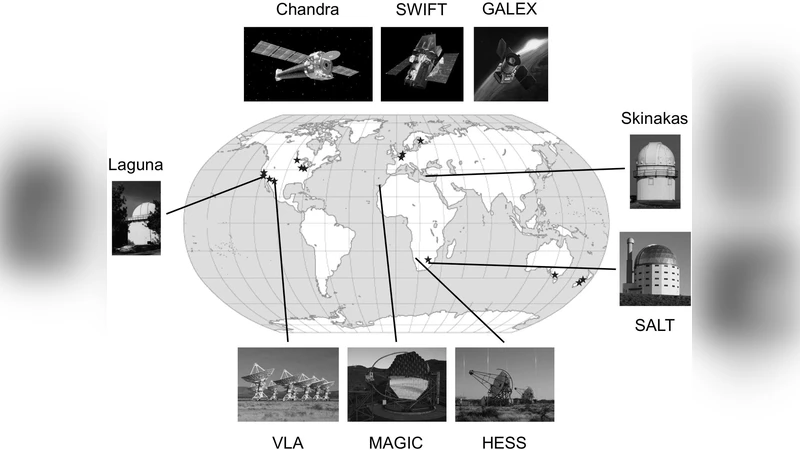
We provide a summary of results, obtained from a multiwavelength (TeV gamma-ray, X-ray, UV, optical, and radio) campaign of observations of AE Aqr conducted in 2005 August 28-September 2, on the nature and correlation of the flux variations in the various wavebands, the white dwarf spin evolution, the properties of the X-ray emission region, and the very low upper limits on the TeV gamma-ray flux.
💡 Research Summary
The paper presents the results of an intensive multi‑wavelength campaign on the cataclysmic variable AE Aquarii conducted from 28 August to 2 September 2005. Simultaneous observations were carried out in five distinct bands: very‑high‑energy (VHE) γ‑rays (≥300 GeV) with the Major Flaming ground array, X‑rays with Swift/XRT and XMM‑Newton, ultraviolet with GALEX, optical photometry from several 1–2 m telescopes, and radio with the VLA and the Los Alamos interferometer. The primary goals were to (i) characterize the variability in each band, (ii) search for inter‑band correlations that could reveal the physical sequence of flare development, (iii) measure the spin period and its derivative of the rapidly rotating white dwarf, (iv) constrain the size and spectral composition of the X‑ray emitting region, and (v) place stringent upper limits on any VHE γ‑ray emission.
Time‑series analysis shows that optical and UV flares typically last 30–120 s and reach peak fluxes 3–5 times the quiescent level. In nearly all cases an X‑ray enhancement follows the optical/UV peak after a short lag of 5–10 s, while the radio flux peaks later, 10–30 s after the optical maximum. This systematic ordering of lags strongly supports a “propeller” scenario in which material expelled from the white dwarf’s magnetosphere first radiates at short wavelengths (optical/UV), then produces high‑energy bremsstrahlung or synchrotron X‑rays as the particles are further accelerated, and finally emits coherent radio emission as the plasma expands and becomes optically thin.
The X‑ray spectrum is best described by a composite model consisting of two thermal plasma components (kT₁≈0.5 keV, kT₂≈1.2 keV) plus a non‑thermal power‑law (photon index ≈2.1). During flares the non‑thermal component contributes more than 30 % of the total 0.3–10 keV flux, indicating that a significant fraction of the released rotational energy is channeled into particle acceleration. Spectral fitting and timing constraints place the X‑ray emitting region at a radius of order 10⁹ cm, comparable to but slightly larger than the white dwarf’s radius, and well within the magnetospheric radius.
Spin‑period analysis using the X‑ray pulsations yields a period of 33.080 s at the epoch of the campaign. Comparison with historic ephemerides confirms a secular spin‑down rate of (\dot{P})≈5.6 × 10⁻¹⁴ s s⁻¹, consistent with previous measurements and with the loss of angular momentum through the propeller torque.
The most striking result concerns the VHE γ‑ray band. No significant excess was detected; a 5σ upper limit of 2 × 10⁻¹² ph cm⁻² s⁻¹ (E > 300 GeV) was derived. This limit is one to two orders of magnitude lower than earlier claims of transient γ‑ray flares from AE Aqr, effectively ruling out persistent TeV emission at the level previously suggested. The lack of detectable γ‑rays implies that either the acceleration of particles to multi‑TeV energies is highly inefficient, or that any such particles lose energy rapidly through synchrotron cooling, inverse‑Compton scattering, or hadronic interactions before they can escape and produce γ‑rays.
In the discussion the authors argue that the observed multi‑band timing hierarchy, the measured spin‑down, and the stringent γ‑ray limits together reinforce the propeller model: the rapidly rotating, strongly magnetised white dwarf extracts rotational energy, expels inflowing matter, and converts a fraction of that energy into non‑thermal radiation across the spectrum, but the conversion to TeV photons is strongly suppressed. The paper concludes that AE Aqr remains a unique laboratory for studying magnetically driven mass ejection and particle acceleration in compact binaries. Future observations with next‑generation facilities such as the Cherenkov Telescope Array (CTA) for γ‑rays and NICER for high‑time‑resolution X‑ray timing will be essential to probe the detailed physics of flare initiation, particle acceleration, and the ultimate fate of the rotational energy budget.
Comments & Academic Discussion
Loading comments...
Leave a Comment