The Possible Impact of GRB Detector Thresholds on Cosmological Standard Candles
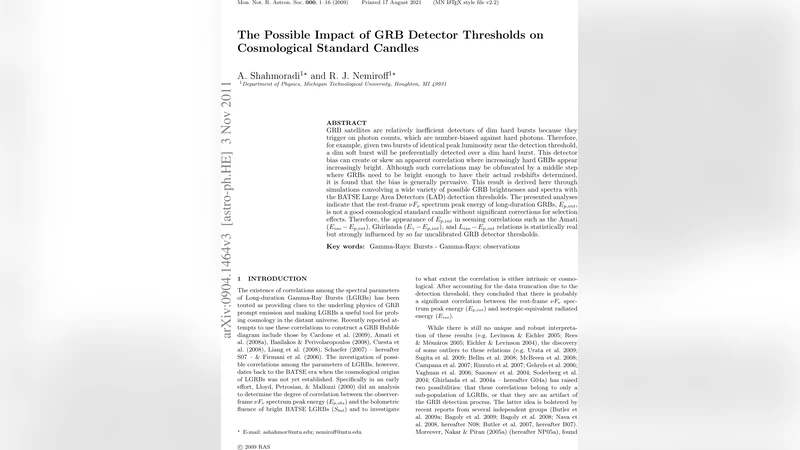
GRB satellites are relatively inefficient detectors of dim hard bursts because they trigger on photon counts, which are number-biased against hard photons. Therefore, for example, given two bursts of identical peak luminosity near the detection threshold, a dim soft burst will be preferentially detected over a dim hard burst. This detector bias can create or skew an apparent correlation where increasingly hard GRBs appear increasingly bright. Although such correlations may be obfuscated by a middle step where GRBs need to be bright enough to have their actual redshifts determined, it is found that the bias is generally pervasive. This result is derived here through simulations convolving a wide variety of possible GRB brightnesses and spectra with the BATSE Large Area Detectors (LAD) detection thresholds. The presented analyses indicate that the rest-frame $\nu F_{\nu}$ spectrum peak energy of long-duration GRBs, $\epi$, is not a good cosmological standard candle without significant corrections for selection effects. Therefore, the appearance of $\epi$ in seeming correlations such as the Amati ($E_{iso}-\epi$), Ghirlanda ($E_{\gamma}-\epi$), and $L_{iso}-\epi$ relations is statistically real but strongly influenced by so far uncalibrated GRB detector thresholds.
💡 Research Summary
The paper investigates how the trigger thresholds of the BATSE Large Area Detectors (LAD) bias the detection of gamma‑ray bursts (GRBs) and consequently affect the use of GRB spectral parameters as cosmological standard candles. The authors begin by reviewing the long‑standing debate over the reality of the Amati (E_iso–E_p,i) and Ghirlanda (E_γ–E_p,i) correlations, noting that several studies have reported large fractions of BATSE bursts that appear inconsistent with these relations. They argue that a key, often overlooked, source of bias is the photon‑count‑based trigger algorithm employed by BATSE: because the instrument triggers when the count rate in the second‑brightest detector exceeds a significance threshold (≈5.5 σ), bursts that are spectrally hard (i.e., have a high rest‑frame peak energy E_p,i) produce fewer counts for a given bolometric luminosity than soft bursts. Consequently, dim hard bursts near the detection limit are preferentially missed, while dim soft bursts are more readily detected.
To quantify this effect, the authors assemble a large sample of 1 900 BATSE GRBs (≈500 short‑duration, ≈1 400 long‑duration) for which light curves, fluences, and durations are available. Instead of relying on spectral fits that assume a fixed Band model (α = −1.1, β = −2.3), they estimate the observed peak energy E_p,obs from a hardness‑ratio calibration (Shahmoradi & Nemiroff 2010a). For each burst they keep the duration (T_90) fixed and progressively reduce the photon counts uniformly across all energy channels until the burst no longer satisfies the BATSE trigger criteria on any of the three standard timescales (64 ms, 256 ms, 1024 ms). This procedure yields the minimum detectable fluence (or peak flux) for each individual burst, effectively mapping the detection boundary in the S_bol–E_p,obs and P_bol–E_p,obs planes.
The resulting distributions show clear truncation on both the low‑fluence/high‑E_p side and the high‑fluence/low‑E_p side, with the left‑hand boundary being especially steep for short‑duration bursts. The authors demonstrate a negative correlation between T_90 and the fraction of outliers to the Amati relation: bursts with shorter durations are far more likely to lie >3 σ away from the best‑fit Amati line. This is visualized in a histogram where the fraction of outliers rises sharply as T_90 decreases, indicating that the sample of GRBs traditionally used to define the Amati relation (e.g., Ghirlanda et al. 2008) is heavily biased toward the longest‑duration, brightest events. Consequently, the apparent low scatter (σ ≈ 0.2 dex) of the Amati and Ghirlanda relations is largely an artifact of selection effects rather than an intrinsic physical law.
The authors also critique earlier works that derived trigger thresholds by applying a fixed Band spectrum to the entire BATSE sample. They argue that such “model‑dependent” approaches suffer from circularity and do not capture the true detector response, which varies with incident angle and spectral hardness. By using the actual count‑rate light curves and background estimates for each burst, their simulation more faithfully reproduces the BATSE trigger behavior.
In the discussion, the paper emphasizes that the rest‑frame peak energy E_p,i cannot be used as a reliable standard candle without substantial corrections for detector thresholds, burst duration, and spectral hardness. The authors propose that future cosmological applications of GRBs must incorporate a detailed selection‑effect model, possibly derived from Monte‑Carlo simulations similar to those presented here, before claiming that GRB correlations provide distance indicators comparable to Type Ia supernovae.
In summary, the study provides compelling evidence that the observed Amati, Ghirlanda, and L_iso–E_p,i correlations are significantly shaped by BATSE’s photon‑count trigger bias. The work underscores the necessity of accounting for detector selection effects when employing GRB spectral properties for cosmology, and it sets the stage for more rigorous, bias‑corrected analyses in forthcoming GRB missions.
Comments & Academic Discussion
Loading comments...
Leave a Comment