Computing a Knot Invariant as a Constraint Satisfaction Problem
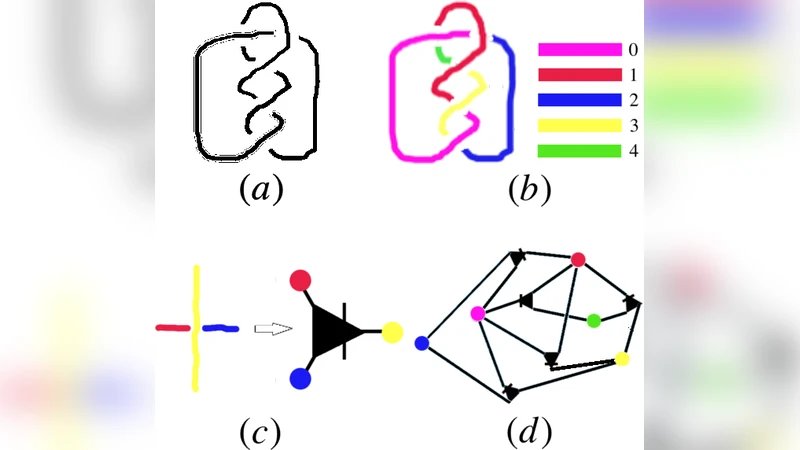
We point out the connection between mathematical knot theory and spin glass/search problem. In particular, we present a statistical mechanical formulation of the problem of computing a knot invariant; p-colorability problem, which provides an algorithm to find the solution. The method also allows one to get some deeper insight into the structural complexity of knots, which is expected to be related with the landscape structure of constraint satisfaction problem.
💡 Research Summary
The paper establishes a concrete bridge between the mathematical problem of p‑colorability in knot theory and the well‑studied domain of constraint satisfaction problems (CSP) as modeled by spin‑glass systems in statistical physics. After a brief review of knot invariants, the authors focus on p‑colorability, which asks whether a given knot diagram can be colored with p distinct colors such that at every crossing the three incident arcs receive three different colors (or, equivalently, satisfy a linear relation modulo p). This problem is known to be NP‑complete for general p, making efficient computation challenging.
To translate the topological problem into a physical one, each arc of the knot diagram is represented by a p‑state spin variable σ_i ∈ {0,…,p‑1}. For each crossing c involving arcs i, j, k a local constraint function C_c(σ) = δ
Comments & Academic Discussion
Loading comments...
Leave a Comment