Mackey functors and abelian class field theories
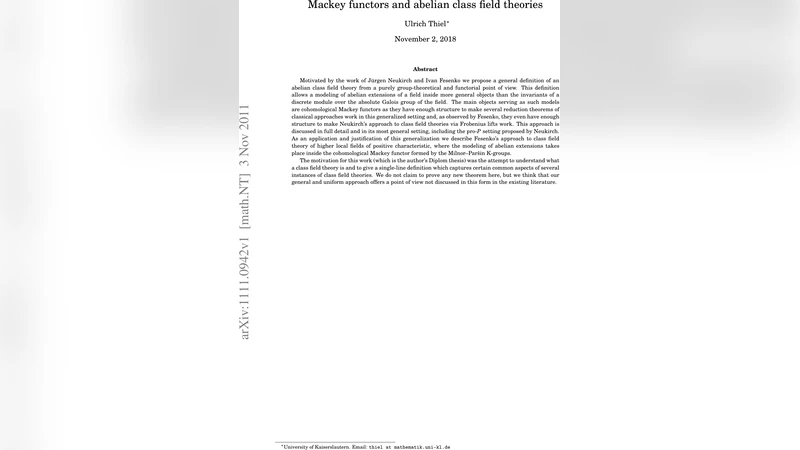
Motivated by the work of J"urgen Neukirch and Ivan Fesenko we propose a general definition of an abelian class field theory from a purely group-theoretical and functorial point of view. This definition allows a modeling of abelian extensions of a field inside more general objects than the invariants of a discrete module over the absolute Galois group of the field. The main objects serving as such models are cohomological Mackey functors as they have enough structure to make several reduction theorems of classical approaches work in this generalized setting and, as observed by Fesenko, they even have enough structure to make Neukirch’s approach to class field theories via Frobenius lifts work. This approach is discussed in full detail and in its most general setting, including the pro-P setting proposed by Neukirch. As an application and justification of this generalization we describe Fesenko’s approach to class field theory of higher local fields of positive characteristic, where the modeling of abelian extensions takes place inside the cohomological Mackey functor formed by the Milnor-Par\v{s}in K-groups. The motivation for this work (which is the author’s Diplom thesis) was the attempt to understand what a class field theory is and to give a single-line definition which captures certain common aspects of several instances of class field theories. We do not claim to prove any new theorem here, but we think that our general and uniform approach offers a point of view not discussed in this form in the existing literature.
💡 Research Summary
The paper proposes a unified, purely group‑theoretic and functorial definition of an abelian class field theory (ACFT). Starting from the observation that classical formulations (local and global class field theory) model abelian extensions via invariants of discrete G‑modules, the author introduces a more flexible framework based on RIC‑functors—objects equipped with restriction, induction, and conjugation operations. These RIC‑functors generalize Mackey functors and encompass cohomological Mackey functors, which are shown to be sufficient for the reduction theorems that underlie class field theory.
An ACFT is defined to consist of three components: (1) a group‑theoretic model C assigning to each finite separable extension K/k an abelian group C(K); (2) a functorial compatibility structure ensuring that restriction, induction, and conjugation on the groups C(K) behave coherently across extensions; and (3) an arithmetic link to the base field k, which in concrete instances is realized by constructing C directly from k (e.g., multiplicative groups for local fields, idèle class groups for global fields). The key map Φ(K,–) embeds the lattice of finite abelian extensions of K into the lattice of subgroups of C(K), and for each finite Galois extension L/K there is a reciprocity isomorphism ρ_{L|K}: Gal(L/K)^{ab} ≅ C(K)/Φ(K,L).
The author proves several “reduction theorems” showing that it suffices to verify the reciprocity morphism on a restricted class of extensions (e.g., cyclic or unramified) when C is a cohomological Mackey functor. This generalizes Neukirch’s Frobenius‑lift approach, originally formulated for discrete modules, to the broader setting of Mackey functors. The paper also treats the pro‑P situation, where the absolute Galois group is a pro‑P group admitting a quotient isomorphic to a product of p‑adic integers Z_p for primes p in a set P. In this context, a Frobenius element can be chosen consistently, allowing the same machinery to work.
A major application is the class field theory for higher local fields of positive characteristic, as developed by Fesenko. Here the cohomological Mackey functor C is given by the Milnor–Paršin K‑groups K_n^{MP}(K). The author details how these groups form a Mackey functor, discusses the necessary sequential topologies, and verifies that the reciprocity map and the reduction theorems apply, thereby recovering Fesenko’s higher local class field theory within the new abstract framework.
The paper is organized as follows: Chapter 2 introduces RIC‑functors, G‑subgroup systems, and shows how discrete modules and abelianizations fit into this picture. Chapter 3 defines ACFTs, presents tautological and induced representations, and establishes the reduction theorems. Chapter 4 extends Neukirch’s approach to cohomological Mackey functors and the pro‑P setting, providing abstract ramification and valuation theories for compact groups. Chapter 5 reviews valuations of higher rank, Milnor K‑theory, and sequential topologies needed for the higher local case. Chapter 6 applies the theory to ordinary local fields and to higher local fields, explicitly constructing the reciprocity morphisms. Appendices A–C collect background on topological groups, projective limits, and miscellaneous categorical constructions, including a universal abelian quotient for compact groups.
In summary, the work offers a concise, uniform definition of abelian class field theories that subsumes classical local and global theories, Neukirch’s Frobenius‑lift method, and Fesenko’s higher local theory, by replacing the restrictive discrete‑module viewpoint with the more versatile language of cohomological Mackey functors and RIC‑functors. This perspective clarifies the essential structural ingredients of class field theory and opens the way for further generalizations to other arithmetic contexts.
Comments & Academic Discussion
Loading comments...
Leave a Comment