Extracting spatial information from networks with low-order eigenvectors
We consider the problem of inferring meaningful spatial information in networks from incomplete information on the connection intensity between the nodes of the network. We consider two spatially distributed networks: a population migration flow network within the US, and a network of mobile phone calls between cities in Belgium. For both networks we use the eigenvectors of the Laplacian matrix constructed from the link intensities to obtain informative visualizations and capture natural geographical subdivisions. We observe that some low order eigenvectors localize very well and seem to reveal small geographically cohesive regions that match remarkably well with political and administrative boundaries. We discuss possible explanations for this observation by describing diffusion maps and localized eigenfunctions. In addition, we discuss a possible connection with the weighted graph cut problem, and provide numerical evidence supporting the idea that lower order eigenvectors point out local cuts in the network. However, we do not provide a formal and rigorous justification for our observations.
💡 Research Summary
The paper investigates how low‑order eigenvectors of a graph Laplacian can reveal meaningful spatial structure in networks where only interaction intensities are known. Two real‑world, geographically distributed datasets are examined: (i) a US county‑to‑county migration flow network derived from the 1995‑2000 Census (3,107 counties) and (ii) a Belgian city‑to‑city mobile‑phone call network (589 cities). For each network the authors construct a weighted adjacency matrix W, compute the degree matrix D, and form the row‑stochastic matrix A = D⁻¹W, which can be interpreted as a random‑walk transition matrix on a weighted graph. The symmetric similarity matrix S = D⁻¹ᐟ² W D⁻¹ᐟ² shares the same spectrum as A; its eigenvalues λ₀ = 1 ≥ λ₁ ≥ … and right eigenvectors ψₖ are used throughout the study.
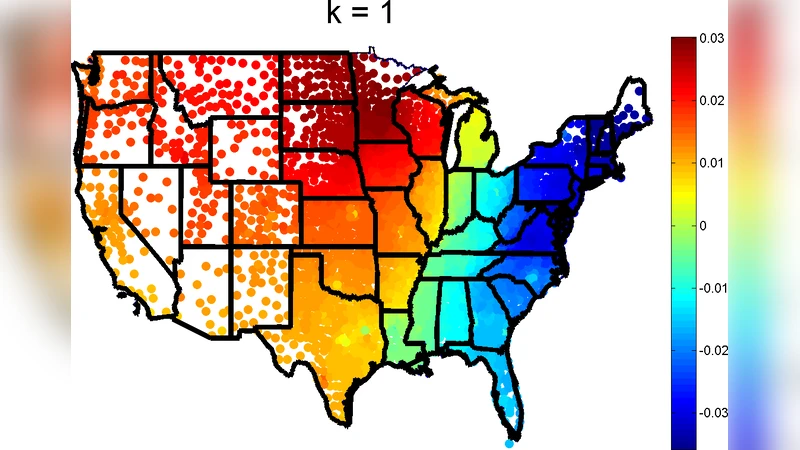
The methodological core is the diffusion‑map framework. By treating ψₖ as functions on the nodes, the diffusion distance after t steps is D_t(i,j) = ∑ₖ λₖ^{2t} (ψₖ(i)‑ψₖ(j))². Setting t = 1 and retaining only the first two non‑trivial eigenvectors yields a 2‑dimensional embedding L₁(x_i) = (λ₁ψ₁(i), λ₂ψ₂(i)), which the authors plot with colors representing longitude or latitude. This visualisation already separates the East‑West coast and North‑South gradients in the US case.
Beyond the global embedding, the authors focus on “eigenvector colorings”: each eigenvector ψₖ is mapped to a color scale, and the resulting map shows where the vector’s components are large (positive or negative). Remarkably, many low‑order eigenvectors (e.g., ψ₇, ψ₂₈, ψ₈₃) are highly localized: their significant entries are confined to a small geographic region (a single state or a cluster of neighboring counties), while the rest of the entries are near zero. This phenomenon, termed eigenvector localization, mirrors the behavior of localized eigenfunctions of the continuous Laplace operator in physics and mathematics.
Three similarity kernels are tested on the US migration data: (1) W¹_{ij}=M_{ij}²/(P_i P_j), (2) W²_{ij}=M_{ij}/(P_i+P_j), and (3) W³_{ij}=5500 M_{ij}/(P_i P_j), where M_{ij} is the migration flow and P_i the population of county i. Kernel (1) yields the most visually coherent geographic partitions and a spectrum with many large eigenvalues and no clear spectral gap, indicating that many low‑order eigenvectors carry useful information. Histograms of eigenvalues confirm these differences.
The paper then connects the observed localized eigenvectors to the weighted minimum‑cut problem. In graph partitioning, one seeks a partition that minimizes the sum of edge weights crossing between clusters while maximizing intra‑cluster weight. Classical spectral clustering uses the second eigenvector (the Fiedler vector) to approximate a global bipartition. Here, however, low‑order eigenvectors appear to encode local cuts: the set of nodes where ψₖ has large magnitude forms a subgraph whose internal edge weight far exceeds the weight of edges leaving the subgraph. Empirical measurements on both datasets support this claim, suggesting that low‑order eigenvectors can be interpreted as indicators of small, well‑connected geographic communities.
Despite these compelling empirical findings, the authors acknowledge that they do not provide a rigorous theoretical justification for why low‑order eigenvectors localize in these spatial networks. They hypothesize that strong community structure combined with geographic distance constraints creates a non‑uniform degree distribution and irregular edge weights, which in turn cause the Laplacian’s eigenfunctions to concentrate energy on specific regions. They also discuss related work on diffusion maps, modularity maximization, and localized eigenfunctions, positioning their contribution as a bridge between manifold learning and graph‑cut theory.
In conclusion, the study demonstrates that low‑order Laplacian eigenvectors are powerful tools for extracting hidden spatial subdivisions from large, noisy interaction networks, even when explicit coordinate data are missing. The approach yields visualizations that align closely with political and administrative boundaries, and it offers a computationally inexpensive alternative to more elaborate community‑detection algorithms. Future research directions include (i) developing a formal spectral theory for eigenvector localization in weighted, spatially embedded graphs, (ii) exploring multi‑scale Laplacians and non‑linear diffusion processes, and (iii) applying the methodology to other domains such as biological interaction networks or transportation systems.
Comments & Academic Discussion
Loading comments...
Leave a Comment