Wind-induced drift of objects at sea: the leeway field method
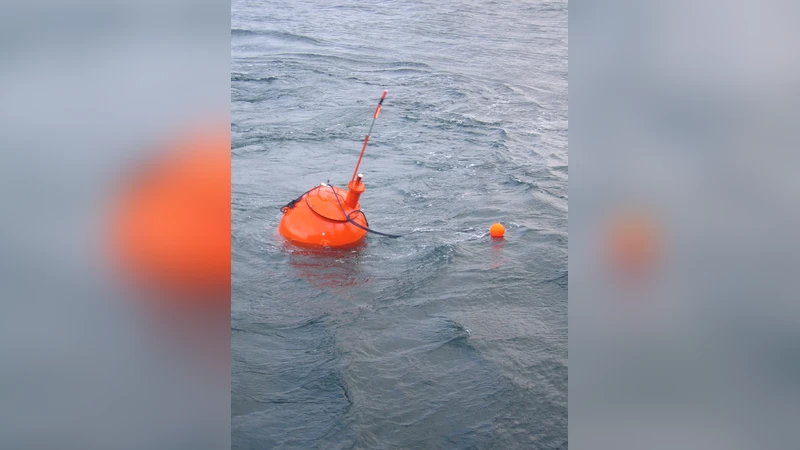
A method for conducting leeway field experiments to establish the drift properties of small objects (0.1-25 m) is described. The objective is to define a standardized and unambiguous procedure for condensing the drift properties down to a set of coefficients that may be incorporated into existing stochastic trajectory forecast models for drifting objects of concern to search and rescue operations and other activities involving vessels lost at sea such as containers with hazardous material. An operational definition of the slip or wind and wave-induced motion of a drifting object relative to the ambient current is proposed. This definition taken together with a strict adherence to 10 m wind speed allows us to refer unambiguously to the leeway of a drifting object. We recommend that all objects if possible be studied using what we term the direct method, where the object’s leeway is studied directly using an attached current meter. We divide drifting objects into four categories, depending on their size. For the smaller objects (less than 0.5 m), an indirect method of measuring the object’s motion relative to the ambient current must be used. For larger objects, direct measurement of the motion through the near-surface water masses is strongly recommended. Larger objects are categorized according to the ability to attach current meters and wind monitoring systems to them. The leeway field method proposed here is illustrated with results from field work where three objects were studied in their distress configuration; a 1:3.3 sized model of a 40-ft Shipping container, a World War II mine and a 220 l (55-gallon) oil drum.
💡 Research Summary
**
The paper presents a standardized methodology for measuring the wind‑ and wave‑induced drift, known as “leeway,” of floating objects ranging from 0.1 m to 25 m in size. The authors aim to provide a clear operational definition of leeway, a set of reproducible field procedures, and a compact set of coefficients that can be directly ingested by stochastic trajectory models used in search‑and‑rescue (SAR) and hazardous‑material (HAZMAT) response.
Operational definition
Leeway is defined as the motion of an object relative to the ambient current (averaged over 0.3–1.0 m depth) that is caused by wind measured at the standard 10 m reference height. The definition deliberately bundles wind and wave effects because, for objects smaller than about 30 m, wave‑induced forces become negligible when the dominant wavelength exceeds roughly six times the object length. Consequently, leeway can be expressed as a linear function of 10‑m wind speed for most practical sea states.
Measurement approaches
Two measurement strategies are distinguished:
-
Direct method – a small current meter (e.g., a miniature ADCP) is attached directly to the object, and, when feasible, a lightweight anemometer is also mounted. This configuration records the object’s velocity through the water and the local wind simultaneously, minimizing the error introduced by spatial separation between the object and the reference current measurement.
-
Indirect method – used for objects smaller than about 0.5 m that cannot carry a current meter. The object’s GPS track is compared with a nearby current measurement obtained from a drifting buoy, an HF‑radar surface current field, or a conventional current meter placed close to the object. The indirect method is simpler but more prone to error, especially in rough weather when the object drifts away from the reference sensor.
The authors recommend the direct method whenever the object’s size and geometry allow it, because field experiments show a substantial reduction in the spread of regression residuals (30–50 % lower standard deviation) compared with the indirect approach.
Parameterisation
Leeway vectors are decomposed into downwind (DWL) and cross‑wind (CWL) components. Each component is modelled with a simple linear regression:
L = a·W + b
where L is the leeway speed (cm s⁻¹), W is the 10‑m wind speed (m s⁻¹), a is the leeway rate expressed as a percentage of wind speed, and b is an optional low‑wind offset. Separate regressions are performed for right‑hand and left‑hand cross‑wind drift to capture possible “jibing” behaviour (switching from one side of the wind to the other). Assuming Gaussian residuals, nine parameters fully describe the leeway of a given object: a_d, b_d for downwind, a_c⁺, b_c⁺ for right‑hand cross‑wind, a_c⁻, b_c⁻ for left‑hand cross‑wind, and the three standard deviations ε_d, ε_c⁺, ε_c⁻. These coefficients can be directly fed into Monte‑Carlo SAR trajectory models, where they replace the more heuristic “windage” percentages traditionally used.
Field experiments
The methodology is illustrated with three case studies conducted in distress configurations:
-
A 1 : 3.3 scale model of a 40‑ft shipping container. Direct measurements revealed a downwind leeway rate ranging from 2 % to 5 % depending on immersion ratio, with cross‑wind components near ±1 % of wind speed.
-
A World War II naval mine, whose asymmetric shape produced markedly different right‑hand and left‑hand cross‑wind coefficients (approximately +2.1 % and –1.8 % of wind speed, respectively).
-
A 220 L (55‑gallon) oil drum, essentially cylindrical, showing a clean linear downwind response (≈3.5 % of wind speed) and negligible cross‑wind drift.
All three experiments employed 10‑minute vector‑averaged wind and leeway measurements, satisfying the temporal resolution recommended for SAR modelling. The resulting regression residuals were markedly smaller than those reported in earlier literature that relied on indirect methods.
Limitations and future work
The authors acknowledge several constraints:
-
Limited wind variability or short observation periods can inflate uncertainties in the regression coefficients.
-
Heteroscedasticity (increasing spread with wind speed) suggests that weighted or non‑linear regression may be advantageous in high‑wind regimes.
-
Rare events such as jibing, capsizing, or tumbling require longer, dedicated experiments to quantify their frequency and impact on leeway statistics.
-
The current definition of leeway does not separate wind and Stokes‑drift contributions; while justified for objects up to ~30 m, future work could explore explicit wave‑drift terms for larger or highly buoyant structures.
Conclusions
The paper delivers a clear, reproducible protocol for leeway measurement, differentiating between direct and indirect approaches based on object size and instrumentation feasibility. By condensing leeway behavior into a small set of linear coefficients, the method enables seamless integration into operational SAR and HAZMAT trajectory models, thereby reducing the uncertainty and spatial extent of search areas. The authors advocate for the creation of regional leeway databases, built on the standardized methodology, to support international cooperation and improve response times for maritime emergencies.
Comments & Academic Discussion
Loading comments...
Leave a Comment