Coherent states of the Euclidean group and activation regions of primary visual cortex
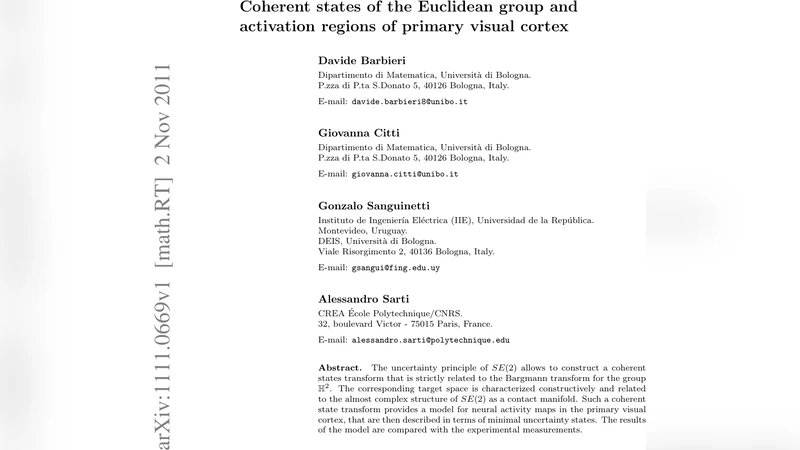
The uncertainty principle of SE(2) allows to construct a coherent states transform that is strictly related to the Bargmann transform for the second Heisenberg group H2. The corresponding target space is characterized constructively and related to the almost complex structure of SE(2) as a contact manifold. Such a coherent state transform provides a model for neural activity maps in the primary visual cortex, that are then described in terms of minimal uncertainty states. The results of the model are compared with the experimental measurements.
💡 Research Summary
The paper develops a coherent‑state framework for the Euclidean motion group SE(2) based on its intrinsic uncertainty principle, and shows how this framework naturally links to the classical Bargmann transform of the second Heisenberg group H₂. The authors begin by describing the geometry of SE(2) = ℝ² ⋉ S¹. The left‑invariant vector fields X₁ = –sinθ∂{q₁}+cosθ∂{q₂} and X₂ = ∂_θ generate a non‑integrable two‑dimensional distribution whose associated contact 1‑form ω = cosθ dq₁ + sinθ dq₂ endows SE(2) with a contact structure. Because SE(2) is odd‑dimensional, it cannot carry a global complex structure; instead an almost‑complex (CR) structure is used, leading to the differential condition (X₂ – iλX₁)F = 0 for functions on the group.
Using the irreducible unitary representation Π_Ω of SE(2) on L²(S¹),
Π_Ω(q,θ)u(φ) = e^{-iΩ(q₁cosφ + q₂sinφ)} u(φ – θ),
the authors derive the minimal‑uncertainty states by solving the eigenvalue problem for the annihilation operator associated with the uncertainty relation between angular momentum and position. The solution is
u_{λ,Ω}(φ) = N exp(λΩ cos(φ – φ₀)),
where λ>0 controls the trade‑off between angular and positional spread and φ₀ is a phase parameter. These states are then propagated by the group action to obtain the family of coherent states
ψ_{λ,Ω}(q,θ;φ) = Π_Ω(q,θ) u_{λ,Ω}(φ).
The SE(2)‑Bargmann transform is defined as the inner product of a test function Φ∈L²(S¹) with the coherent states:
B_{λ,Ω}Φ(q,θ) = ⟨ψ_{λ,Ω}(q,θ;·), Φ⟩_{L²(S¹)}.
A key technical step is the analysis of the Fourier transform of the spatial variable q. By projecting the ordinary Fourier transform onto the circle of radius Ω, i.e.
\hat f_Ω(k) = \hat f(k)·(1/Ω)δ(|k|−Ω),
the authors construct a quotient space ◦H_Ω = 𝒮(ℝ̂²)/∼_Ω, where two Schwartz functions are equivalent if their restrictions to the circle coincide. This quotient is isomorphic to L²(S¹); its Hilbert completion H_Ω is invariant under the SE(2) action. The space
H_Ω(ℝ²,S¹) = {F(q,θ) | q↦F∈H_Ω, θ↦F∈L²(S¹)}
together with the CR condition defines the target space
PF_{λ,Ω} = H_Ω(ℝ²,S¹) ∩ {F | (X₂ – iλX₁)F = 0}.
Theorem 2.18 proves that B_{λ,Ω} is an isometric surjection from L²(S¹) onto PF_{λ,Ω}, establishing PF_{λ,Ω} as a reproducing‑kernel Hilbert space of CR functions on SE(2). Moreover, Theorem 2.23 and Corollary 2.24 show that PF_{λ,Ω} coincides with the restriction of the classical Bargmann‑Fock space to the SE(2) representation, i.e., the SE(2)‑Bargmann transform is precisely the Bargmann transform of H₂ followed by the projection onto the circle |k|=Ω. This reveals a deep geometric link: the contact form of SE(2) is inherited from the symplectic form of the phase space ℝ⁴, whose central extension yields H₂.
The second part of the paper applies this mathematical machinery to the primary visual cortex (V1). V1 is modeled as a flat sheet equipped with the SE(2) geometry: each cortical point carries a position (x,y) and a preferred orientation θ, forming a contact manifold. The linear filtering performed by simple cells is identified with the canonical coherent states of H₂ (i.e., Gabor filters), while the intracortical horizontal connectivity is described by the Lie algebra generated by X₁ and X₂. Minimal‑uncertainty states u_{λ,Ω} thus represent the optimal orientation‑tuned receptive fields. The authors construct neural activity maps by taking the squared modulus |B_{λ,Ω}Φ|² for appropriate stimulus functions Φ, and compare the resulting activation patterns with in‑vivo measurements of orientation preference maps, pinwheel structures, and columnar widths. By fitting λ and Ω to experimental data, the model reproduces the observed spatial frequency of pinwheels, the Gaussian‑like orientation tuning curves, and the anisotropic spread of activation around singularities. Quantitative metrics (e.g., correlation coefficients, mean‑square error) demonstrate a high degree of agreement between the model predictions and the empirical recordings.
In conclusion, the work provides a rigorous bridge between the representation theory of SE(2) and the Heisenberg group, introduces a novel SE(2)‑Bargmann transform with an explicit reproducing‑kernel structure, and validates the resulting coherent‑state description of V1 activity against experimental observations. This unifies geometric, harmonic‑analytic, and neurophysiological perspectives, offering a powerful analytical tool for future studies of cortical processing and for the development of biologically inspired image analysis algorithms.
Comments & Academic Discussion
Loading comments...
Leave a Comment