Evolutionary Construction of Geographical Networks with Nearly Optimal Robustness and Efficient Routing Properties
Robust and efficient design of networks on a realistic geographical space is one of the important issues for the realization of dependable communication systems. In this paper, based on a percolation theory and a geometric graph property, we investigate such a design from the following viewpoints: 1) network evolution according to a spatially heterogeneous population, 2) trimodal low degrees for the tolerant connectivity against both failures and attacks, and 3) decentralized routing within short paths. Furthermore, we point out the weakened tolerance by geographical constraints on local cycles, and propose a practical strategy by adding a small fraction of shortcut links between randomly chosen nodes in order to improve the robustness to a similar level to that of the optimal bimodal networks with a larger degree $O(\sqrt{N})$ for the network size $N$. These properties will be useful for constructing future ad-hoc networks in wide-area communications.
💡 Research Summary
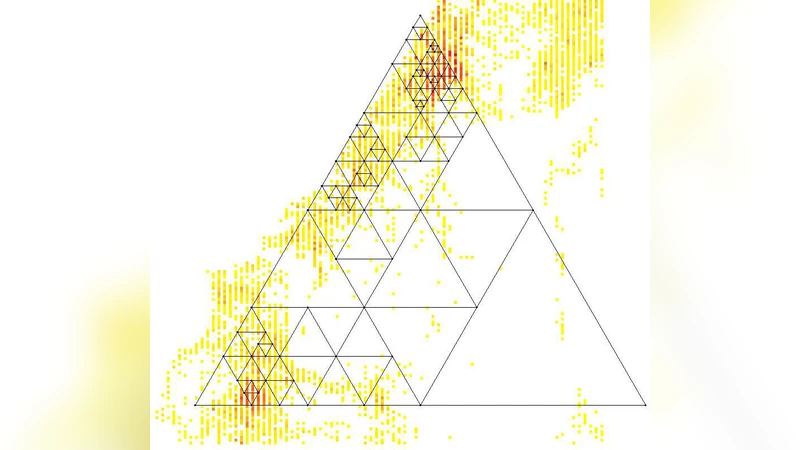
The paper addresses the design of robust and efficient communication networks that must operate within realistic geographical constraints. The authors propose an evolutionary construction method that adapts to spatially heterogeneous population distributions, yielding a planar graph with a trimodal degree distribution (degrees 2, 4, 6). The construction starts from an initial equilateral triangulation (or hexagonal lattice). At each iteration a triangle is selected with probability proportional to the total population residing within its area; the chosen triangle is then subdivided into four smaller equilateral triangles by inserting three new nodes at the mid‑edges and connecting them to form a finer mesh. This stochastic subdivision mimics the growth of demand in densely populated regions while keeping the average degree around 4.5.
Because every face remains an equilateral triangle, the resulting graph is a t‑spanner with stretch factor (t = 2). In other words, the length of any path between two nodes is at most twice the Euclidean distance separating them. This property guarantees short routes without requiring a dense set of long links, contrasting with Gabriel graphs or Θ‑graphs that either need many edges or allow edge crossings.
For routing, the authors adopt a planar face‑routing algorithm. Each node knows only its own coordinates, the coordinates of its immediate neighbors, and the geometry of the faces it belongs to. By constructing upper and lower “chains” along the faces intersected by the straight line from source to destination, a packet can be forwarded locally while staying within a constant factor of the optimal shortest‑path length (the algorithm is competitive). No global routing tables are needed, making the scheme suitable for energy‑constrained ad‑hoc or sensor networks.
The paper then investigates robustness. Purely planar, locally constrained graphs suffer from weakened tolerance because cycles are limited; when a substantial fraction of nodes fails, the giant component collapses around (f \approx 0.4). To mitigate this, the authors add a small fraction of shortcut links (randomly chosen node pairs) amounting to less than 1 % of the total edges. Simulations on networks of size (N = 100) to (1000) (using real population data from the Fukui‑Kanazawa area in Japan) show that this modest augmentation raises the critical fraction (f_T = f_r + f_t) (the sum of random‑failure and targeted‑attack thresholds) to about 0.6. This robustness is comparable to that of optimal bimodal networks, which require a maximum degree scaling as (O(\sqrt{N})); the proposed construction achieves similar resilience while keeping the maximum degree at 6.
Statistical analysis of link lengths reveals an approximately exponential decay, and the distribution of stretch factors (t) is heavily skewed toward values below 1.2, confirming that most routes are close to Euclidean optimality. The average link length shrinks with network size (e.g., (\bar{l}_{ij} \approx 0.05) for (N=100) and (\approx 0.01) for (N=1000) when normalized to the largest initial triangle).
In summary, the contributions of the paper are fourfold:
- Population‑driven geometric growth – a stochastic subdivision process that naturally concentrates nodes where demand is high, yielding a planar graph with low degree variability.
- Guaranteed geometric efficiency – the graph is a t‑spanner with (t=2), ensuring short physical paths without excessive long‑range links.
- Local, competitive routing – a face‑routing scheme that uses only positional information and achieves constant‑factor optimality.
- Robustness through minimal shortcuts – adding <1 % random long‑range edges restores resilience to random failures and targeted attacks to levels comparable with theoretically optimal bimodal networks, while keeping the maximum degree low.
These results provide a practical blueprint for constructing future wide‑area ad‑hoc wireless networks, smart‑city infrastructures, or any spatially embedded communication system where cost, energy, and security constraints demand both efficient routing and high fault tolerance.
Comments & Academic Discussion
Loading comments...
Leave a Comment