Constant-degree graph expansions that preserve the treewidth
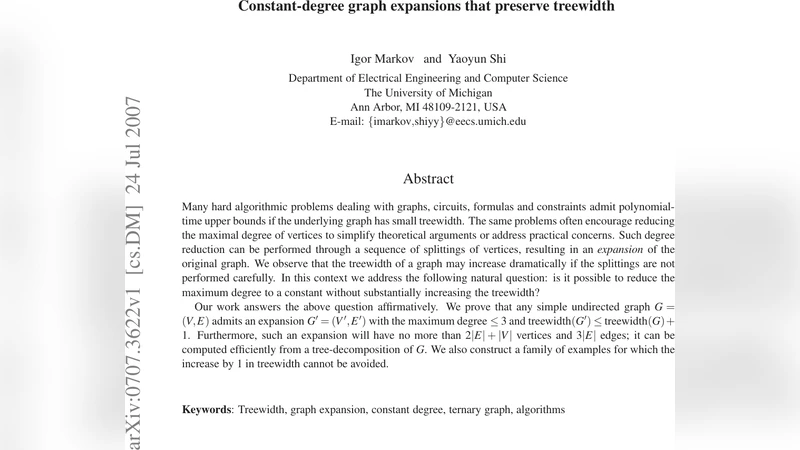
Many hard algorithmic problems dealing with graphs, circuits, formulas and constraints admit polynomial-time upper bounds if the underlying graph has small treewidth. The same problems often encourage reducing the maximal degree of vertices to simplify theoretical arguments or address practical concerns. Such degree reduction can be performed through a sequence of splittings of vertices, resulting in an expansion of the original graph. We observe that the treewidth of a graph may increase dramatically if the splittings are not performed carefully. In this context we address the following natural question: is it possible to reduce the maximum degree to a constant without substantially increasing the treewidth? Our work answers the above question affirmatively. We prove that any simple undirected graph G=(V, E) admits an expansion G’=(V’, E’) with the maximum degree <= 3 and treewidth(G’) <= treewidth(G)+1. Furthermore, such an expansion will have no more than 2|E|+|V| vertices and 3|E| edges; it can be computed efficiently from a tree-decomposition of G. We also construct a family of examples for which the increase by 1 in treewidth cannot be avoided.
💡 Research Summary
The paper tackles a fundamental tension in graph‑based algorithm design: many hard problems become tractable on graphs of bounded treewidth, yet practical and theoretical considerations often demand that the maximum vertex degree be reduced to a constant. The standard tool for degree reduction is vertex splitting, which replaces a high‑degree vertex by a small gadget of lower‑degree vertices. Unfortunately, arbitrary splittings can blow up the treewidth, destroying the very property that enables efficient algorithms. The authors ask whether one can systematically lower the degree to a constant while keeping the treewidth essentially unchanged.
The main contribution is a constructive affirmative answer. For any simple undirected graph (G=(V,E)) they show how to build an expansion (G’=(V’,E’)) whose maximum degree is at most three and whose treewidth satisfies (\operatorname{tw}(G’)\le \operatorname{tw}(G)+1). Moreover, the expansion is modest in size: (|V’|\le 2|E|+|V|) and (|E’|\le 3|E|). The construction assumes that a tree‑decomposition of (G) of optimal width is given; from this decomposition the algorithm produces (G’) in linear time.
The technical core relies on a careful local modification of each bag in the tree‑decomposition. For a bag (X_i) the algorithm creates a set of “copy” vertices representing the original vertices that appear in the bag. These copies are linked together in a small tree structure that guarantees every copy has degree at most three. Edges of the original graph are re‑routed through the appropriate copies, and the copies belonging to adjacent bags are identified so that the global graph remains connected and faithfully represents the original adjacency. Because the new connections are confined to individual bags, the size of each bag grows by at most one vertex, which directly yields the bound (\operatorname{tw}(G’)\le \operatorname{tw}(G)+1).
The authors also analyze the algorithmic aspects. Starting from an optimal tree‑decomposition (which can be computed in exponential time for general graphs but is often given in parameterized settings), the expansion proceeds by a single pass over the decomposition tree. Each step performs a constant‑time operation per vertex and edge, leading to an overall (O(|V|+|E|)) runtime. The resulting graph is explicit, and its degree‑three property makes it suitable for downstream algorithms that assume bounded degree, such as certain dynamic‑programming schemes, SAT‑to‑CSP reductions, or circuit‑layout optimizations.
To demonstrate that the additive “+1” in the treewidth bound cannot be avoided in general, the paper presents a family of graphs for which any degree‑three expansion necessarily increases the treewidth by at least one. The construction is based on a grid‑like structure where any attempt to split high‑degree vertices forces the creation of a new separator that enlarges the minimal width of any tree‑decomposition. This lower‑bound example establishes the tightness of the main theorem.
In the concluding discussion the authors emphasize the practical impact of their result. Many algorithms that are fixed‑parameter tractable with respect to treewidth (e.g., exact algorithms for Hamiltonian Cycle, Graph Coloring, or various Constraint Satisfaction Problems) can now be applied to instances where the degree has been reduced without sacrificing the parameter bound. The work bridges a gap between structural graph theory and algorithm engineering, opening avenues for further research such as extending the technique to degree‑two expansions, exploring trade‑offs between edge count and treewidth increase, or integrating the construction into automated preprocessing pipelines for SAT and CSP solvers.
Comments & Academic Discussion
Loading comments...
Leave a Comment