Quantum Diffusion-Limited Aggregation
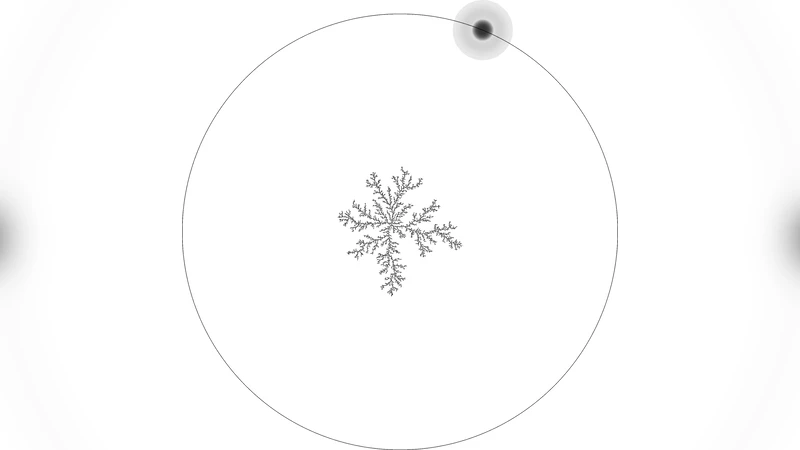
Though classical random walks have been studied for many years, research concerning their quantum analogues, quantum random walks, has only come about recently. Numerous simulations of both types of walks have been run and analyzed, and are generally well-understood. Research pertaining to one of the more important properties of classical random walks, namely, their ability to build fractal structures in diffusion-limited aggregation, has been particularly noteworthy. However, only now has research begun in this area in regards to quantum random motion. The study of random walks and the structures they build has various applications in materials science. Since all processes are quantum in nature, it is important to consider the quantum variant of diffusion-limited aggregation. Recognizing that Schr"odinger equation and a classical random walk are both diffusion equations, it is possible to connect and compare them. Using similar parameters for both equations, we ran various simulations aggregating particles. Our results show that particles moving according to Schr"odinger equation can create fractal structures, much like the classical random walk. Furthermore, the fractal dimensions of these quantum diffusion-limited aggregates vary between 1.43 and 2, depending on the size of the initial wave packet.
💡 Research Summary
The paper investigates diffusion‑limited aggregation (DLA) using both classical random walks and quantum mechanical propagation governed by the Schrödinger equation, a model the authors term quantum DLA (QDLA). The authors first review the classical DLA process, where particles perform a random walk on a two‑dimensional lattice and stick irreversibly to an existing cluster, producing a fractal with a well‑known mass dimension of roughly 1.69. They note that the discrete random walk can be recast as a diffusion equation, allowing a direct numerical comparison with the continuous quantum case.
For the quantum simulations, the authors solve the time‑dependent Schrödinger equation for a free particle on the same lattice using an explicit symmetric finite‑difference scheme. Because the diffusion coefficient in the Schrödinger equation is imaginary, the scheme is stable, unlike the real‑diffusion counterpart. The complex wavefunction ψ(x,y,t) yields a probability density |ψ|²; any lattice site occupied by the growing aggregate is forced to have zero probability, and the wavefunction is renormalized after each time step. Particles are introduced as two‑dimensional Gaussian packets (σx=σy=10) placed on a circle surrounding the seed, with zero initial velocity. The simulation proceeds with a time step Δt=0.05 (so detection is attempted every 20 steps) and a diffusion constant D=0.25. A particle is considered attached when the cumulative probability on sites adjacent to the cluster exceeds a randomly drawn number; otherwise those sites are set to zero and the wavefunction is renormalized again.
Both the classical and quantum simulations are implemented in parallel C code using MPI on a 16‑core cluster, with grid sizes of 256×256 and later 512×512. Thirteen independent runs are performed for each set of parameters to obtain statistical averages. The fractal (mass) dimension d is extracted from the scaling relation M(r)=k rᵈ by fitting a straight line to the linear region of a log‑log plot of mass versus radius. The linear region is identified automatically using the method of Kroll et al., avoiding subjective selection.
Results for the classical diffusion‑based DLA reproduce the expected dimension d ≈ 1.67 ± 0.04. For the quantum case, two theoretical possibilities are discussed: (i) quantum diffraction could allow particles to fill gaps between branches, pushing d toward 2, or (ii) the squared amplitudes might behave semi‑classically, yielding d≈1.43 as predicted by Pietronero et al. Surprisingly, the average quantum dimension is d = 1.69 ± 0.03, essentially identical to the classical value. The authors attribute this to the fact that the wavefunction, when forced to vanish on the aggregate, interacts with the cluster in a manner similar to classical diffusion, limiting the ability of the particle to spread sufficiently to explore the inter‑branch voids.
Additional experiments varying the initial Gaussian width σ reveal a clear dependence: a broad packet (σ = 16) produces a low dimension d ≈ 1.45, while a narrow packet (σ = 1) yields a high dimension d ≈ 1.91. This trend aligns with the theoretical framework of Pietronero, where the aggregation probability scales as φⁿ with n = 1 for classical diffusion (giving d≈2) and n = 2 for the quantum case (giving d≈1.43). The observed intermediate dimensions result from the finite size of the lattice, the discretization, and the specific choice of σ, which controls how much the wavefunction interferes with itself before reaching the cluster.
The discussion emphasizes that, despite the mathematical equivalence of the underlying Laplace equation for stationary states, the dynamical evolution of a complex wavefunction introduces subtle effects that can be tuned via the initial packet. The authors suggest that larger grids, alternative boundary conditions, or inclusion of external potentials could amplify quantum diffraction effects, potentially leading to fractal dimensions markedly different from the classical case.
In conclusion, the study demonstrates that quantum diffusion‑limited aggregation can generate fractal structures, but under the simulation conditions used the resulting fractal dimension closely matches that of classical DLA. The dimension is sensitive to the initial wave‑packet width, ranging from 1.43 to 2, confirming theoretical predictions. The work opens avenues for exploring quantum‑controlled pattern formation in material science and nanofabrication, and highlights the need for further computational and experimental investigations to harness quantum interference in aggregation processes.
Comments & Academic Discussion
Loading comments...
Leave a Comment