Platform Dependent Verification: On Engineering Verification Tools for 21st Century
The paper overviews recent developments in platform-dependent explicit-state LTL model checking.
💡 Research Summary
The paper surveys recent advances in platform‑dependent explicit‑state LTL model checking and presents a comprehensive engineering methodology for building verification tools that can exploit modern heterogeneous computing resources. It begins by highlighting the growing complexity of hardware and software systems and the consequent need for formal verification techniques to guarantee correctness and reliability. The authors point out that the state‑space explosion problem remains the principal obstacle to scaling model checking, despite decades of research on state compression, partial‑order reduction, and symbolic representations.
In response to the proliferation of multi‑core CPUs, clusters of network‑connected workstations, and external‑memory devices, the authors argue that verification tools must be tailored to the specific characteristics of each platform. The centerpiece of the paper is the DiVinE tool, a distributed LTL model checker that follows the automata‑based approach: an LTL formula is translated into a Büchi automaton, and verification reduces to detecting an accepting cycle in the automaton’s directed graph. Traditional Nested Depth‑First Search (DFS) cannot be efficiently implemented in a distributed‑memory environment because maintaining a global DFS stack incurs prohibitive communication overhead. Consequently, DiVinE incorporates a suite of parallel cycle‑detection algorithms, including MAP, OWCTY, BLEDGE, and NEGC. Table 1 summarizes their theoretical time complexities (ranging from O(N·(N+M)) for general LTL to O(N+M) for weak LTL) and indicates whether they support on‑the‑fly verification.
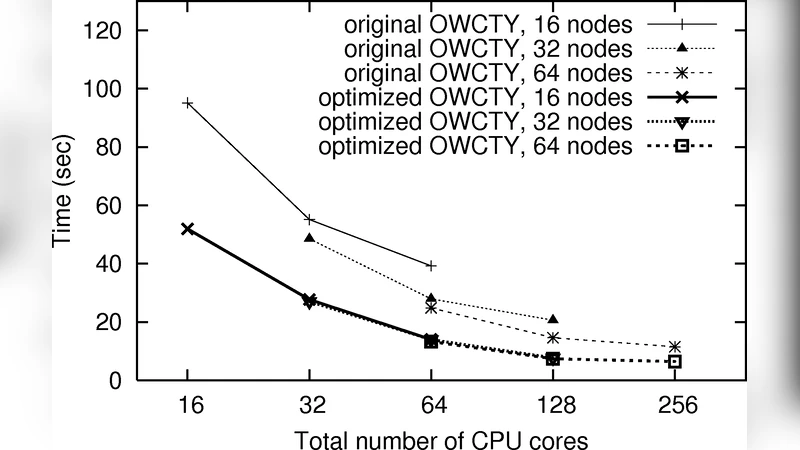
The paper details how DiVinE adapts these algorithms to three major platform categories. For distributed‑memory clusters, a static hash‑based partitioning distributes states among nodes; each node buffers outgoing messages and flushes them based on size, idle status, or explicit algorithmic requests. Empirical tuning showed that discarding the “old‑message” flushing rule and eliminating uncontrolled polling dramatically improved throughput, as illustrated in Figure 2. In shared‑memory multi‑core machines, DiVinE mimics the distributed scheme: each thread owns a private hash table and a local work queue, communicating via lock‑free queues. The authors acknowledge that this thread‑private design limits scalability and suggest that future work should explore global hash structures, specialized termination detection, and dual‑core algorithms.
External‑memory support is addressed through I/O‑optimal techniques such as delayed duplicate detection, which reduces the number of disk accesses during state‑space generation. While breadth‑first search can be adapted for safety‑property verification with external storage, it is unsuitable for LTL cycle detection; the paper therefore discusses a reduction of LTL model checking to reachability, noting that this incurs a quadratic blow‑up in memory requirements and remains an open research challenge.
A central theme throughout the work is algorithm engineering: theoretical optimality alone does not guarantee practical performance. Platform‑specific considerations—network latency, memory hierarchy, core count, and synchronization costs—must be incorporated into data‑structure design, message aggregation, and load‑balancing strategies. The authors conclude that a close coupling of algorithmic advances with low‑level engineering is essential for building verification tools that can handle the massive models encountered in contemporary industry. DiVinE serves as a concrete demonstration that, when properly tuned, platform‑dependent verification can achieve scalability far beyond traditional sequential model checkers, thereby offering a viable path toward reliable, high‑performance formal verification in the 21st century.
Comments & Academic Discussion
Loading comments...
Leave a Comment