Exact Sequences in Non-Exact Categories (An Application to Semimodules)
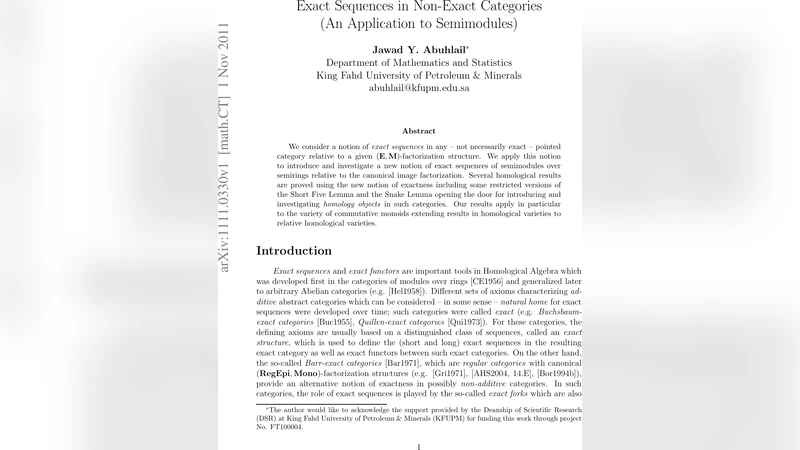
We consider a notion of exact sequences in any -not necessarily exact- pointed category relative to a given (E;M)-factorization structure. We apply this notion to introduce and investigate a new notion of exact sequences of semimodules over semirings relative to the canonical image factorization. Several homological results are proved using the new notion of exactness including some restricted versions of the Short Five Lemma and the Snake Lemma opening the door for introducing and investigating homology objects in such categories. Our results apply in particular to the variety of commutative monoids extending results in homological varieties to relative homological varieties.
💡 Research Summary
The paper tackles the longstanding problem of defining exact sequences in pointed categories that are not necessarily exact in the classical sense, and it applies this new framework to the theory of semimodules over semirings. The authors begin by reviewing the classical notions of exactness in Puppe‑exact and Barr‑exact categories, where an exact sequence A →^f B →^g C is characterized by the equality Im f ≅ Ker g, with images and coimages defined via kernels of cokernels and cokernels of kernels respectively. They point out that this definition fails in many naturally pointed categories such as Mon (monoids) or Grp (groups) because the universal properties of images/coimages break down; consequently, left‑exactness (Im f ≅ Ker g) and right‑exactness (Coim g ≅ Coker f) become distinct notions.
To overcome this, the authors exploit the fact that every pointed category admits an (E, M)‑factorization structure: a pair of classes of morphisms (E, M) closed under composition with isomorphisms, such that every morphism factors uniquely as an E‑morphism followed by an M‑morphism, and the diagonal‑fill‑in property holds. Typical choices are (RegEpi, Mono) or (Surj, Inj). For any morphism γ they define the E‑coimage coim_E(γ) and the M‑image im_M(γ) via the universal properties of the factorization.
The central definition (Definition 1.13) declares a sequence A →^f B →^g C to be (E, M)‑exact if f and g admit factorizations f = ker(g) ∘ f′ and g = g″ ∘ coker(f) with (f′, ker g)∈E×M and (coker f, g″)∈E×M. In a Puppe‑exact category this reduces to the classical Im f ≅ Ker g condition, but in non‑Puppe‑exact settings it provides a coherent way to require both left‑ and right‑exactness simultaneously.
The authors then specialize to the category of semimodules over a semiring. They adopt the canonical image factorization (regular epimorphism followed by monomorphism) as (E, M). In this context the “regular image” of a homomorphism is the cokernel of its kernel, and the “regular coimage” is the kernel of its cokernel—precisely the constructions that behave well in the absence of additive inverses. With these choices, a short exact sequence 0→A→^f B→^g C→0 is (E, M)‑exact exactly when f is a regular epimorphism, g is a regular monomorphism, and the usual kernel‑cokernel identities hold. This resolves earlier difficulties noted by Takahashi and others, where naïve image definitions led to pathological homological behaviour for semimodules.
Armed with this robust notion of exactness, the paper proves two fundamental diagram lemmas in the relative setting. The restricted Short Five Lemma (Theorem 4.7) shows that in a commutative diagram with exact rows, if the outer vertical maps are regular epimorphisms (or monomorphisms) and the middle vertical map is both a regular epi and mono, then it is an isomorphism. The Snake Lemma (Theorem 4.13) is established for the category of cancellative semimodules (and, equivalently, cancellative commutative monoids). It yields a connecting morphism and a long exact sequence of kernels and cokernels, thereby providing the first genuine homology objects in these non‑additive settings.
Beyond these lemmas, the authors introduce the concept of a “relative homological category” – a pointed (E, M)‑structured category in which every regular epi is a strong epi and every regular mono is a strong mono, and where the usual exactness axioms (e.g., stability under pullbacks/pushouts) hold relative to the chosen factorization. They demonstrate that the category of cancellative semimodules satisfies these axioms, making it a prototype of a relative homological variety. Consequently, many classical homological results (e.g., the Nine Lemma, the 3×3 Lemma) can be transferred to this setting.
In the concluding discussion the authors emphasize that their framework unifies and extends previous attempts to develop homological algebra for semirings and monoids. By grounding exactness in a universal factorization rather than in ad‑hoc image constructions, they obtain a theory that works uniformly across a wide range of algebraic structures lacking additive inverses. The paper opens several avenues for future work: extending derived functor theory to semimodules, investigating relative projective and injective objects, and applying the relative homological machinery to problems in tropical geometry, automata theory, and categorical algebra. Overall, the work provides a solid categorical foundation for homological methods in non‑exact, non‑additive contexts.
Comments & Academic Discussion
Loading comments...
Leave a Comment