Discovery, classification, and scientific exploration of transient events from the Catalina Real-time Transient Survey
Exploration of the time domain - variable and transient objects and phenomena - is rapidly becoming a vibrant research frontier, touching on essentially every field of astronomy and astrophysics, from the Solar system to cosmology. Time domain astronomy is being enabled by the advent of the new generation of synoptic sky surveys that cover large areas on the sky repeatedly, and generating massive data streams. Their scientific exploration poses many challenges, driven mainly by the need for a real-time discovery, classification, and follow-up of the interesting events. Here we describe the Catalina Real-Time Transient Survey (CRTS), that discovers and publishes transient events at optical wavelengths in real time, thus benefiting the entire community. We describe some of the scientific results to date, and then focus on the challenges of the automated classification and prioritization of transient events. CRTS represents a scientific and a technological testbed and precursor for the larger surveys in the future, including the Large Synoptic Survey Telescope (LSST) and the Square Kilometer Array (SKA).
💡 Research Summary
The paper presents a comprehensive overview of the Catalina Real‑Time Transient Survey (CRTS), a pioneering optical, filter‑less, synoptic sky survey that discovers and publishes transient events in real time. CRTS operates three complementary telescopes—CSS (0.68 m Schmidt), MLS (1.5 m reflector), and SSS (0.5 m Schmidt)—each equipped with a 4 k × 4 k CCD, covering the sky north of –30° and south of –25° with a cadence of four exposures per field taken about ten minutes apart. This four‑image sequence provides a powerful veto against moving objects (asteroids, satellites) and image artifacts, enabling reliable detection of genuine astrophysical transients that brighten by at least two magnitudes relative to deep co‑added reference images built from ≥20 past exposures.
The detection pipeline uses SExtractor to generate source catalogs, cross‑matches them with higher‑resolution catalogs (SDSS, USNO‑B, PQ) to reject spurious detections, and then flags objects that have significantly brightened. Candidates are immediately disseminated as VOEvent alerts and posted on public web pages, reflecting CRTS’s open‑data policy—there is no proprietary period.
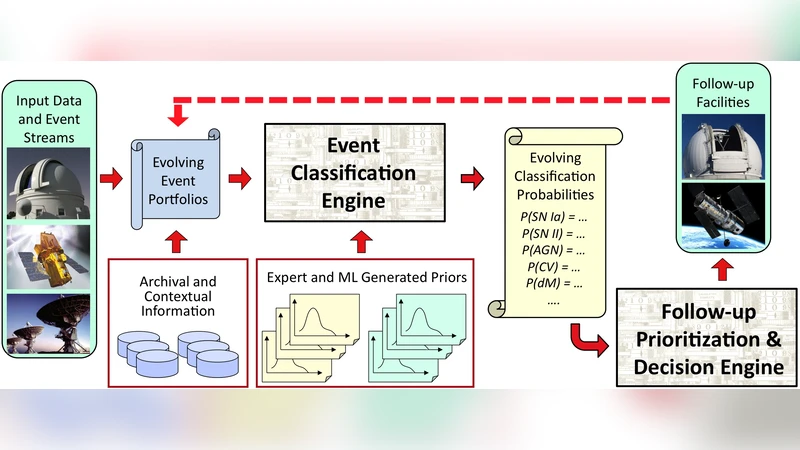
A major focus of the work is the development of an automated classification and prioritization framework. The authors combine rule‑based filters with machine‑learning models (artificial neural networks and Bayesian networks) to assign each transient to one of eight broad classes: supernovae (SN), cataclysmic variables (CV), blazars, active galactic nuclei (AGN), stellar flares, eclipsing white dwarfs, FU Ori‑type objects, and “other.” Features used include historical light‑curve shape, color information, proximity to known galaxies or radio sources, and variability timescales. The system produces a priority score that guides follow‑up observations with larger facilities (Keck, Palomar), thereby addressing the critical bottleneck of limited spectroscopic resources. Current classification accuracy exceeds 85 %, and uncertain cases are flagged for human review, creating a feedback loop that continuously improves the models.
Scientific results highlighted in the paper demonstrate CRTS’s impact. Notable discoveries include the extremely luminous Type IIn supernova SN 2008fz, the unusually slow‑rising SN 2008iy, and the hybrid AGN‑SN event CSS100217, which outshone previous supernovae and occurred within ~150 pc of a narrow‑line Seyfert 1 nucleus. CRTS has also identified over 500 dwarf‑nova cataclysmic variables, more than 100 flare stars (UV Ceti‑type), dozens of eclipsing white dwarf systems, and several FU Ori‑type eruptive stars. Importantly, many supernovae were found in faint or dwarf host galaxies that are often missed by image‑subtraction surveys, illustrating the complementary power of magnitude‑change detection.
Despite these successes, the authors acknowledge that follow‑up spectroscopy remains a severe limitation: less than 50 % of transients receive photometric follow‑up and under 10 % obtain spectra. As upcoming surveys such as LSST and the Square Kilometre Array will generate orders of magnitude more alerts, the need for scalable, automated classification and real‑time allocation of follow‑up resources becomes even more pressing. CRTS serves as both a scientific and technological testbed for these future facilities, showcasing the value of open data, rapid alert dissemination, and machine‑learning‑driven decision making in time‑domain astronomy.
Comments & Academic Discussion
Loading comments...
Leave a Comment