Generalization of a few results in Integer Partitions
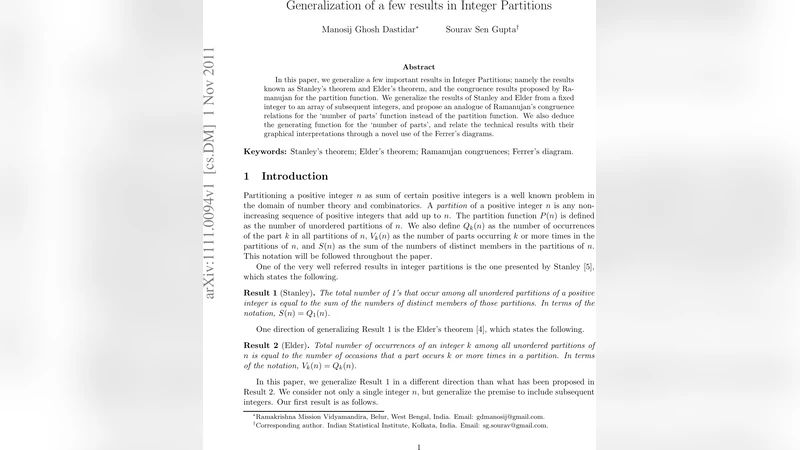
In this paper, we generalize a few important results in Integer Partitions; namely the results known as Stanley’s theorem and Elder’s theorem, and the congruence results proposed by Ramanujan for the partition function. We generalize the results of Stanley and Elder from a fixed integer to an array of subsequent integers, and propose an analogue of Ramanujan’s congruence relations for the number of parts' function instead of the partition function. We also deduce the generating function for the number of parts’, and relate the technical results with their graphical interpretations through a novel use of the Ferrer’s diagrams.
💡 Research Summary
The paper “Generalization of a few results in Integer Partitions” attempts to broaden three classic results in partition theory: Stanley’s theorem, Elder’s theorem, and Ramanujan’s congruences. The authors introduce a new notation: Qₖ(n) denotes the total number of occurrences of the part k across all partitions of n, Vₖ(n) counts the partitions of n in which k appears at least k times, and S(n) is the sum of the numbers of distinct parts in all partitions of n.
First, they extend Stanley’s theorem, which originally states S(n)=Q₁(n), to a family of identities involving consecutive integers. For any positive integers n and k they claim
S(n)=∑{i=0}^{k‑1} Qₖ(n+i).
The proof relies on the known identity Q₁(n)=∑{i=0}^{n‑1}P(i) (where P(i) is the partition function) and on the recurrence Qₖ(n)=Qₖ(n‑k)+P(n‑k). By repeatedly applying the recurrence they obtain the series representation Qₖ(n)=P(n‑k)+P(n‑2k)+…, and then sum over a block of k consecutive arguments to recover S(n). This result reduces to the original Stanley theorem when k=1.
Second, they generalize Elder’s theorem, which asserts Vₖ(n)=Qₖ(n). Introducing an arbitrary scaling factor r, they propose
Vₖ(n)=∑{i=0}^{r‑1} Q{rk}(n+ik).
When r=1 the identity collapses to Elder’s original statement. The argument again uses the same recurrence for Qₖ and a block‑wise summation over an arithmetic progression with step k.
Third, the authors present analogues of Ramanujan’s famous congruences for the partition function. Ramanujan proved p(5n+4)≡0 (mod 5), p(7n+5)≡0 (mod 7), and p(11n+6)≡0 (mod 11). The paper claims that the same congruences hold for Qₖ(n) when k equals the modulus:
Q₅(5n+4)≡0 (mod 5), Q₇(7n+5)≡0 (mod 7), Q₁₁(11n+6)≡0 (mod 11).
The proof is elementary: using the series Qₖ(n)=∑_{j≥1}P(n‑jk), each term on the right is of the form P(5m+4) (or the analogous 7‑ or 11‑type), which is known to be divisible by the corresponding modulus. Hence the whole sum is divisible as well. The authors note that higher‑power congruences follow similarly, e.g., Q₅(25n+24)≡0 (mod 5²).
A generating function for Qₖ(n) is derived. Starting from the ordinary partition generating function
F(x)=∏{m≥1}(1‑x^m)^{‑1},
they multiply by the factor (x^k)/(1‑x^k) to keep track of each occurrence of k. Consequently,
Gₖ(x)=∑{n≥0}Qₖ(n)x^n = (x^k)/(1‑x^k)·F(x).
Expanding this product reproduces the earlier series representation of Qₖ(n).
The paper also offers a graphical interpretation using Ferrers diagrams. They define a “packet” of k points to be added vertically to an existing diagram. Adding such a packet either (a) creates a new partition by appending k ones (contributing P(n) new partitions) or (b) merges with an existing column of at least k equal parts, which is possible precisely when the original partition contributes to Vₖ(n). Thus the total number of new partitions generated by this operation equals P(n)+Vₖ(n)=Qₖ(n+k), matching the algebraic identities previously established.
In the conclusion the authors summarize their contributions: a block‑wise generalization of Stanley’s and Elder’s theorems, a direct transfer of Ramanujan‑type congruences to the part‑count function Qₖ, a compact generating function, and a Ferrers‑diagram based combinatorial picture.
While the paper succeeds in presenting a unified framework, several shortcomings are evident. The proofs are largely manipulations of known recurrences and do not provide new bijective arguments; the combinatorial intuition behind the block sums is hinted at but not fully developed. Notational inconsistencies (e.g., occasional misuse of subscripts and superscripts) and typographical errors make the exposition difficult to follow. Moreover, the claim that all Ramanujan‑type congruences extend to Qₖ(n) is justified only for the basic moduli; a deeper modular‑form perspective, which underlies Ramanujan’s original results, is absent. Future work could aim to construct explicit bijections that explain the block identities, explore the modular properties of the generating function (x^k)/(1‑x^k)·F(x), and investigate whether higher‑order congruences for Qₖ(n) can be derived from the theory of modular forms rather than elementary term‑by‑term arguments.
Comments & Academic Discussion
Loading comments...
Leave a Comment