An Improved Implementation and Abstract Interface for Hybrid
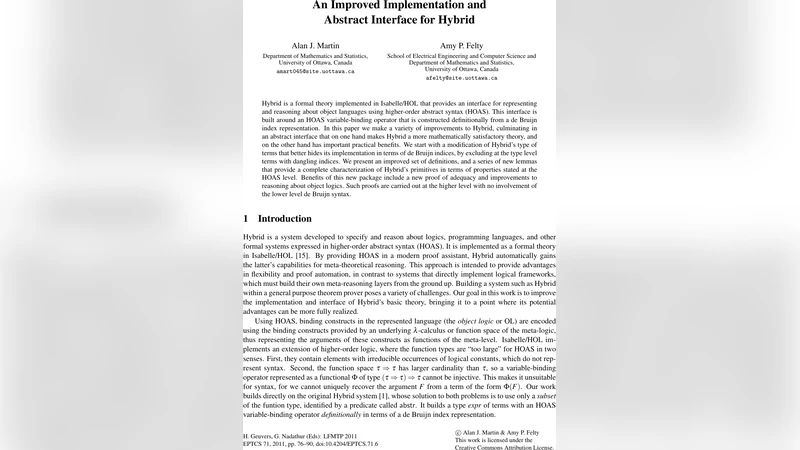
Hybrid is a formal theory implemented in Isabelle/HOL that provides an interface for representing and reasoning about object languages using higher-order abstract syntax (HOAS). This interface is built around an HOAS variable-binding operator that is constructed definitionally from a de Bruijn index representation. In this paper we make a variety of improvements to Hybrid, culminating in an abstract interface that on one hand makes Hybrid a more mathematically satisfactory theory, and on the other hand has important practical benefits. We start with a modification of Hybrid’s type of terms that better hides its implementation in terms of de Bruijn indices, by excluding at the type level terms with dangling indices. We present an improved set of definitions, and a series of new lemmas that provide a complete characterization of Hybrid’s primitives in terms of properties stated at the HOAS level. Benefits of this new package include a new proof of adequacy and improvements to reasoning about object logics. Such proofs are carried out at the higher level with no involvement of the lower level de Bruijn syntax.
💡 Research Summary
Hybrid is a formal theory implemented in Isabelle/HOL that provides a higher‑order abstract syntax (HOAS) interface for representing and reasoning about object languages. The original implementation built the HOAS binding operator LAM definitionally on top of a de Bruijn index representation, exposing the low‑level datatype dB directly as the term type expr. This design required users to constantly check for dangling indices and to supply abstraction predicates (abstr) on both sides of any LAM equality in order to obtain injectivity, because a truly injective function from (expr ⇒ expr) to expr cannot exist in Isabelle’s function space.
The paper presents a series of systematic improvements that culminate in a clean abstract interface. First, the authors introduce a level predicate that tracks the depth of de Bruijn binders and guarantees that only well‑formed dB terms (those without dangling indices) can be lifted to the expr type. Consequently, the expr type itself enforces well‑formedness at the type level, eliminating the need for external dangling‑index checks.
Second, they redesign the LAM operator. By adding a distinguished constant ERR, LAM is defined to return ERR whenever its argument does not satisfy abstr. This allows the injectivity theorem to be stated with a single abstraction premise: if abstr S ∨ abstr T and LAM S = LAM T, then S = T. The requirement for both sides to be abstract is thus removed, simplifying object‑language encodings and reducing the number of explicit abstr conditions that must be carried through proofs.
Third, the paper gives a complete characterization of the abstr predicate. The authors prove that abstr Y holds exactly when Y is one of the following: the identity function, a constant‑producing function, a free‑variable generator, an application of two abstract functions, a nested LAM built from a two‑argument function whose each “slice” is abstract, or the ERR case. For two‑argument functions they show equivalence between a joint abstr condition and the conjunction of abstr on each curried component. This result enables compositional reasoning about higher‑order functions without converting back to de Bruijn indices.
Fourth, auxiliary machinery from the earlier version (such as the dB_fn function) is eliminated by exploiting Isabelle/HOL’s function package and the systematic use of the level predicate. All proofs are rewritten in Isar style, improving readability and robustness against changes in Isabelle’s kernel. Rewrite rules are provided to automate conversion between HOAS terms (type expr) and their de Bruijn counterparts (type dB), but the new interface makes such conversions unnecessary for most user‑level work.
Using the refined interface, the authors present a new adequacy proof for Hybrid that stays entirely at the HOAS level, avoiding any reference to the underlying de Bruijn syntax. This demonstrates that the abstract interface is not merely a cosmetic change but a substantive improvement that enables meta‑theoretic reasoning to be carried out in a more natural and concise manner.
Overall, the paper delivers a mathematically cleaner and practically more powerful version of Hybrid. By enforcing well‑formedness at the type level, simplifying LAM injectivity, fully characterizing abstr, and streamlining the implementation, the authors make HOAS‑based encodings of object languages more ergonomic and better suited for automation. The work paves the way for broader adoption of Hybrid in formalizations of programming languages, logics, and other systems within Isabelle/HOL, offering a solid foundation for future research that requires higher‑order abstract syntax.
Comments & Academic Discussion
Loading comments...
Leave a Comment