Nominal Logic with Equations Only
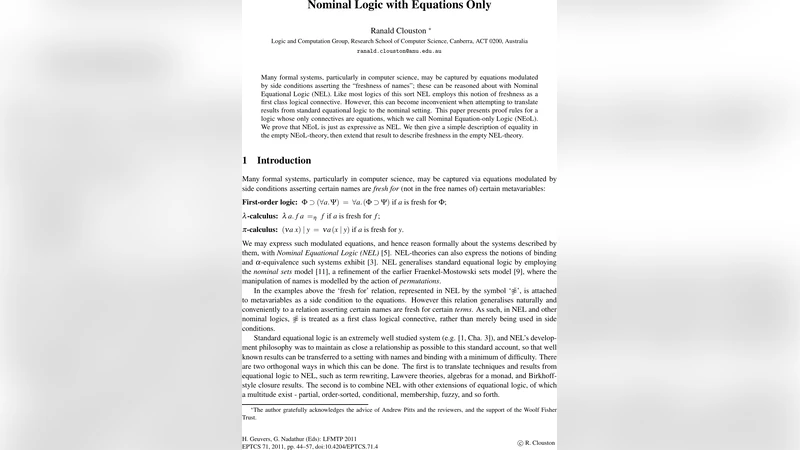
Many formal systems, particularly in computer science, may be captured by equations modulated by side conditions asserting the “freshness of names”; these can be reasoned about with Nominal Equational Logic (NEL). Like most logics of this sort NEL employs this notion of freshness as a first class logical connective. However, this can become inconvenient when attempting to translate results from standard equational logic to the nominal setting. This paper presents proof rules for a logic whose only connectives are equations, which we call Nominal Equation-only Logic (NEoL). We prove that NEoL is just as expressive as NEL. We then give a simple description of equality in the empty NEoL-theory, then extend that result to describe freshness in the empty NEL-theory.
💡 Research Summary
The paper addresses a recurring inconvenience in Nominal Equational Logic (NEL), namely the treatment of freshness (the “#” relation) as a first‑class logical connective. While this design makes it easy to express side‑conditions such as “a is fresh for term t”, it hampers the transfer of results from ordinary equational logic, where only equations appear, and it complicates categorical interpretations. To remedy this, the authors introduce Nominal Equation‑only Logic (NEoL), a system that retains the expressive power of NEL but restricts its judgments to pure equations of the form ∇ ⊢ t ≈ t′ : s, eliminating any explicit freshness connective on the right‑hand side of the turnstile.
The paper begins with a concise review of the nominal sets model. Atoms form a countably infinite set A, and finite permutations (Perm) act on elements, giving rise to the notions of support and freshness: a finite set a ⊆ A supports an element x if any permutation fixing a also fixes x; a set a is fresh for x when a ∩ supp(x) = ∅. This framework underlies both NEL and NEoL.
NEL is then formalized. A signature Σ specifies sorts, operation symbols (which themselves form a nominal set), and typing information. Terms are built from variables, suspended variables (π x), and operation applications. Two environments are introduced: sorting environments Γ and freshness environments ∇, the latter assigning to each variable a finite set of atoms that must be fresh for it. A NEL judgment has the shape ∇ ⊢ a # t ≈ t′ : s. Figure 1 lists ten inference rules, including symmetry, transitivity, weakening, substitution, and the crucial atom‑introduction (AT M‑INTRO) and atom‑elimination (AT M‑ELIM) rules that manipulate the freshness connective directly.
A pivotal technical result, Lemma 3.8, shows how any freshness judgment can be encoded as an ordinary equation using a suitable permutation of fresh atoms. Concretely, ∇ ⊢ a # t : s iff ∇ ⊢ supp(ã) # (ã ã′)·t : s, where ã is an ordered list of the atoms in a and ã′ is a fresh tuple of the same length. This lemma provides the bridge for eliminating the freshness connective.
NEoL is then defined (Definition 4.1). Its judgments are exactly the NEL judgments without the “a #” part. Figure 2 presents the corresponding proof system, which includes the usual equational rules plus a (SUSP) rule for handling suspended variables and a (PERM) rule that allows the application of a permutation to both sides of an equation. The authors note that the original (PERM) rule from earlier work was cumbersome; they replace it with a simpler (SUSP) and later derive (PERM) as Lemma 4.6.
The core theorem of the paper (Section 4) establishes the equivalence of NEoL and NEL: every NEL derivation can be transformed into an NEoL derivation by repeatedly applying Lemma 3.8, and conversely every NEoL derivation can be simulated in NEL using the atom‑introduction and elimination rules. Thus, NEoL is not a weaker fragment but a reformulation that makes freshness a side condition rather than a connective.
Having aligned the two logics, the authors turn to the empty theory (no axioms). In ordinary equational logic, two terms are provably equal in the empty theory exactly when they are syntactically identical. Corollary 5.5 shows that the same holds for NEoL: equality in the empty NEoL theory reduces to syntactic identity. By translating this result back through Lemma 3.8, they obtain a simple description of freshness in the empty NEL theory: a # t holds precisely when the term t is syntactically invariant under swapping a with a fresh atom. This gives a clean, syntax‑directed account of freshness without invoking any additional logical machinery.
The final sections compare NEoL/NEL with related frameworks such as Nominal Algebra, Nominal Lawvere theories, and other nominal equational systems. The authors argue that NEoL’s equation‑only nature makes it especially suitable for reusing standard results from universal algebra and category theory, while NEL remains convenient for direct reasoning about languages with binding.
In conclusion, the paper delivers a rigorous proof that the freshness connective can be treated as syntactic sugar: an equation‑only logic (NEoL) is fully expressive for nominal reasoning. This insight simplifies the transfer of classical equational results to settings with names and binding, and it clarifies the semantic role of freshness in the nominal sets model.
Comments & Academic Discussion
Loading comments...
Leave a Comment