Exact solutions for mass-dependent irreversible aggregations
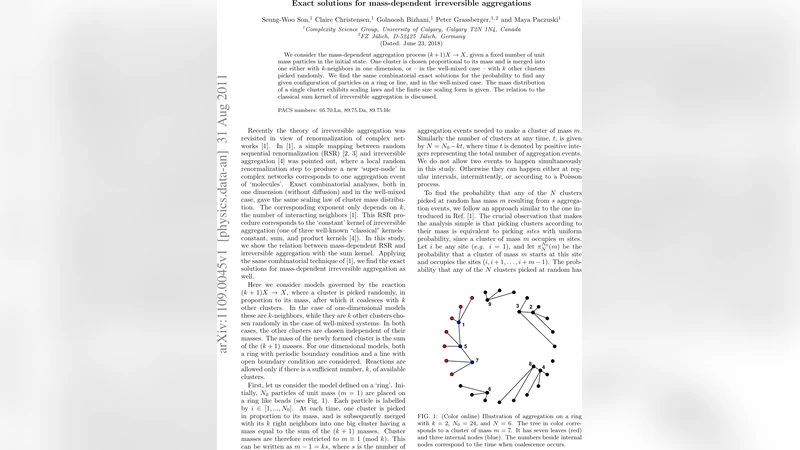
We consider the mass-dependent aggregation process (k+1)X -> X, given a fixed number of unit mass particles in the initial state. One cluster is chosen proportional to its mass and is merged into one either with k-neighbors in one dimension, or – in the well-mixed case – with k other clusters picked randomly. We find the same combinatorial exact solutions for the probability to find any given configuration of particles on a ring or line, and in the well-mixed case. The mass distribution of a single cluster exhibits scaling laws and the finite size scaling form is given. The relation to the classical sum kernel of irreversible aggregation is discussed.
💡 Research Summary
The paper investigates a class of irreversible aggregation processes in which a cluster is selected with probability proportional to its mass and then merged with k other clusters. Three geometries are considered: (i) a one‑dimensional ring with periodic boundary conditions, (ii) an open‑ended line, and (iii) a well‑mixed “bucket” where the k partners are chosen uniformly at random. In all cases the elementary reaction is (k + 1) X → X, i.e. a cluster of mass m joins with k neighbors (or random clusters) to form a new cluster of mass equal to the sum of the k + 1 masses. Because a cluster of mass m occupies exactly m sites, selecting a cluster with mass‑weighted probability is equivalent to picking a lattice site uniformly at random. This observation allows the authors to count the number of possible histories (ordered sequences of aggregation events) combinatorially.
Let N₀ be the initial number of unit‑mass particles, t the number of aggregation events performed, and N = N₀ − k t the remaining number of clusters. A cluster of mass m can only appear if m ≡ 1 (mod k); writing m − 1 = k s, s is the number of aggregation steps that built this cluster. The total number of histories for a given t is N₀^t. The number of histories that produce a specific cluster of mass m is m^{s−1}, reflecting the s − 1 choices of which of the s aggregation events involve that cluster. The remaining N − 1 clusters can be formed in (N − 1)·(N₀ − m)^{t−s−1} ways. Combining these factors yields the exact single‑cluster mass distribution
p_{N₀}^{N}(m) = (N − 1)/N · C(t,s) ·
Comments & Academic Discussion
Loading comments...
Leave a Comment