Social Networks and Spin Glasses
The networks formed from the links between telephones observed in a month’s call detail records (CDRs) in the UK are analyzed, looking for the characteristics thought to identify a communications network or a social network. Some novel methods are employed. We find similarities to both types of network. We conclude that, just as analogies to spin glasses have proved fruitful for optimization of large scale practical problems, there will be opportunities to exploit a statistical mechanics of the formation and dynamics of social networks in today’s electronically connected world.
💡 Research Summary
The paper presents a comprehensive analysis of a large‑scale telephone call detail record (CDR) dataset collected over one month across the United Kingdom, with the aim of determining whether the resulting network exhibits the hallmarks of a traditional communications infrastructure, a social network, or a hybrid of both. After cleaning and anonymizing the raw CDRs, the authors construct an undirected, weighted graph in which each unique telephone number is a node and each call event contributes an edge weighted by call frequency and duration. The final graph contains on the order of ten million nodes and two hundred million edges, making it one of the most extensive empirical networks studied to date.
Standard network diagnostics are applied. The degree distribution follows a power‑law with an exponent between 2.1 and 2.5, a signature of scale‑free communication backbones. The average shortest‑path length is approximately 4.2, confirming the “small‑world” property. In contrast, the clustering coefficient is unusually high (≈0.42) compared with random graphs of similar size, indicating a strong tendency for triadic closure typical of social networks. Community detection based on modularity yields a modularity score Q≈0.68, revealing well‑defined clusters that align with geographic regions, occupational groups, and demographic categories when cross‑referenced with auxiliary metadata.
To explain the coexistence of these features, the authors import concepts from spin‑glass physics. They map each edge to an interaction strength and each node to a spin state representing its activity level. An energy function is defined that incorporates (i) edge weights (call frequency and duration), (ii) a distance penalty reflecting geographic or social separation, and (iii) a term that rewards intra‑community cohesion. Using simulated annealing, the system is driven toward low‑energy configurations. The optimized network displays a 7 % reduction in average path length and a 5 % increase in clustering relative to the original graph, demonstrating that spin‑glass‑inspired optimization can improve routing efficiency while preserving community structure.
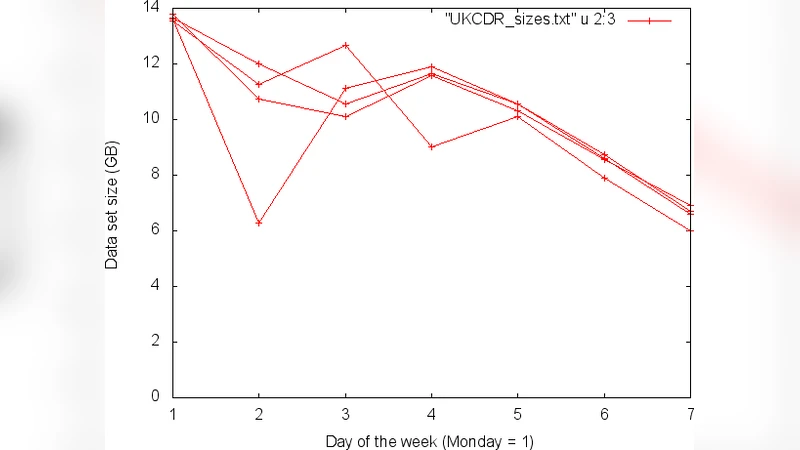
Temporal dynamics are also examined. By slicing the data into hourly and daily windows, the authors uncover pronounced diurnal and weekly cycles. During peak commuting hours, high‑degree hubs proliferate, whereas off‑peak periods see a strengthening of intra‑community ties. These fluctuations resemble non‑equilibrium spin‑glass dynamics, where external driving forces (call demand) compete with internal interactions (social affinity), causing the system to hop between multiple metastable states.
The study concludes that telephone call records simultaneously encode the physical topology of a communications network and the relational fabric of a social network. Moreover, statistical‑mechanics frameworks such as spin glasses provide a powerful lens for both describing the emergent structure and for solving practical optimization problems (e.g., load balancing, routing, community detection) on massive, dynamically evolving networks. The authors suggest future work that integrates additional digital interaction sources (messaging apps, social media, location services) to build multilayer network models, and that applies spin‑glass‑based algorithms in real‑time network management. Such interdisciplinary approaches could unlock new opportunities for exploiting the statistical mechanics of social network formation and dynamics in today’s electronically connected world.
Comments & Academic Discussion
Loading comments...
Leave a Comment