Multicommodity Flows and Cuts in Polymatroidal Networks
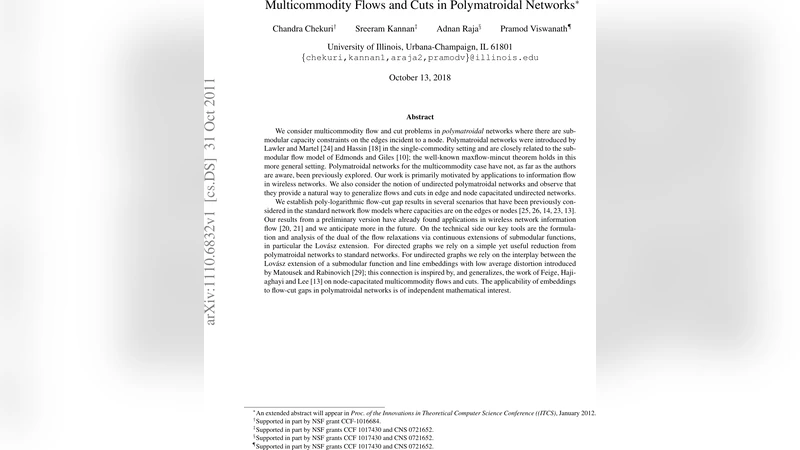
We consider multicommodity flow and cut problems in {\em polymatroidal} networks where there are submodular capacity constraints on the edges incident to a node. Polymatroidal networks were introduced by Lawler and Martel and Hassin in the single-commodity setting and are closely related to the submodular flow model of Edmonds and Giles; the well-known maxflow-mincut theorem holds in this more general setting. Polymatroidal networks for the multicommodity case have not, as far as the authors are aware, been previously explored. Our work is primarily motivated by applications to information flow in wireless networks. We also consider the notion of undirected polymatroidal networks and observe that they provide a natural way to generalize flows and cuts in edge and node capacitated undirected networks. We establish poly-logarithmic flow-cut gap results in several scenarios that have been previously considered in the standard network flow models where capacities are on the edges or nodes. Our results have already found aplications in wireless network information flow and we anticipate more in the future. On the technical side our key tools are the formulation and analysis of the dual of the flow relaxations via continuous extensions of submodular functions, in particular the Lov'asz extension. For directed graphs we rely on a simple yet useful reduction from polymatroidal networks to standard networks. For undirected graphs we rely on the interplay between the Lov'asz extension of a submodular function and line embeddings with low average distortion introduced by Matousek and Rabinovich; this connection is inspired by, and generalizes, the work of Feige, Hajiaghayi and Lee on node-capacitated multicommodity flows and cuts. The applicability of embeddings to polymatroidal networks is of independent mathematical interest.
💡 Research Summary
This paper studies multicommodity flow and cut problems in polymatroidal networks, a generalization of classic network flow models where each node imposes submodular (polymatroid) capacity constraints on the set of incident edges. The authors extend the well‑known single‑commodity max‑flow/min‑cut theorem to the multicommodity setting and investigate flow‑cut gaps for two standard objectives: (i) maximum throughput (sum of commodity rates) and (ii) maximum concurrent flow (largest uniform scaling of given demands).
The model is defined precisely: for a directed graph each vertex v has two monotone submodular functions ρ⁻_v and ρ⁺_v governing the total flow that can traverse any subset of incoming or outgoing edges, respectively. In the undirected case a single function ρ_v applies to all incident edges. These functions are accessed via value oracles. The authors formulate the multicommodity flow problems as linear programs (LPs) using a path‑based representation; the exponential number of variables and constraints arising from the polymatroid constraints is handled via the Lovász extension, which turns each submodular function into a convex function on the unit hypercube. This convexification simplifies the dual of the flow LP, making it amenable to analysis.
For directed polymatroidal networks the paper presents a reduction that transforms the dual of the polymatroidal flow LP into the dual of a standard edge‑capacity flow LP. Intuitively, each node’s submodular constraints are replaced by a set of auxiliary edges whose capacities encode the Lovász‑extended values. Because the reduction preserves the objective value, any known flow‑cut gap bound for standard directed graphs carries over. In particular, for symmetric demand pairs the authors obtain an O(min{log³ k, log² n log log n}) gap between maximum concurrent flow and sparsest cut, matching the best known bounds for ordinary directed networks.
The undirected case requires a different technique. The authors exploit the relationship between the Lovász extension and low‑average‑distortion line embeddings introduced by Matoušek and Rabinovich. By embedding the metric induced by the dual variables into a line with small average distortion, they translate the dual objective into an average cut cost. This approach generalizes the method of Feige, Hajiaghayi, and Lee for node‑capacitated graphs and yields optimal O(log k) gaps for both (a) maximum concurrent flow versus sparsest cut and (b) maximum throughput versus multicut in undirected polymatroidal networks. Consequently, the same O(log k) guarantees hold for bidirected polymatroidal networks, which model many wireless communication scenarios where forward and reverse channels are comparable.
Beyond the gap results, the paper provides new dual‑based proofs of the classic max‑flow/min‑cut theorem for single‑commodity polymatroidal networks, illustrating the power of the Lovász extension in this context. Although algorithmic details are omitted, the LP formulations together with the reductions and embeddings imply polynomial‑time algorithms for computing the approximate cuts promised by the gap theorems.
The technical contributions can be summarized as:
- Introduction of the Lovász extension as a tool to convexify submodular capacity constraints and to rewrite flow LP duals in a clean form.
- A reduction from directed polymatroidal networks to standard edge‑capacity networks, enabling the transfer of existing flow‑cut gap bounds.
- An embedding‑based analysis for undirected polymatroidal networks that yields optimal O(log k) gaps, extending prior work on node‑capacitated graphs.
- New dual‑based proofs of the max‑flow/min‑cut theorem in the polymatroidal setting.
These results have immediate applications to wireless information flow, where interference constraints are naturally submodular, and they open the door to further algorithmic developments such as semidefinite‑programming relaxations and stronger metric‑embedding techniques. The paper thus bridges combinatorial optimization, submodular analysis, and network information theory, providing a unified framework for multicommodity flow problems in highly general network models.
Comments & Academic Discussion
Loading comments...
Leave a Comment