Contaminant remediation decision analysis using information gap theory
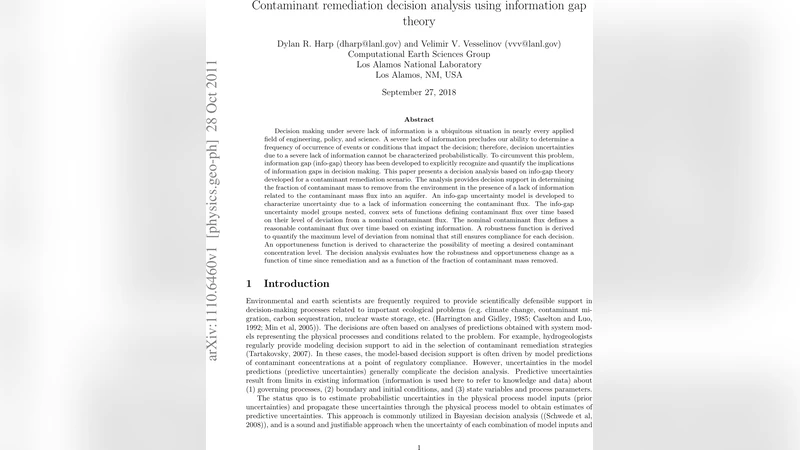
Decision making under severe lack of information is a ubiquitous situation in nearly every applied field of engineering, policy, and science. A severe lack of information precludes our ability to determine a frequency of occurrence of events or conditions that impact the decision; therefore, decision uncertainties due to a severe lack of information cannot be characterized probabilistically. To circumvent this problem, information gap (info-gap) theory has been developed to explicitly recognize and quantify the implications of information gaps in decision making. This paper presents a decision analysis based on info-gap theory developed for a contaminant remediation scenario. The analysis provides decision support in determining the fraction of contaminant mass to remove from the environment in the presence of a lack of information related to the contaminant mass flux into an aquifer. An info-gap uncertainty model is developed to characterize uncertainty due to a lack of information concerning the contaminant flux. The info-gap uncertainty model groups nested, convex sets of functions defining contaminant flux over time based on their level of deviation from a nominal contaminant flux. The nominal contaminant flux defines a reasonable contaminant flux over time based on existing information. A robustness function is derived to quantify the maximum level of deviation from nominal that still ensures compliance for each decision. An opportuneness function is derived to characterize the possibility of meeting a desired contaminant concentration level. The decision analysis evaluates how the robustness and opportuneness change as a function of time since remediation and as a function of the fraction of contaminant mass removed.
💡 Research Summary
The paper presents a decision‑analysis framework for contaminant remediation that explicitly addresses severe lack of information about the contaminant mass flux entering an aquifer. Recognizing that such “Knightian” uncertainties cannot be described probabilistically, the authors adopt information‑gap (info‑gap) theory, which quantifies the size of an information gap rather than assigning probabilities to events.
A physical system model is first defined: a two‑dimensional advective‑dispersive transport equation describes contaminant concentration C(x,t) as the convolution of an unknown source‑flux function I(t) with an impulse‑response kernel h(x,t). The kernel incorporates porosity, dispersion coefficients, decay constant, and groundwater velocity. This formulation is generic and can be applied to any process where an unknown input function drives system response.
The core of the info‑gap approach is the “energy‑bound” uncertainty model for I(t). The model specifies a family of nested convex sets of admissible flux functions: any I(t) whose squared deviation from a nominal flux eI(t) has an L2‑norm no larger than α² times the L2‑norm of the nominal flux is allowed. The scalar α ≥ 0 therefore measures the magnitude of the information gap; larger α permits larger deviations from the nominal flux, encompassing scenarios with a single extreme event, many moderate events, or any combination thereof.
Two performance goals are defined. The required goal is a regulatory concentration limit Cc at a compliance point (e.g., a municipal well), expressed as C(x₀,t) ≤ Cc for all t>0. A desired (but not mandatory) goal is a more stringent concentration Cw (< Cc), representing a stakeholder‑driven target.
From these ingredients the authors derive two immunity functions. The robustness function bα(q) gives the maximal α for which the required goal is guaranteed to be met, given a decision variable q (the fraction of the original contaminant mass removed). Formally, bα(q)=max{α : C(x₀,t; I, q) ≤ Cc ∀t}. The opportuneness function bβ(q) gives the minimal α that makes the desired goal attainable: bβ(q)=min{α : C(x₀,t; I, q) ≤ Cw for some t}. Robustness quantifies immunity to failure; opportuneness quantifies immunity to windfall success.
The analysis explores how bα and bβ vary with time since remediation and with the removal fraction q. Early after remediation, uncertainty about the flux is large, so robustness is low (small bα) while opportuneness is high (large bβ). As time progresses, natural decay (λ) and the diminishing residual flux increase robustness and reduce the required α for opportuneness, reflecting the diminishing influence of the unknown flux. Increasing the removal fraction q reduces the nominal flux, thereby raising robustness dramatically; however, higher q also entails higher remediation costs, worker exposure risk, and potential for contaminant redistribution.
Key insights include: (1) Info‑gap theory provides a rigorous, non‑probabilistic way to treat severe information deficits, avoiding the questionable “principle of indifference” often invoked in Bayesian analyses. (2) The energy‑bound model captures a wide spectrum of possible flux behaviors without requiring detailed statistical knowledge, making it suitable for early‑stage decision making when data are scarce. (3) The dual immunity functions reveal a natural trade‑off between regulatory compliance (robustness) and the possibility of achieving stricter environmental targets (opportuneness). Decision makers can locate an optimal q where robustness is acceptable and opportuneness is not prohibitively high, or they can combine the immunity curves with a cost‑benefit analysis to select a remediation strategy.
The paper also emphasizes that the presented analytical transport model is a first‑tier tool; the same info‑gap framework can be layered onto more sophisticated numerical models (e.g., 3‑D groundwater simulators) in a hierarchical decision‑support process.
In conclusion, by integrating info‑gap uncertainty modeling with a physically based transport equation, the authors deliver a transparent, quantitative method for contaminant‑remediation decisions under profound ignorance. The approach clarifies how much unknown flux can be tolerated while still meeting legal limits, and how much uncertainty must be present to make ambitious concentration goals feasible. Future work is suggested to apply the method to real‑world sites, to incorporate explicit cost and risk metrics, and to extend the framework to multi‑objective environmental management problems.
Comments & Academic Discussion
Loading comments...
Leave a Comment