Compressive Mechanism: Utilizing Sparse Representation in Differential Privacy
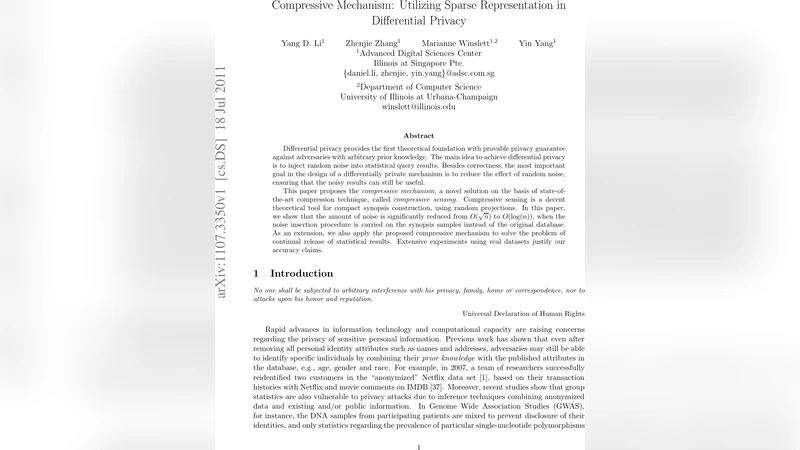
Differential privacy provides the first theoretical foundation with provable privacy guarantee against adversaries with arbitrary prior knowledge. The main idea to achieve differential privacy is to inject random noise into statistical query results. Besides correctness, the most important goal in the design of a differentially private mechanism is to reduce the effect of random noise, ensuring that the noisy results can still be useful. This paper proposes the \emph{compressive mechanism}, a novel solution on the basis of state-of-the-art compression technique, called \emph{compressive sensing}. Compressive sensing is a decent theoretical tool for compact synopsis construction, using random projections. In this paper, we show that the amount of noise is significantly reduced from $O(\sqrt{n})$ to $O(\log(n))$, when the noise insertion procedure is carried on the synopsis samples instead of the original database. As an extension, we also apply the proposed compressive mechanism to solve the problem of continual release of statistical results. Extensive experiments using real datasets justify our accuracy claims.
💡 Research Summary
The paper introduces a novel differentially private mechanism called the “compressive mechanism,” which leverages compressive sensing (CS) to dramatically reduce the amount of noise required for privacy protection. Traditional differential privacy mechanisms, such as the Laplace mechanism, add noise proportional to the sensitivity of each query. When the database is represented as a vector of dimension n, answering a large number of queries typically incurs a total noise magnitude on the order of O(√n). This quickly exhausts the privacy budget and degrades utility.
The authors observe that many real‑world datasets admit a sparse or compressible representation in an appropriate orthonormal basis (e.g., wavelets, Fourier). Under this assumption, they first apply a random linear projection Φ∈ℝ^{k×n} (with k = Θ(S log (n/S))) to the data vector D, producing a compressed synopsis y = ΦD of size k ≪ n. The projection matrix is chosen to satisfy the Restricted Isometry Property (RIP) with high probability, guaranteeing that distances between S‑sparse vectors are approximately preserved.
Noise is then added only to the compressed synopsis: each component of y receives independent Laplace noise with scale λ = Δ/ε, where Δ is the ℓ₁‑sensitivity of the compressed query (which is bounded by O(1) because each row of Φ has entries ±1/√k). Since the synopsis has only k entries, the total noise magnitude becomes O(√k) = O(√(S log n)), which for typical S≪n reduces to O(log n). This is a substantial improvement over the O(√n) noise required when adding Laplace noise directly to the original data.
After noise injection, the noisy synopsis ŷ = y + η is decoded using standard CS reconstruction algorithms (ℓ₁‑minimization or greedy methods such as CoSaMP). Theoretical analysis (Lemma 1 and Corollary 1) shows that the reconstruction error satisfies
‖D − D*‖₂ ≤ C₁·S^{½−1/p} + C₂·λ,
where D* is the reconstructed database, p∈(0,1) characterizes compressibility, and λ is the Laplace scale. Because λ is only logarithmic in n, the overall error remains low. Crucially, once D* is obtained, any number of statistical queries (linear counts, range queries, histograms, etc.) can be answered without adding further noise, effectively achieving “one‑budget‑for‑unlimited‑queries.”
The paper also extends the mechanism to a streaming setting where data arrives over time. At each time step a new compressed sample is generated, and a carefully designed noise‑reallocation scheme ensures that the cumulative privacy loss does not grow linearly with time. This enables continual release of statistics while preserving differential privacy.
Empirical evaluation uses two real datasets: (1) a Genome‑Wide Association Study (GWAS) dataset containing sparse SNP frequency vectors, and (2) a user transaction log from an e‑commerce platform, which is also highly sparse. The compressive mechanism is compared against the standard Laplace mechanism, wavelet‑based synopsis, and tree‑based methods. Metrics include mean squared error, Pearson correlation with ground truth, and query response latency. Results show that the compressive mechanism achieves up to an order of magnitude lower error (often 5–10× improvement) while maintaining comparable runtime (˜O(n) for both compression and reconstruction). The benefit is most pronounced when the data truly exhibits sparsity or compressibility; for dense data the advantage diminishes, as predicted by the theoretical bounds.
Limitations are acknowledged: if the data lacks a sparse representation, reconstruction error can be as large as O(n/√S), making the method unsuitable. Additionally, the generation of the random projection matrix and the CS reconstruction step incur computational overhead, which may be prohibitive for extremely high‑throughput real‑time systems without further optimization or hardware acceleration.
In summary, the paper makes three key contributions: (1) a novel integration of compressive sensing with differential privacy that reduces required noise from O(√n) to O(log n) under sparsity assumptions; (2) a rigorous error analysis linking RIP, compressibility, and Laplace noise; and (3) an extension to continual release scenarios. The work opens a promising research direction where advanced signal processing techniques are harnessed to improve privacy‑utility trade‑offs, suggesting future work on non‑sparse data, adaptive basis selection, and integration with machine‑learning pipelines.
Comments & Academic Discussion
Loading comments...
Leave a Comment