George Augustus Linhart - as a "widely unknown" thermodynamicist
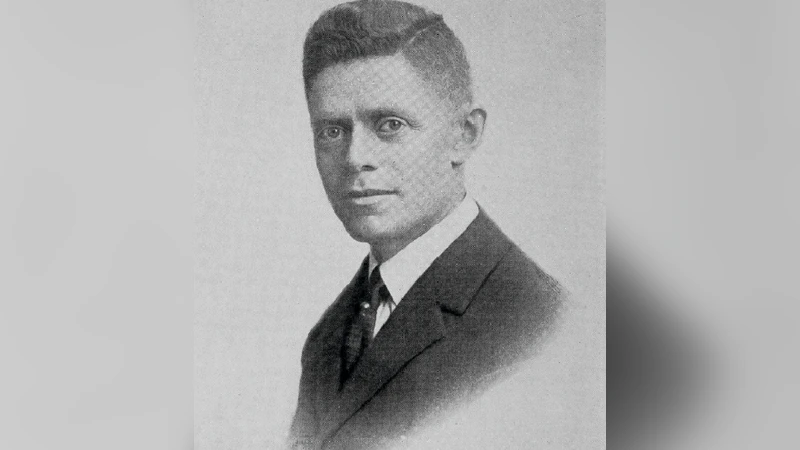
The name of George Augustus Linhart is in fact “widely unknown”. In effect, he was a Viennese-born USA-American physicist-chemist, partially associated with the Gilbert Newton Lewis’ school of thermodynamics at the University of California in Berkeley. As a lone small boy, he had arrived (from Austria via Hamburg) at New York in 1896, but was officially USA-naturalized only in 1912. He was able to pick up English in the streets of New York and Philadelphia, when occasionally working as a waiter and/or as a tailor - just to somehow survive. But, nonetheless, he could successfully graduate a high school in about one year - and then went to the universities for his further education. After obtaining his BS from the University of Pennsylvania, he could manage getting both MA and then PhD from the Yale University, Kent Chemical Laboratory. George Augustus Linhart was afterwards definitely able to successfully work out the true foundations of thermodynamics and could thus outdistance many famous thermodynamicists of his time and even the later ones. Linhart’s view of the Second Law of Thermodynamics was and is extremely fruitful. The interconnection of Linhart’s ideas with those of Gilbert Newton Lewis, as well as with the modern standpoints are discussed here in detail.
💡 Research Summary
The paper revives the largely forgotten physicist‑chemist George Augustus Linhart (1885‑1951), tracing his remarkable personal journey from an Austrian immigrant to a Yale‑trained chemist who spent most of his career teaching at junior colleges in California. Beyond his modest publication record, Linhart proposed a radical reinterpretation of the second law of thermodynamics. He introduced the dialectical pair “progress” (the unidirectional growth of a system) and “hindrance” (the opposing entropy) and suggested that entropy should be expressed as heat divided by time rather than by temperature, coining the term “chronodynamic entropy.” Using Carathéodory’s integrating‑factor theory and the mathematics of Pfaffian forms, Linhart argued that time, like temperature, can serve as an intensive integrating factor for the first‑law differential, leading to dS = (Q/t) dt. He applied this framework to a generic growth process, relating the mass G to a maximal attainable mass Gᵢ, interpreting G/Gᵢ as a probability and deriving an entropy expression analogous to the binary Shannon entropy. The author situates Linhart’s ideas within the broader historical context—contrasting them with Boltzmann, Clausius, and modern non‑equilibrium thermodynamics (Onsager, Prigogine, de Groot‑Mazur)—and highlights the philosophical “Yin‑Yang” view of energy versus entropy. While acknowledging the conceptual elegance, the paper points out practical shortcomings: the lack of an absolute time scale comparable to temperature, the ambiguity of choosing among infinitely many integrating factors, and the scarcity of experimental validation because most of Linhart’s work remains unpublished. Nonetheless, the author argues that Linhart’s “progress‑hindrance” dialectic and his time‑based entropy could inspire contemporary research on time‑dependent entropy, information‑theoretic complexity, and self‑organizing systems, thereby granting overdue recognition to a scientist whose ideas were ahead of his time.
Comments & Academic Discussion
Loading comments...
Leave a Comment