INTEGRAL: science highlights and future prospects
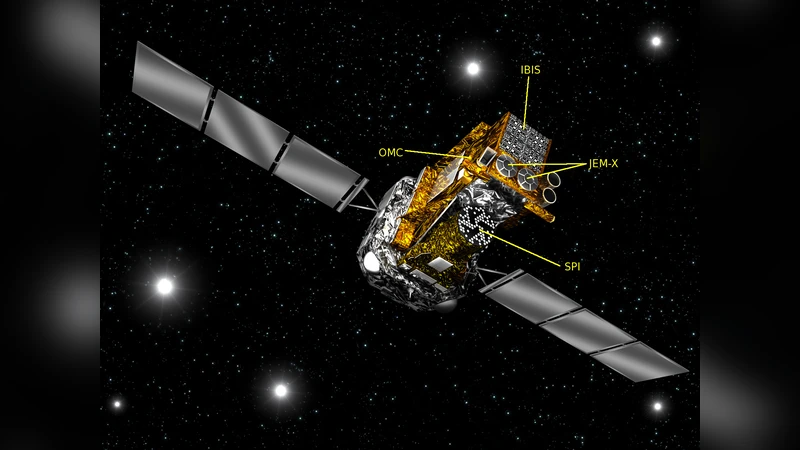
ESA’s hard X-ray and soft gamma-ray observatory INTEGRAL is covering the 3 keV to 10 MeV energy band, with excellent sensitivity during long and uninterrupted observations of a large field of view (~100 square degrees), with ms time resolution and keV energy resolution. It links the energy band of pointed soft X-ray missions such as XMM-Newton with that of high-energy gamma-ray space missions such as Fermi and ground based TeV observatories. Key results obtained so far include the first sky map in the light of the 511 keV annihilation emission, the discovery of a new class of high mass X-ray binaries and detection of polarization in cosmic high energy radiation. For the foreseeable future, INTEGRAL will remain the only observatory allowing the study of nucleosynthesis in our Galaxy, including the long overdue next nearby supernova, through high-resolution gamma-ray line spectroscopy. Science results to date and expected for the coming mission years span a wide range of high-energy astrophysics, including studies of the distribution of positrons in the Galaxy; reflection of gamma-rays off clouds in the interstellar medium near the Galactic Centre; studies of black holes and neutron stars particularly in high- mass systems; gamma-ray polarization measurements for X-ray binaries and gamma-ray bursts, and sensitive detection capabilities for obscured active galaxies with more than 1000 expected to be found until 2014. This paper summarizes scientific highlights obtained since INTEGRAL’s launch in 2002, and outlines prospects for the INTEGRAL mission.
💡 Research Summary
**
The INTEGRAL observatory, launched by ESA in 2002, uniquely bridges the gap between soft X‑ray missions (e.g., XMM‑Newton, Chandra) and high‑energy gamma‑ray facilities (e.g., Fermi, ground‑based TeV arrays). Its payload consists of the high‑resolution spectrometer SPI, the high‑angular‑resolution imager IBIS, and two monitors (JEM‑X for soft X‑rays and OMC for optical). Both SPI and IBIS employ coded‑mask optics, allowing simultaneous imaging and background subtraction over a ∼100 deg² field of view with millisecond timing and keV energy resolution.
Key scientific achievements include the first all‑sky map of the 511 keV positron‑annihilation line, which revealed a bright bulge and a fainter disk component, constraining Galactic positron sources. INTEGRAL discovered a new class of high‑mass X‑ray binaries—Supergiant Fast X‑ray Transients—characterized by short, intense flares driven by clumpy stellar winds. Polarisation measurements with IBIS and SPI have detected linear polarisation at the 10‑30 % level in sources such as the Crab pulsar, Cygnus X‑1, and several gamma‑ray bursts, providing direct insight into magnetic field geometry and particle acceleration mechanisms.
The spectrometer’s fine energy resolution enabled the detection of nuclear‑line emission from ⁶⁶Al, ⁶⁰Fe, and ⁴⁴Ti, mapping ongoing nucleosynthesis across the Milky Way and probing recent supernova activity. Reflected gamma‑ray emission from molecular clouds near the Galactic Centre has been used to trace past outbursts of Sgr A*. In the extragalactic domain, INTEGRAL’s sensitivity to heavily obscured AGN predicts the identification of more than a thousand new sources, complementing surveys at other wavelengths.
Operationally, INTEGRAL follows a highly elliptical orbit (perigee ≈9 000 km, apogee ≈154 000 km) that provides long, uninterrupted observing windows with low background. The mission has accumulated over 1 450 individual observations, many exceeding 1 Ms, and maintains a high oversubscription factor (~3.8), reflecting strong community demand. The spacecraft’s consumables allow extensions beyond the nominal 2014 end‑of‑life; plans exist to continue operations into the mid‑2020s. This longevity is crucial for catching a nearby supernova, which would permit unprecedented high‑resolution gamma‑ray line spectroscopy of freshly synthesized isotopes.
In summary, INTEGRAL remains the sole observatory capable of simultaneous wide‑field imaging, fine spectroscopy, and polarimetry in the 3 keV–10 MeV band. Its legacy includes transformative results on Galactic positrons, nucleosynthesis, high‑mass X‑ray binaries, and gamma‑ray polarisation, while its continued operation promises further breakthroughs, especially in the rare event of a nearby supernova and in deep studies of obscured active galaxies.
Comments & Academic Discussion
Loading comments...
Leave a Comment