On The Lack of Time Dilation Signatures in Gamma-ray Burst Light Curves
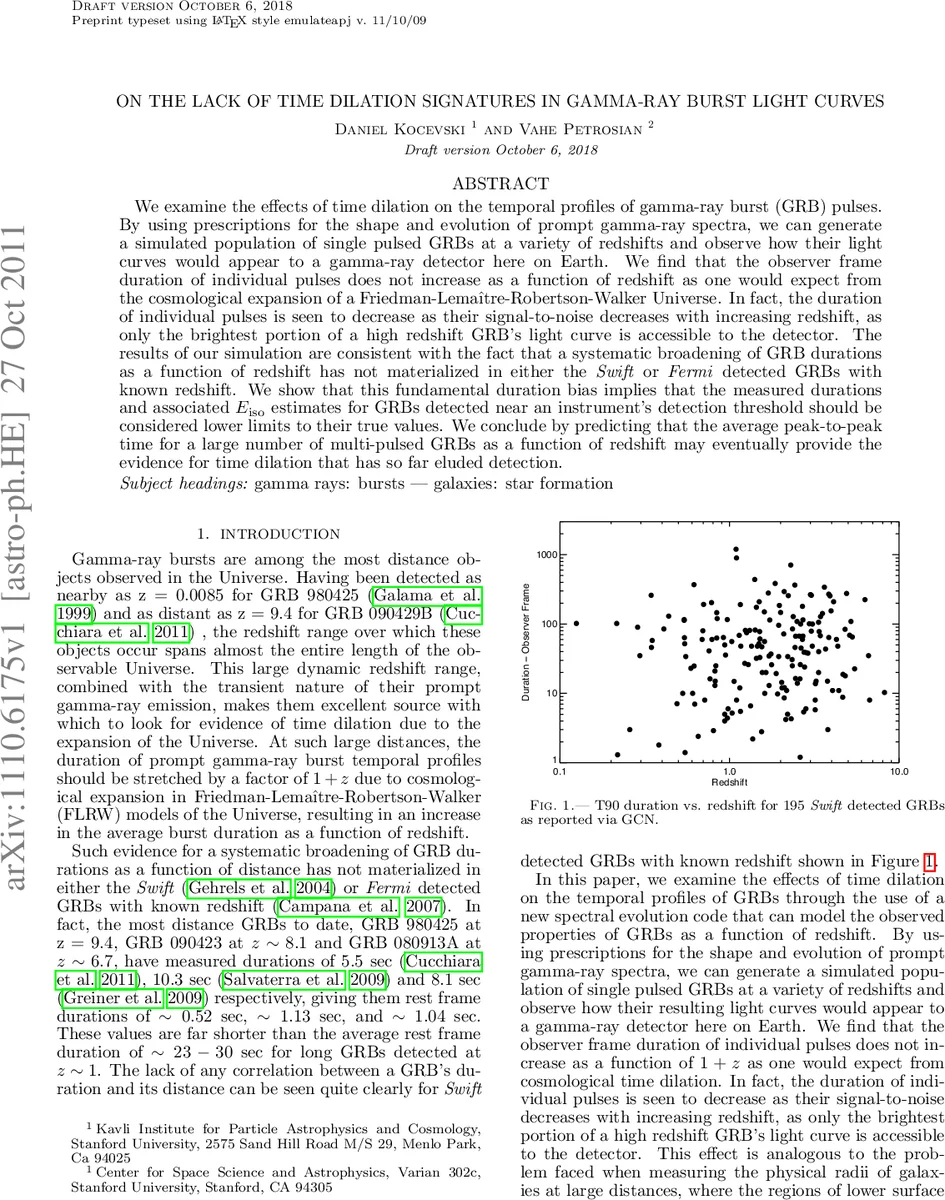
We examine the effects of time dilation on the temporal profiles of gamma-ray burst (GRB) pulses. By using prescriptions for the shape and evolution of prompt gamma-ray spectra, we can generate a simulated population of single pulsed GRBs at a variety of redshifts and observe how their light curves would appear to a gamma-ray detector here on Earth. We find that the observer frame duration of individual pulses does not increase as a function of redshift as one would expect from the cosmological expansion of a Friedman-Lemaitre-Robertson-Walker Universe. In fact, the duration of individual pulses is seen to decrease as their signal-to-noise decreases with increasing redshift, as only the brightest portion of a high redshift GRB’s light curve is accessible to the detector. The results of our simulation are consistent with the fact that a systematic broadening of GRB durations as a function of redshift has not materialized in either the Swift or Fermi detected GRBs with known redshift. We show that this fundamental duration bias implies that the measured durations and associated Eiso estimates for GRBs detected near an instrument’s detection threshold should be considered lower limits to their true values. We conclude by predicting that the average peak-to-peak time for a large number of multi-pulsed GRBs as a function of redshift may eventually provide the evidence for time dilation that has so far eluded detection.
💡 Research Summary
The paper investigates why the expected cosmological time‑dilation signature—an increase of observed gamma‑ray burst (GRB) pulse durations by a factor of (1+z)—is absent in Swift and Fermi data. The authors construct a physically motivated simulation of single‑pulse GRBs that incorporates two empirical correlations observed in real bursts: the hardness‑intensity correlation (HIC) and the hardness‑fluence correlation (HFC). The HIC links instantaneous spectral hardness (Eₚₖ) to the instantaneous energy flux (F_E) via a power‑law, while the HFC describes an exponential decay of Eₚₖ with accumulated photon fluence. By assuming a Band‑function spectrum (α≈1, β≈−2, initial Eₚₖ≈500 keV) and evolving it according to these relations, they reproduce the classic fast‑rise exponential‑decay (FRED) pulse shape.
The simulation pipeline proceeds as follows: (1) generate intrinsic pulse light curves for a range of redshifts (z) and intrinsic luminosities (L); (2) apply the HIC and HFC to produce time‑resolved photon spectra; (3) fold each spectrum through a BATSE detector response matrix (DRM) to obtain count spectra; (4) add realistic, energy‑dependent background drawn from median BATSE backgrounds, introducing Poisson noise; (5) integrate counts over the detector’s effective energy band (≈20–2000 keV) to create observed count light curves; (6) use a Bayesian block algorithm to identify intervals above background and define a T₁₀₀ duration (the interval containing essentially all detectable emission).
The key finding is that, contrary to the naïve expectation of duration stretching, the measured T₁₀₀ duration decreases with increasing redshift for a given intrinsic pulse. Two intertwined effects drive this bias: (i) redshifting of the spectral peak moves Eₚₖ toward lower energies where the detector’s effective area drops sharply, reducing the observed flux; (ii) the luminosity distance dimming combined with background noise lowers the signal‑to‑noise ratio (SNR), causing the faint trailing edges of the pulse to fall below detection thresholds. Consequently, only the brightest core of the pulse remains observable, leading to an apparent shortening of the light curve despite the underlying (1+z) stretching.
The authors quantify this bias by simulating pulses of identical intrinsic duration but varying intrinsic luminosities across a redshift grid. The “expected” (1+z)‑scaled duration is plotted alongside the simulated photon‑flux durations (no detector effects) and the count‑based durations (including detector response and noise). While the photon‑flux curves already show a modest reduction due to spectral redshifting, the count‑based durations exhibit a pronounced turnover: they rise with redshift up to a peak (where SNR is still adequate) and then decline sharply as SNR drops below ≈25. The turnover redshift depends on intrinsic luminosity and on the source‑frame Eₚₖ; brighter bursts or those with higher Eₚₖ survive to higher redshifts before the bias dominates.
Because isotropic‑equivalent energy (E_iso) is calculated by integrating the observed flux over the measured duration (and applying a k‑correction to a standard 10–10 000 keV band), the underestimation of duration propagates directly into an underestimation of E_iso. The simulations show that near the detection threshold, E_iso can be underestimated by 50–90 % or more, even when the k‑correction is performed correctly. This systematic error is particularly severe for high‑z, low‑luminosity bursts, precisely the regime where time‑dilation tests are most needed.
In the discussion, the authors argue that the lack of an observed duration‑redshift correlation in current GRB samples is a natural consequence of this bias rather than evidence against cosmological expansion. They propose that multi‑pulse GRBs offer a more robust avenue: while individual pulses may be truncated, the intervals between successive peaks (peak‑to‑peak times) are less sensitive to SNR loss and retain the underlying temporal stretching. By averaging peak‑to‑peak intervals over a large population of multi‑pulse GRBs, one could recover the (1+z) scaling and finally detect the expected time‑dilation signature.
The paper concludes that (1) observed GRB pulse durations are heavily biased low by detector sensitivity and spectral redshifting; (2) this bias leads to substantial underestimates of both duration and isotropic energy, especially near instrument thresholds; and (3) statistical analysis of peak‑to‑peak separations in multi‑pulse bursts provides a promising path forward for measuring cosmological time dilation with GRBs. Future missions with broader energy coverage and higher sensitivity (e.g., SVOM, THESEUS) will be essential to mitigate these biases and to exploit GRBs as independent probes of the expanding Universe.
Comments & Academic Discussion
Loading comments...
Leave a Comment