Discussion on "Techniques for Massive-Data Machine Learning in Astronomy" by A. Gray
Astronomy is increasingly encountering two fundamental truths: (1) The field is faced with the task of extracting useful information from extremely large, complex, and high dimensional datasets; (2) The techniques of astroinformatics and astrostatistics are the only way to make this tractable, and bring the required level of sophistication to the analysis. Thus, an approach which provides these tools in a way that scales to these datasets is not just desirable, it is vital. The expertise required spans not just astronomy, but also computer science, statistics, and informatics. As a computer scientist and expert in machine learning, Alex’s contribution of expertise and a large number of fast algorithms designed to scale to large datasets, is extremely welcome. We focus in this discussion on the questions raised by the practical application of these algorithms to real astronomical datasets. That is, what is needed to maximally leverage their potential to improve the science return? This is not a trivial task. While computing and statistical expertise are required, so is astronomical expertise. Precedent has shown that, to-date, the collaborations most productive in producing astronomical science results (e.g, the Sloan Digital Sky Survey), have either involved astronomers expert in computer science and/or statistics, or astronomers involved in close, long-term collaborations with experts in those fields. This does not mean that the astronomers are giving the most important input, but simply that their input is crucial in guiding the effort in the most fruitful directions, and coping with the issues raised by real data. Thus, the tools must be useable and understandable by those whose primary expertise is not computing or statistics, even though they may have quite extensive knowledge of those fields.
💡 Research Summary
The paper opens by stating two undeniable trends in modern astronomy: data volumes are exploding to terabyte and petabyte scales, and the scientific questions demand analysis of high‑dimensional, noisy, and often incomplete datasets. Traditional statistical tools are insufficient; instead, the emerging disciplines of astroinformatics and astrostatistics must be brought to bear, requiring expertise that spans astronomy, computer science, and statistics.
Against this backdrop, the authors discuss the contributions of the FASTlab group, led by Alex Gray, which has produced a suite of machine‑learning algorithms whose computational complexity scales as O(N log N) or better. By exploiting space‑partitioning data structures such as k‑d trees, ball trees, and cover trees, classic methods that would otherwise be O(N³) or O(N²) – for example, Support Vector Machines (SVM), Kernel Density Estimation (KDE), Kernel Principal Component Analysis (KPCA), and n‑point correlation functions (nPCF) – are transformed into algorithms that can handle millions of objects on modest hardware. The paper emphasizes that many of these algorithms are already well‑known in the broader ML community; the novelty lies in the engineering that makes them tractable for astronomical data volumes.
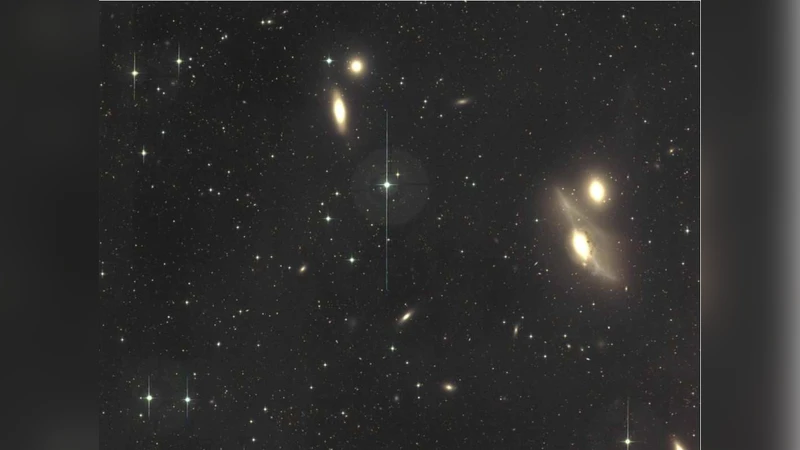
To demonstrate practical impact, the authors describe the Canadian Advanced Network for Astronomical Research (CANFAR) infrastructure, which couples batch‑system job scheduling with cloud‑based virtual machines, providing hundreds of cores for parallel execution. They then focus on a concrete scientific case: the Next Generation Virgo Cluster Survey (NGVS). NGVS will deliver roughly 50 TB of multi‑band imaging over 104 deg², reaching a limiting magnitude of g_AB = 25.7 (10σ) and probing surface‑brightness features down to ≈ 29 mag arcsec⁻². The survey will detect objects spanning a dynamic range from the giant elliptical M87 (M_B ≈ ‑21.6) to ultra‑faint dwarf galaxies (M_B ≈ ‑6).
Table 1 in the manuscript lists nine representative analysis tasks – object classification, cluster membership, photometric redshift estimation, all‑nearest‑neighbor searches, redshift‑PDF construction, and multi‑wavelength cross‑matching – together with their naïve computational complexities and the speed‑ups achieved by FASTlab implementations. For instance, SVM classification drops from O(N³) to O(N), yielding a theoretical speed‑up of several thousand times; KDE‑based photometric‑redshift PDFs improve from O(N²) to O(N); and the all‑NN search improves from O(N²) to O(N). When run on CANFAR’s multi‑core environment, these algorithmic gains translate into processing times that shrink from hours or days to minutes, making analyses that were previously infeasible now routine.
The authors do not ignore the messiness of real astronomical data. They enumerate typical complications: missing observations, heteroscedastic and non‑Gaussian errors, outliers, systematic artifacts, and correlated inputs. They argue that any scalable algorithm must be robust to these issues, and note that the FASTlab software includes options for handling missing values, weighting schemes, and robust loss functions.
In the concluding “Questions” section, the paper raises a series of forward‑looking concerns: whether Bayesian inference might ultimately be more useful than the predictive‑oriented methods presented; how much approximation error is acceptable in kernel‑based speed‑ups; the impact of input‑error propagation on algorithmic reliability; memory constraints when datasets exceed RAM; whether certain stages of astronomical pipelines will always remain super‑linear and thus demand massive parallelism; the curse of dimensionality for intrinsically high‑dimensional data; the potential of GPUs to make brute‑force nearest‑neighbor searches practical; licensing implications for deploying the software on distributed systems; and finally, whether astronomers will need the most sophisticated algorithms or whether simpler, well‑scaled methods will suffice for most science cases.
Overall, the paper makes a compelling case that the combination of algorithmic engineering (to achieve N log N scaling) and high‑performance, flexible computing infrastructure (CANFAR) is essential for extracting scientific value from the next generation of massive astronomical surveys. It also underscores that successful deployment hinges on close, long‑term collaborations between domain astronomers and experts in statistics and computer science, ensuring that the tools remain usable, understandable, and scientifically relevant.
Comments & Academic Discussion
Loading comments...
Leave a Comment