📝 Original Info
- Title: Banach matchboxes problem and a congruence for primes
- ArXiv ID: 1110.5686
- Date: 2011-10-27
- Authors: Researchers from original ArXiv paper
📝 Abstract
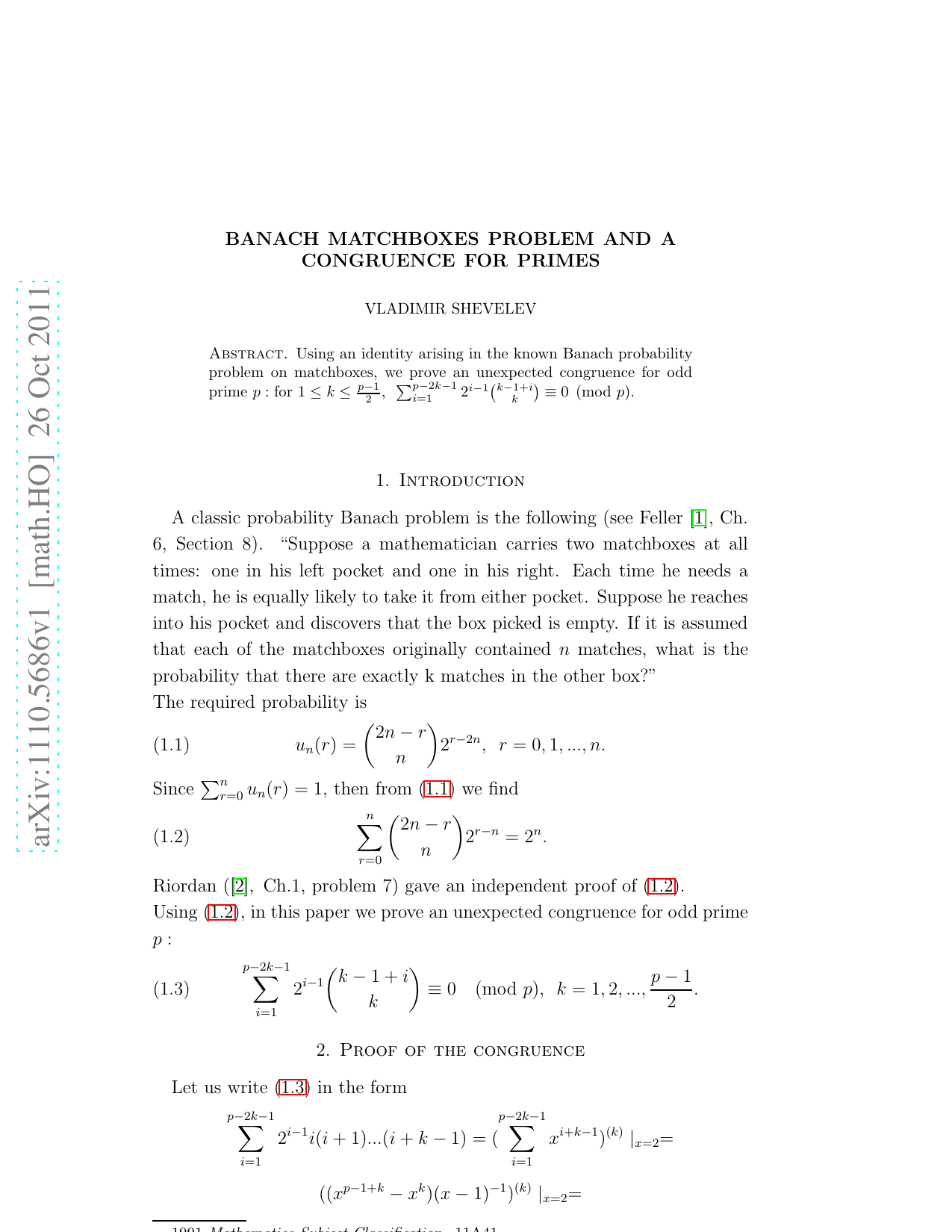
Using an identity arising in the known Banach probability problem on matchboxes, we prove an unexpected congruence for odd prime $p:$ for $1\leq k\leq \frac{p-1}{2},\enskip \sum_{i=1}^{p-2k-1}2^{i-1}\binom{k-1+i}{k}\equiv 0\pmod p.$
💡 Deep Analysis
Deep Dive into Banach matchboxes problem and a congruence for primes.
Using an identity arising in the known Banach probability problem on matchboxes, we prove an unexpected congruence for odd prime $p:$ for $1\leq k\leq \frac{p-1}{2},\enskip \sum_{i=1}^{p-2k-1}2^{i-1}\binom{k-1+i}{k}\equiv 0\pmod p.$
📄 Full Content
A classic probability Banach problem is the following (see Feller [1], Ch. 6, Section 8). "Suppose a mathematician carries two matchboxes at all times: one in his left pocket and one in his right. Each time he needs a match, he is equally likely to take it from either pocket. Suppose he reaches into his pocket and discovers that the box picked is empty. If it is assumed that each of the matchboxes originally contained n matches, what is the probability that there are exactly k matches in the other box?" The required probability is
Since n r=0 u n (r) = 1, then from (1.1) we find
Riordan ([2], Ch.1, problem 7) gave an independent proof of (1.2). Using (1.2), in this paper we prove an unexpected congruence for odd prime p :
(1.3)
Let us write (1.3) in the form
We should prove that
Since 2 p-1 ≡ 1 (mod p), then this congruence is reduced to the identity
or, finally, putting here j = ki, we reduce congruence (1.3) to the Banach identity (1.2)
This completes the proof.
📸 Image Gallery
Reference
This content is AI-processed based on ArXiv data.