Subspace Evasive Sets
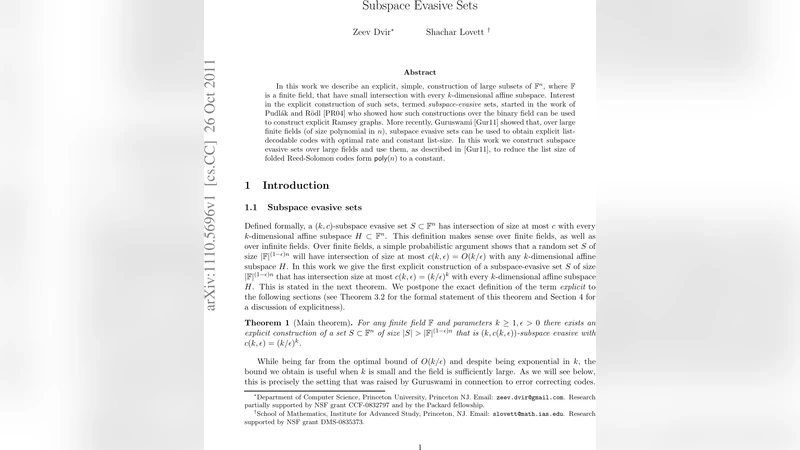
In this work we describe an explicit, simple, construction of large subsets of F^n, where F is a finite field, that have small intersection with every k-dimensional affine subspace. Interest in the explicit construction of such sets, termed subspace-evasive sets, started in the work of Pudlak and Rodl (2004) who showed how such constructions over the binary field can be used to construct explicit Ramsey graphs. More recently, Guruswami (2011) showed that, over large finite fields (of size polynomial in n), subspace evasive sets can be used to obtain explicit list-decodable codes with optimal rate and constant list-size. In this work we construct subspace evasive sets over large fields and use them to reduce the list size of folded Reed-Solomon codes form poly(n) to a constant.
💡 Research Summary
The paper addresses the problem of constructing large subsets of a finite‑field vector space that intersect every low‑dimensional affine subspace in only a few points – the so‑called subspace‑evasive sets. Formally, a set S⊆Fⁿ is (k,c)‑evasive if for every affine subspace H⊂Fⁿ of dimension k we have |S∩H|≤c. Randomly chosen sets of size |F|·(1−ε)ⁿ achieve c=O(k/ε) with high probability, but such constructions are non‑explicit.
The authors present the first explicit construction of a (k,c)‑evasive set over large fields (|F|≥n) with size |S|> |F|(1−ε)ⁿ and c(k,ε) = (k/ε)ᵏ. The construction proceeds in two stages. First, they define an “everywhere‑finite variety” V⊂Fⁿ as the common zero set of k carefully chosen polynomials f₁,…,f_k. Each f_i is a weighted sum of monomials x_j^{d_j} where the exponents d₁>…>d_n are distinct positive integers and the coefficient matrix A∈F^{k×n} is k‑regular (all k×k minors are non‑zero). By a linear change of variables and an application of Bézout’s theorem, they prove that for any k‑dimensional affine subspace H, the intersection V∩H is finite and bounded by ∏_{i=1}^k deg(f_i)=d₁^k.
Next, they partition the n coordinates into blocks of size roughly k/ε. Within each block they instantiate the same variety V, independently of the other blocks. The Cartesian product of the block‑wise solution sets yields the final set S. Since each block contributes at most d₁^{k/ε} points to any intersecting subspace, the overall bound becomes (k/ε)ᵏ. The size of S follows from the fact that each block contains a fraction (1−ε) of the field elements, giving the desired density.
The paper also tackles the “explicitness” requirements needed for algorithmic applications. Encoding a message into S reduces to evaluating the defining polynomials on a chosen vector, which can be done in polynomial time. Computing S∩H for a given affine subspace H reduces to solving a system of low‑degree polynomial equations; the authors show that standard algebraic‑geometry tools (e.g., Gröbner bases) run in time polynomial in n and log|F| because the degrees are bounded and the system has a special triangular structure.
The main motivation is the list‑decoding of folded Reed–Solomon (FRS) codes. Guruswami (2011) showed that the list returned by the FRS decoder is always a low‑dimensional affine subspace (dimension O(1/ε)). By restricting codewords to lie in the constructed (1/ε, c(ε))‑evasive set S, the list size collapses from poly(n) to c(ε) = (1/ε)^{O(1/ε)}, effectively a constant for fixed ε. The authors prove (Theorem 2) that for any rate R and error fraction 1−R−ε, there exists an explicit family of codes with quadratic‑time encoding/decoding and list size (1/ε)^{O(1/ε)}.
The paper briefly discusses related applications to bipartite Ramsey graphs and two‑source/affine extractors, noting that the current construction requires a field of size at least n and therefore does not directly improve those earlier results. The authors suggest extending the technique to smaller fields as a promising direction.
In summary, the work delivers a concrete, efficiently computable construction of large subspace‑evasive sets over sufficiently large finite fields, provides rigorous bounds on their intersection properties via elementary algebraic geometry, and demonstrates a powerful application: reducing the list size of folded Reed–Solomon codes to a constant, thereby advancing the state of explicit list‑decodable codes.
Comments & Academic Discussion
Loading comments...
Leave a Comment