Morphisms determined by objects in triangulated categories
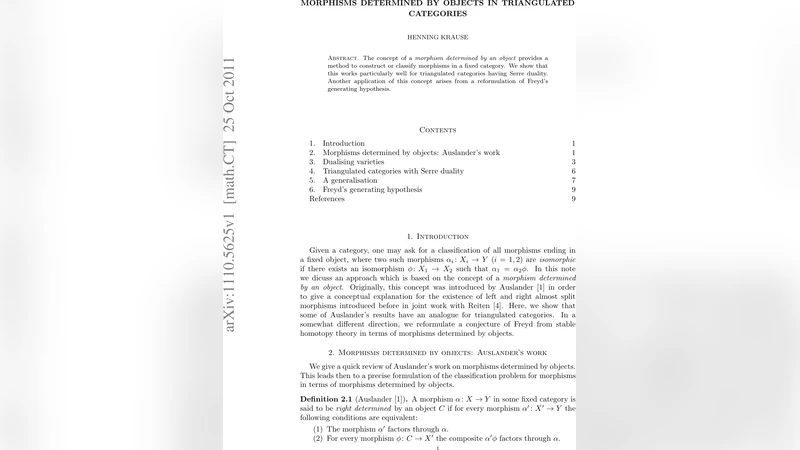
The concept of a morphism determined by an object provides a method to construct or classify morphisms in a fixed category. We show that this works particularly well for triangulated categories having Serre duality. Another application of this concept arises from a reformulation of Freyd’s generating hypothesis.
💡 Research Summary
The paper investigates the notion of a morphism being “determined by an object” and extends this concept from module categories to triangulated categories, especially those equipped with Serre duality. Starting from Auslander’s original definition, a morphism α : X→Y is right‑determined by an object C if any morphism α′ : X′→Y factors through α precisely when every map C→X′ does so after composition with α′. Lemma 2.2 shows that for right‑minimal morphisms the image of Hom(C,–) completely characterises the morphism up to isomorphism. Auslander’s theorems (2.4, 2.5) guarantee, for finitely presented modules over a ring Λ, the existence and uniqueness (up to isomorphism) of a right‑minimal C‑determined morphism realising any prescribed End(C)‑submodule H⊆Hom(C,Y). The proofs rely on the Auslander–Reiten formula D Hom(C,–)≅Ext¹(–,DT C).
The authors then move to the framework of dualising varieties, introduced by Auslander–Reiten. A k‑linear, Hom‑finite, idempotent‑complete, essentially small category C is a dualising k‑variety if the duality D=Hom_k(–,E) sends finitely presented functors to finitely presented functors, i.e. D Hom(–,C) and D Hom(C,–) are finitely presented for every object C. Lemma 3.3 shows this is equivalent to C having weak kernels and cokernels together with the finiteness condition on the duals. Using the Yoneda embedding and the restriction–coinduction adjunction, Lemma 3.6 and Proposition 3.7 prove that any morphism α for which there is an exact sequence Hom(–,X)→Hom(–,Y)→D Hom(C,–) is right‑determined by C. Consequently, Corollary 3.8 states that if C has weak cokernels and D Hom(–,C) is finitely presented, then every morphism in C is right‑determined by some object.
Proposition 3.9 constructs, for any End(C)‑submodule H⊆Hom(C,Y), a right‑minimal C‑determined morphism α with Im Hom(C,α)=H, using an injective envelope of Hom(C,Y)/H and the coinduction functor. Minimal determinators are studied in Proposition 3.13, where it is shown that if a morphism is right‑determined by both C and C′ then add C⊆add C′; thus the “smallest” determinator is unique up to additive closure.
The paper’s central contribution lies in Section 4, where triangulated categories with Serre duality are examined. A right Serre functor S provides natural isomorphisms D Hom(X,–)≅Hom(–,SX). Proposition 4.1 proves the equivalence between (1) existence of a right Serre functor, (2) the ability to realise any submodule H as the image of a right‑C‑determined morphism, and (3) every morphism being left‑determined by some object. Using Auslander–Reiten triangles, the authors show that condition (2) forces the existence of a Serre functor, and conversely a Serre functor yields the dualising variety structure. Theorem 4.2 summarises the three equivalent conditions for a Hom‑finite, essentially small, idempotent‑complete triangulated category: (i) existence of a Serre functor, (ii) being a dualising variety, (iii) having right‑determined morphisms. Moreover, any morphism with cone C is right‑determined by S⁻¹C.
Section 5 generalises the notion further: a morphism is right‑determined by a class 𝔇 of objects if the factorisation condition holds for all C∈𝔇. This broader viewpoint accommodates situations where a single object does not suffice, yet a family does.
Finally, the authors connect these categorical results to Freyd’s generating hypothesis in stable homotopy theory, showing that the hypothesis can be reformulated as a statement about morphisms being determined by a particular object (or class of objects) in the stable homotopy category.
Overall, the paper successfully transports the classical Auslander‑Reiten machinery into the realm of triangulated categories with Serre duality, providing a unified framework for classifying morphisms, constructing almost split triangles, and offering new perspectives on long‑standing conjectures such as Freyd’s generating hypothesis.
Comments & Academic Discussion
Loading comments...
Leave a Comment