Self-oscillation acoustic system destined to measurement of stresses in mass rocks
The paper presents an electronic self-oscillation acoustic system (SAS) destined to measure of stresses variations in the elastic media. The system consists of piezoelectric detector, amplifier-limiter, pass-band filter, piezoelectric exciter and the frequency meter. The mass rock plays a role of delaying element, in which variations in stresses causing the variations of acoustic wave velocity of propagation, and successive variation in frequency of oscillations generated by system. The laboratory test permitted to estimate variations in frequency caused by variations in stresses of elastic medium. The principles of selection of frequency and other parameters of the electronic system in application to stresses measurement in condition of the mine were presented.
💡 Research Summary
The paper introduces a self‑oscillating acoustic system (SAS) designed to monitor stress variations in elastic media such as rocks, concrete, and other civil‑engineering structures. The system consists of a piezoelectric detector (PD), a nonlinear amplifier‑limiter (A‑L), a band‑pass filter (F), a piezoelectric exciter (PE), a delaying element (DE) which is the test specimen itself, and a frequency meter (FM). The basic principle is that the specimen acts as a delay line: stress changes alter the acoustic wave velocity, thereby changing the propagation delay τ. The feedback loop formed by PD‑A‑L‑F‑PE‑DE forces the circuit into an unstable regime that generates sustained self‑oscillations. The oscillation frequency ω is determined by the phase‑balance condition ωτ + arg Y(ω) = 2πn, where Y(ω) is the admittance of the resonant filter. An amplitude‑balance equation U = k F₁(U) |Y(ω)| provides the required gain for stable operation.
A theoretical derivation shows that the sensitivity of the oscillation frequency to stress σ is given by dω/dσ = −ω (dτ/dσ)/τ. Because τ = L/v and the acoustic velocity v depends linearly on stress for the materials examined, the frequency shift can be directly related to the applied load. The filter’s phase slope introduces a time constant T = 2Qω₀, which modifies the effective sensitivity to (1/τ + T)⁻¹. In practice, T is often comparable to τ, so the correction is modest.
The authors performed MATLAB‑Simulink simulations using a linear regression model for concrete: v = a·F + b (a = 5.278 × 10⁻³ m/(N·s), b = 2678.5 m/s). With an amplifier gain K = 25 and a two‑stage band‑pass filter (center frequency ωₘ, quality factor Q), the simulated system reproduced a frequency shift of about 1 Hz per kN of compressive force (S ≈ 1.02 Hz/kN).
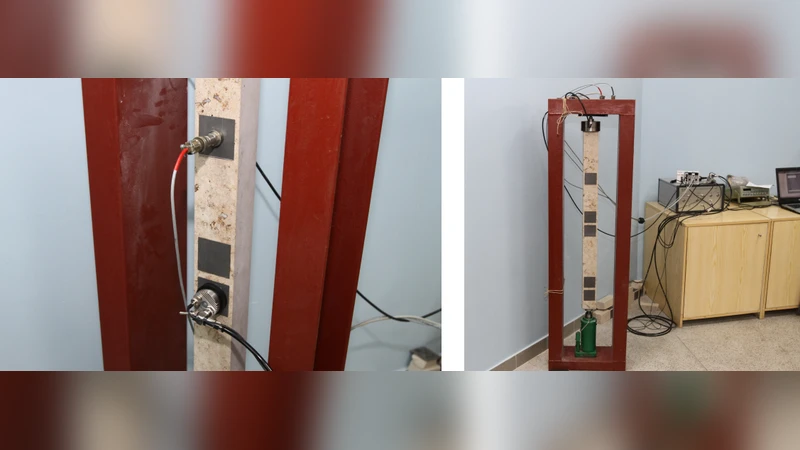
Experimental validation employed sandstone, marble, and concrete specimens of length 0.45 m. The piezoelectric exciter and three accelerometers were mounted on the specimen; one accelerometer was placed opposite the exciter to capture the transmitted wave. Two configurations were tested: an open‑loop (no feedback) and a closed‑loop (feedback enabled). In the open‑loop, increasing the load produced a frequency shift of roughly 90 Hz; in the closed‑loop, the same load change yielded a much larger shift of about 450 Hz and an amplitude increase of 20–30 times, confirming the advantage of self‑excitation for sensitivity and signal‑to‑noise ratio.
Additional experiments examined the influence of sensor/actuator placement relative to modal nodes and antinodes, demonstrating that positioning at antinodes maximizes signal strength. The authors also discuss practical considerations: the delay τ depends on specimen geometry and material heterogeneity (e.g., porosity, cracks), requiring calibration for field applications; high‑Q filter design and temperature compensation are necessary because temperature variations affect the resonant frequency ω₀; and robust, possibly wireless, hardware would be needed for deployment in mines, tunnels, bridges, or dams.
In conclusion, the SAS provides a non‑contact, high‑sensitivity method for real‑time stress monitoring in elastic structures. Its reliance on frequency rather than amplitude makes it less susceptible to environmental noise, and the self‑oscillating feedback amplifies small changes into easily measurable frequency shifts. The paper demonstrates both theoretical foundations and experimental proof‑of‑concept, suggesting that with further calibration and ruggedization the technology could be integrated into structural health‑monitoring systems for a wide range of engineering applications.
Comments & Academic Discussion
Loading comments...
Leave a Comment