Constant-factor approximation of domination number in sparse graphs
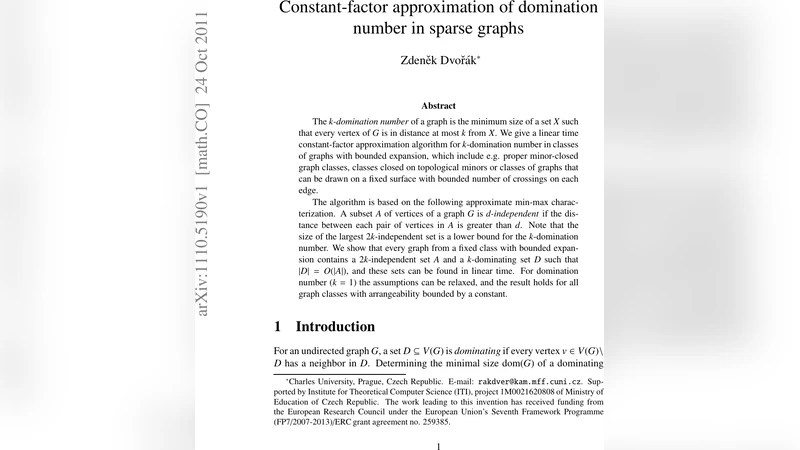
The k-domination number of a graph is the minimum size of a set X such that every vertex of G is in distance at most k from X. We give a linear time constant-factor approximation algorithm for k-domination number in classes of graphs with bounded expansion, which include e.g. proper minor-closed graph classes, classes closed on topological minors or classes of graphs that can be drawn on a fixed surface with bounded number of crossings on each edge. The algorithm is based on the following approximate min-max characterization. A subset A of vertices of a graph G is d-independent if the distance between each pair of vertices in A is greater than d. Note that the size of the largest 2k-independent set is a lower bound for the k-domination number. We show that every graph from a fixed class with bounded expansion contains a 2k-independent set A and a k-dominating set D such that |D|=O(|A|), and these sets can be found in linear time. For domination number (k=1) the assumptions can be relaxed, and the result holds for all graph classes with arrangeability bounded by a constant.
💡 Research Summary
The paper addresses the classic NP‑hard problem of finding a minimum dominating set (domination number) and its generalization, the k‑domination number, in sparse graph families. The authors present a linear‑time algorithm that achieves a constant‑factor approximation for these parameters in any graph class with bounded expansion—a broad category that includes proper minor‑closed families, classes closed under topological minors, and graphs embeddable on a fixed surface with a bounded number of crossings per edge.
The central idea is to relate the domination number to the size of a large independent set defined by distances. A set A is d‑independent if every pair of vertices in A is at distance greater than d; consequently, the maximum size α₂ₖ(G) of a 2k‑independent set is a lower bound for the k‑domination number. The authors prove that in bounded‑expansion graphs one can simultaneously find a 2k‑independent set A and a k‑dominating set D such that |D| = O(|A|). For the special case k = 1 (ordinary domination) the requirement relaxes to bounded arrangeability, covering even more graph families.
To formalize the structural restrictions, the paper uses three ordering‑based parameters: weak m‑coloring number wcolₘ(G), m‑coloring number colₘ(G), and m‑admissibility admₘ(G). These numbers measure, for a given vertex ordering, how many earlier vertices can be reached within distance m under various constraints. The key relationship is admₘ(G) < colₘ(G) ≤ wcolₘ(G). Bounded expansion is characterized by the existence of a function f such that wcolₘ(G) ≤ f(m) for every graph G in the class.
Main Results
- Theorem 2: If wcol₂(G) ≤ c then dom(G) ≤ c²·α₂(G). Moreover, given an ordering achieving wcol₂(G) ≤ c, a dominating set D and a 2‑independent set A with |D| ≤ c²·|A| can be constructed in linear time.
- Theorem 4: For any integers k ≥ 1 and 1 ≤ m ≤ 2k + 1, if wcolₘ(G) ≤ c then domₖ(G) ≤ c²·αₘ(G). An algorithm finds a k‑dominating set D and an m‑independent set A with |D| ≤ c²·|A| in O(c²·max(k,m)·n) time, assuming the appropriate ordering is given.
- Theorem 6: In any bounded‑expansion class, the m‑admissibility admₘ(G) can be computed exactly in linear time, together with an ordering attaining this bound.
- Theorem 7: Combining the above, for any fixed k and any bounded‑expansion class there is a linear‑time algorithm that outputs a k‑dominating set D and a (2k + 1)‑independent set A with |D| = O(|A|).
Algorithmic Framework The algorithm (Algorithm 1) proceeds iteratively over a vertex ordering with bounded weak‑m‑coloring number. It maintains a set R of uncovered vertices. In each iteration it selects the first vertex v in R, adds v to a provisional independent set A′, and adds v together with its Qₘ(v) (the set of earlier vertices within distance m) to the dominating set D. All vertices within distance k of {v} ∪ Qₘ(v) are then removed from R. This guarantees that D is k‑dominating and that |D| ≤ c·|A′|.
To extract a truly m‑independent set, the algorithm builds an auxiliary graph H on A′ where two vertices are adjacent if their distance in G is at most m. Using the bound col₁(H) ≤ c (derived from the ordering’s weak‑m‑coloring number), a proper coloring of H with at most c colors is obtained greedily; the largest color class forms an m‑independent set A. Since |A| ≥ |A′|/c, the final bound |D| ≤ c²·|A| follows.
Complexity Analysis Computing all Qᵢ(v) for i ≤ m takes O(c²·m·n) time because each Qᵢ(v) has size at most c and can be built recursively from Q_{i‑1}. Updating distances during the removal phase uses a per‑vertex counter p(v) that decreases at most k + 1 times, yielding O(c·(k + 1)·n) total work. Constructing H and its coloring costs O(c·n). Hence the overall runtime is O(c²·max(k,m)·n) and the memory usage O(c·n).
Ordering Construction Finding an ordering with small weak‑m‑coloring number is non‑trivial. The paper shows that if admₘ(G) is bounded by a constant, then wcolₘ(G) is also bounded. An ordering minimizing the back‑connectivity measure bₘ(S,v) (the maximum number of internally vertex‑disjoint paths of length ≤ m from v to earlier vertices) can be built by repeatedly removing a vertex with minimal bₘ value (Algorithm 2). While exact computation of bₘ is NP‑complete for m ≥ 5, the authors provide a constant‑factor approximation and, crucially, demonstrate that for bounded‑expansion classes the exact value can be obtained in linear time using a sophisticated first‑order query data structure introduced by Dvořák et al.
Implications The results extend the earlier Böhm‑Mohar bound, which applied only to proper minor‑closed families, to the much larger realm of bounded‑expansion graphs. For k = 1 the requirement reduces to bounded arrangeability, covering all graphs with constant degeneracy, such as planar graphs, graphs of bounded genus, and many real‑world networks. The algorithm provides a practical tool: given a large sparse graph, one can compute in linear time a dominating set whose size is guaranteed to be within a constant factor of optimal, with the constant depending only on the structural parameters of the graph class.
In summary, the paper delivers a unified, linear‑time, constant‑factor approximation framework for domination and k‑domination problems across a wide spectrum of sparse graphs, leveraging modern concepts from graph sparsity theory (bounded expansion, weak coloring numbers) and providing both theoretical guarantees and algorithmic constructions suitable for large‑scale applications.
Comments & Academic Discussion
Loading comments...
Leave a Comment