Tilting theory and functor categories I. Classical tilting
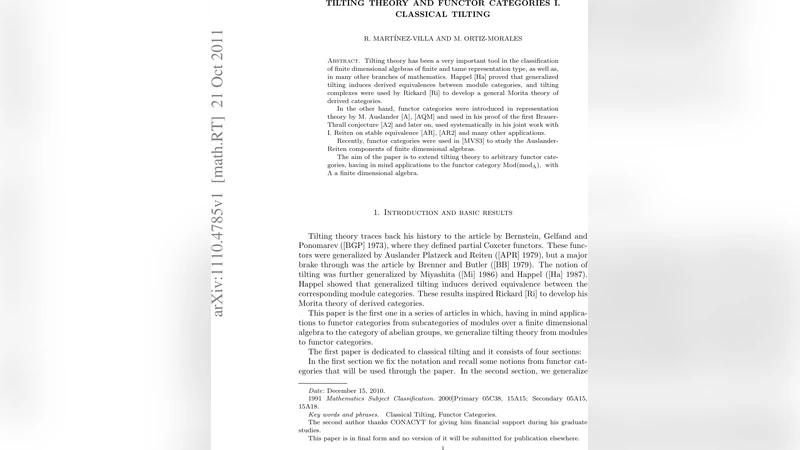
Tilting theory has been a very important tool in the classification of finite dimensional algebras of finite and tame representation type, as well as, in many other branches of mathematics. Happel [Ha] proved that generalized tilting induces derived equivalences between module categories, and tilting complexes were used by Rickard [Ri] to develop a general Morita theory of derived categories. In the other hand, functor categories were introduced in representation theory by M. Auslander and used in his proof of the first Brauer- Thrall conjecture and later on, used systematically in his joint work with I. Reiten on stable equivalence and many other applications. Recently, functor categories were used to study the Auslander- Reiten components of finite dimensional algebras. The aim of the paper is to extend tilting theory to arbitrary functor cate- gories, having in mind applications to the functor category Mod(mod{\Lambda}), with {\Lambda} a finite dimensional algebra.
💡 Research Summary
**
The paper “Tilting theory and functor categories I. Classical tilting” by R. Martínez‑Villa and M. Ortiz‑Morales extends the classical theory of tilting modules from the setting of finite‑dimensional algebras to the much broader context of functor categories. The authors work with a skeletally small pre‑additive category C and consider the abelian category Mod(C) of additive contravariant functors from C to the category of abelian groups. They recall that Mod(C) is an AB5 category with enough projectives (the representable functors C(–,X)) and enough injectives, and that every object admits a projective cover when C has pseudokernels. The subcategory mod(C) of finitely presented functors is abelian precisely under this pseudokernel condition.
A central notion introduced is that of a tilting subcategory T ⊂ Mod(C). The definition mirrors the classical one for tilting modules: each object of T is finitely presented, the projective dimension of T is at most one, Ext¹_C(T_i,T_j)=0 for all i,j, and every representable functor C(–,C) admits a short exact sequence 0→C(–,C)→T₁→T₂→0 with T₁,T₂∈T. Under these hypotheses the authors prove a version of the Brenner‑Butler theorem for functor categories. They define the functor φ: Mod(C)→Mod(T) by φ(M)=Hom_C(T,M) and show that φ has a left adjoint –⊗_T. The adjunction yields derived functors Torⁿ_T and Extⁿ_C that satisfy the familiar relations: for finitely presented M, Ext¹_C(M,–) commutes with arbitrary direct sums, and φ and Ext¹_C(–,–)_T preserve direct sums as well. Consequently, φ induces an equivalence between the derived categories D⁽ᵇ⁾(Mod(C)) and D⁽ᵇ⁾(Mod(T)), establishing a derived‑equivalence “tilting” between the original functor category and its tilted counterpart.
The paper also discusses structural properties of C that guarantee the existence of minimal projective presentations (e.g., when End_C(X)ᵒᵖ is semiperfect for every X∈C). When C is Krull–Schmidt, Hom‑finite, and dualizing (so that the duality D: (C^op,mod R)↔(C,mod R) exists), the authors obtain further results: the Grothendieck groups K₀ of mod(C) and mod(T) are isomorphic, and the global dimensions satisfy gl.dim C ≤ gl.dim T + 1. Moreover, under these conditions the tilting functor φ restricts to an equivalence between the subcategories of finitely presented objects.
Two concrete applications are presented. First, the authors treat infinite quivers without relations (in particular infinite Dynkin quivers). By constructing an appropriate tilting subcategory they compute the Auslander‑Reiten components of the corresponding functor categories, showing that the tilted category captures the preprojective, regular, and preinjective parts in a manner analogous to the finite‑dimensional case. Second, they apply the theory to graded and Koszul functor categories. Using the graded structure, they extend results from earlier work on preprojective algebras to the setting of Koszul functors, again describing the Auslander‑Reiten components of the tilted categories.
In summary, the authors successfully generalize classical tilting theory to arbitrary functor categories, establishing derived equivalences, preserving homological invariants, and providing tools for the analysis of infinite‑dimensional and graded contexts. The paper lays the groundwork for subsequent work on tilting complexes and derived Morita theory in functor categories, promising further connections with representation theory, homological algebra, and non‑commutative geometry.
Comments & Academic Discussion
Loading comments...
Leave a Comment