Category-Based Routing in Social Networks: Membership Dimension and the Small-World Phenomenon (Full)
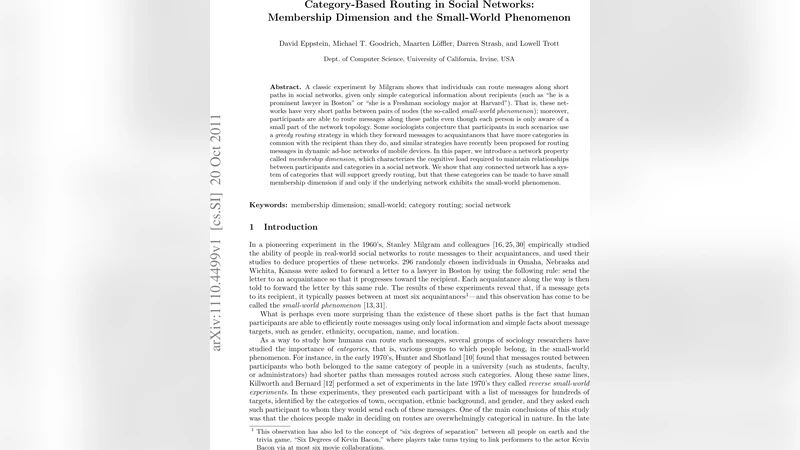
A classic experiment by Milgram shows that individuals can route messages along short paths in social networks, given only simple categorical information about recipients (such as “he is a prominent lawyer in Boston” or “she is a Freshman sociology major at Harvard”). That is, these networks have very short paths between pairs of nodes (the so-called small-world phenomenon); moreover, participants are able to route messages along these paths even though each person is only aware of a small part of the network topology. Some sociologists conjecture that participants in such scenarios use a greedy routing strategy in which they forward messages to acquaintances that have more categories in common with the recipient than they do, and similar strategies have recently been proposed for routing messages in dynamic ad-hoc networks of mobile devices. In this paper, we introduce a network property called membership dimension, which characterizes the cognitive load required to maintain relationships between participants and categories in a social network. We show that any connected network has a system of categories that will support greedy routing, but that these categories can be made to have small membership dimension if and only if the underlying network exhibits the small-world phenomenon.
💡 Research Summary
The paper investigates how messages can be routed efficiently in social networks using only categorical information about the target, a phenomenon first observed in Milgram’s “small‑world” experiments. The authors formalize this intuition by defining a graph G = (U, E) whose vertices are individuals and edges represent acquaintance relationships, together with a family S ⊂ 2^U of subsets that model social categories (e.g., occupation, university, location).
A central contribution is the introduction of membership dimension (memdim), the maximum number of categories any single vertex belongs to. This metric captures the cognitive load required for a person to keep track of his own categories, those of his neighbors, and those of a message’s destination. The routing rule, called ROUTING, is greedy: a vertex u receiving a message destined for w chooses a neighbor v such that the distance d(v,w) < d(u,w), where distance is defined as the number of target categories not shared by the current vertex, i.e., d(s,t)=|cat(t) \ cat(s)|. In other words, the message is forwarded to a neighbor that shares more categories with the target than the current holder does.
The authors identify two structural properties that guarantee success of this greedy scheme for every source–target pair:
- Internal connectivity – for each category C ∈ S, the subgraph induced by C must be connected. This reflects the intuition that a social group should be internally reachable.
- Shattering – for any current vertex u and destination w, there must exist a neighbor v of u that belongs to at least one category of w that u does not. This ensures that a “better” neighbor is always available.
With these conditions, the paper proves three main theorems:
Theorem 1 establishes a lower bound: any category system that enables greedy routing must satisfy memdim ≥ diam(G), where diam(G) is the graph’s diameter. Thus the cognitive load cannot be smaller than the longest shortest‑path distance in the network.
Theorem 2 shows constructive sufficiency: for any connected graph G, one can build a category family S such that greedy routing always succeeds and memdim(S) = O((diam(G)+log |U|)²). The construction uses a hierarchical decomposition of G into a tree, assigns logarithmic‑size “levels” to vertices, and creates categories that correspond to sub‑paths at each level. The resulting membership dimension grows only quadratically in the sum of the graph’s diameter and the logarithm of its size.
Theorem 3 proves impossibility of a universal category system: there is no single family S that works for all graphs. Hence the design of categories must be tailored to the underlying topology.
The authors then connect these results to the small‑world hypothesis. Empirical studies suggest that many real social networks have diameters that grow polylogarithmically with the number of participants (often O(log n)). Under this assumption, Theorem 2 implies memdim = O((log n)²). Consequently, the amount of categorical information each person needs to store grows only polylogarithmically, which is plausible for human cognition.
The paper situates its contribution relative to prior work. Geometric greedy routing relies on physical or virtual coordinates; the present model replaces coordinates with categorical memberships, offering a more socially realistic abstraction. Kleinberg’s seminal model builds networks from spatial coordinates, whereas this work starts from an arbitrary network and asks what category structures can support greedy routing. The notion of membership dimension parallels the “succinctness” of virtual coordinates in networking, where low‑bit embeddings reduce routing table size.
Practical implications are discussed. In organizational design or online platforms, ensuring that groups are internally connected and “shattered” can facilitate efficient information diffusion without requiring global knowledge. In mobile ad‑hoc networks, devices can exploit user‑interest categories as routing hints, achieving low memory overhead while preserving delivery guarantees.
In summary, the paper provides a rigorous algorithmic framework linking three concepts: (1) the graph‑theoretic diameter, (2) the cognitive metric of membership dimension, and (3) the feasibility of greedy, category‑based routing. It demonstrates that small‑world networks naturally admit low‑membership‑dimension category systems, thereby offering a plausible explanation for the empirical success of human message forwarding observed in Milgram’s experiments and suggesting concrete design principles for engineered networks.
Comments & Academic Discussion
Loading comments...
Leave a Comment