Basketball scoring in NBA games: an example of complexity
Scoring in a basketball game is a process highly dynamic and non-linear type. The level of NBA teams improve each season. They incorporate to their rosters the best players in the world. These and other mechanisms, make the scoring in the NBA basketball games be something exciting, where, on rare occasions, we really know what will be the result at the end of the game. We analyzed all the games of the 2005-06, 2006-07, 2007-08, 2008-09, 2009-10 NBA regular seasons (6150 games). We have studied the evolution of the scoring and the time intervals between points. These do not behave uniformly, but present more predictable areas. In turn, we have analyzed the scoring in the games regarding the differences in points. Exists different areas of behavior related with the scorea and each zone has a different nature. There are point that we can consider as tipping points. The presence of these critical points suggests that there are phase transitions where the dynamic scoring of the games varies significantly.
💡 Research Summary
The authors set out to investigate whether the scoring dynamics of NBA games exhibit signatures of complex‑system behavior. Using the official play‑by‑play logs for every regular‑season game from the 2005‑06 through 2009‑10 seasons (a total of 6 150 games), they extracted two primary variables: (1) the elapsed time between successive scoring events (any made field goal or the first free‑throw attempt) and (2) the final point differential between the two teams.
In the methods section the authors describe constructing histograms of the inter‑score intervals (in seconds) and of the final point differences, then visualising these distributions on semi‑log (log‑frequency vs. linear time) and log‑log (log‑frequency vs. log‑time) axes. They argue that an exponential decay on a semi‑log plot would be consistent with a Poisson (memoryless) process, whereas a straight line on a log‑log plot would indicate a power‑law (scale‑free) behavior. No formal fitting procedures, goodness‑of‑fit tests, or parameter estimation are reported; the analysis relies on visual inspection of the plotted curves.
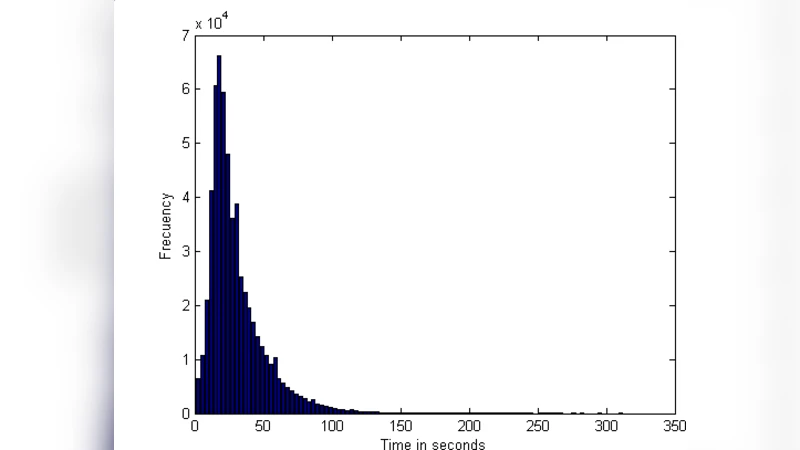
The results show that the inter‑score interval histogram has a pronounced peak around 20 seconds, a rapid drop for shorter intervals, and a long right‑hand tail extending to about 310 seconds. On the semi‑log plot, intervals longer than roughly 24 seconds fall on a straight line, suggesting an exponential regime, while the tail beyond 100 seconds appears to deviate from pure exponential decay. The log‑log plot of the tail hints at a possible power‑law region, but the authors do not quantify the scaling exponent or assess the statistical plausibility of a power‑law versus alternative heavy‑tailed distributions.
For the point‑difference distribution, the histogram is roughly uniform for differences up to 10 points, then declines more steeply. Approximately 65 % of games end with a margin of 1–11 points, 33 % with a margin of 11–28 points, and only 2 % with a margin of 28 points or more. The log‑log plot reveals two apparent “break points” at around 10 points and 28 points, where the slope changes. The authors interpret these as critical thresholds that separate distinct dynamical regimes: (i) a competitive regime (<10 points) where the outcome is unpredictable, (ii) an intermediate regime (10–28 points) where one team gains a decisive advantage, and (iii) a “blown‑out” regime (>28 points) where the result is essentially predetermined. They liken the point differential to an order parameter and the thresholds to percolation‑type phase transitions, invoking concepts from self‑organized criticality (SOC) and the Red‑Queen hypothesis.
In the discussion the authors connect the 20‑second peak to the NBA’s 24‑second shot clock, suggesting that fast‑break opportunities dominate short intervals. They propose that the long tail may reflect periods of low offensive activity (e.g., defensive stands, fouls, time‑outs). Regarding the point‑difference thresholds, they argue that the observed scaling behavior supports the existence of multiple power‑law regimes, each associated with a different “state” of the game. They cite a range of complex‑systems literature (e.g., Bar‑Yam, Vicsek, Scheffer) to frame basketball as an evolving, non‑equilibrium system that can undergo abrupt transitions.
The conclusion reiterates that scoring intervals are non‑uniform and that point differentials display distinct regimes, which the authors interpret as evidence of criticality and phase transitions in NBA games. They suggest future work should explore learning and memory effects at the team level and apply extreme‑value statistics to better characterize the tail behavior.
Overall, the paper offers an intriguing hypothesis that NBA scoring dynamics can be described using concepts from statistical physics and complex‑systems theory. However, the empirical analysis is limited to descriptive plots; it lacks rigorous statistical testing (e.g., likelihood‑ratio tests for power‑law versus exponential, confidence intervals for scaling exponents, or model comparison). The identification of “critical points” is based on visual breaks in log‑log plots rather than on quantitative criteria such as change‑point detection algorithms. Moreover, the treatment of free‑throw timing, possession changes, and other contextual factors is simplistic, potentially conflating distinct processes. To substantiate the claim that NBA games exhibit true SOC or phase‑transition behavior, future studies should (1) perform formal distribution fitting with goodness‑of‑fit assessments, (2) control for confounding game‑state variables, (3) estimate critical exponents and test scaling relations, and (4) compare findings across leagues or seasons to assess robustness. With such methodological enhancements, the proposed link between basketball scoring and complex‑system phenomena could become a compelling contribution to sports analytics.
Comments & Academic Discussion
Loading comments...
Leave a Comment