A Turan-type problem for circular arc graphs
A circular arc graph is the intersection graph of a collection of connected arcs on the circle. We solve a Tur’an-type problem for circular arc graphs: for n arcs, if m and M are the minimum and maximum number of arcs that contain a common point, what is the maximum number of edges the circular arc graph can contain? We establish a sharp bound and produce a maximal construction. For a fixed m, this can be used to show that if the circular arc graph has enough edges, there must be a point that is covered by at least M arcs. In the case m=0, we recover results for interval graphs established by Abbott and Katchalski (1979). We suggest applications to voting situations with interval or circular political spectra.
💡 Research Summary
This paper addresses a Turán‑type extremal problem for circular arc graphs, which are the intersection graphs of a collection of connected arcs placed on a circle. The classical Turán theorem tells us that a sufficiently dense graph must contain a complete subgraph K_r, but that result does not directly apply to special graph classes such as interval graphs or their circular counterparts, because the Helly property (the equivalence between a clique and a common intersection point) may fail. The authors therefore formulate and solve the following question: given n arcs, let m be the minimum number of arcs covering any point of the circle and let M be the maximum number of arcs covering a point. What is the largest possible number of edges e that the intersection graph can have under these constraints? Moreover, how large must e be to guarantee that some point of the circle is covered by at least M arcs?
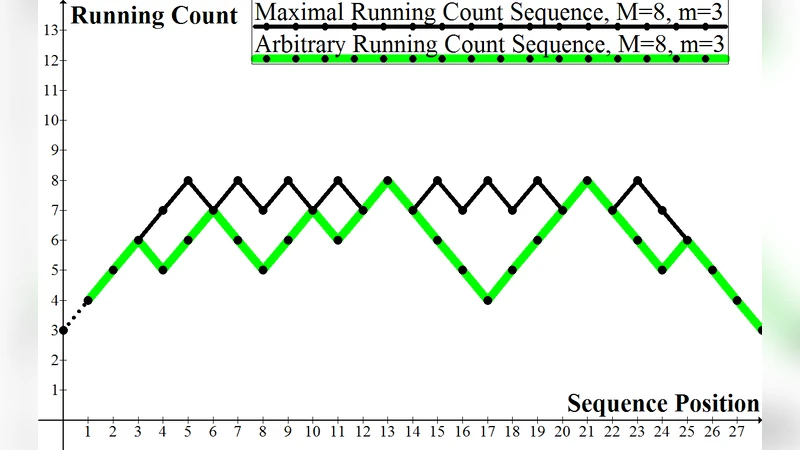
The paper introduces two combinatorial tools that capture the geometry of the arcs without referring to the graph itself. First, the LR‑sequence records the left (L) and right (R) endpoints of the arcs as one traverses the circle clockwise. Second, the running count r_i is defined as the number of arcs covering the region immediately to the right of each endpoint in the LR‑sequence. The sequence of running counts completely determines the edge count, the number of double intersections (pairs of arcs that contain each other’s endpoints), and the total number of arcs. The central algebraic relation, called the Edge Formula (Theorem 7), is
d + e = C − (\binom{n}{2}),
where d is the number of double intersections, e is the number of edges, and C is the sum of all running counts. This formula is proved by induction on n, showing that moving an endpoint around the circle changes C and (d + e) by the same amount.
Having a clean expression for e in terms of C, the authors then seek the maximal possible C for given parameters (M, m, n). Proposition 8 (and Theorem 10) identifies a unique maximal running‑count sequence:
Comments & Academic Discussion
Loading comments...
Leave a Comment