A Modular Toolkit for Distributed Interactions
We discuss the design, architecture, and implementation of a toolkit which supports some theories for distributed interactions. The main design principles of our architecture are flexibility and modularity. Our main goal is to provide an easily extensible workbench to encompass current algorithms and incorporate future developments of the theories. With the help of some examples, we illustrate the main features of our toolkit.
💡 Research Summary
The paper presents a modular toolkit designed to bring theoretical advances in session‑type based distributed interaction into a practical workbench. Recognising that modern distributed applications are built from loosely coupled components whose communication must be safe and verifiable, the authors focus on session types—both dyadic and multiparty—as a solid mathematical foundation, extending them with global assertions that act as contracts.
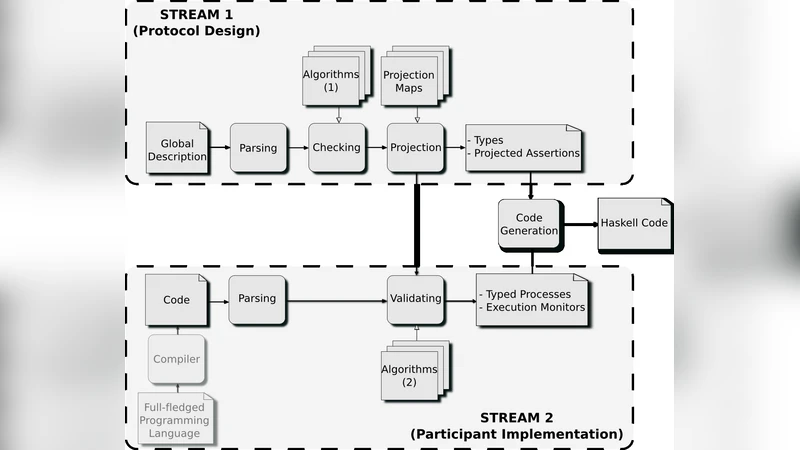
The toolkit’s architecture is deliberately split into two parallel processing streams. STREAM 1 consumes a global description of a protocol (written in a dedicated syntax), parses it into an abstract syntax tree, and then runs a series of verification algorithms: one‑time unfolding of recursive types, a linearity check to prevent channel races, and a well‑assertedness check that guarantees temporal satisfiability and history sensitivity of the embedded logical assertions. If any check fails, the user receives immediate feedback and the pipeline aborts. When the global description passes, the system applies projection algorithms (based on the works of Honda, Yoshida, Carbone, and others) to generate a local type for each participant.
STREAM 2 processes the code of each participant, which is written in a π‑calculus‑like language. This code is parsed, type‑inferred, and, if assertions are present, validated for logical consistency. The inferred local types are then compared against the projections produced by STREAM 1. Mismatches are reported with precise diagnostics, allowing developers to correct their implementations.
When both streams succeed, the toolkit proceeds to code generation. A prototype translator converts the well‑typed π‑calculus code into safe Haskell code, leveraging Haskell’s strong static type system to enforce the session‑type guarantees at compile time. The authors also mention the possibility of generating execution monitors from global assertions, although this feature is not yet integrated.
Implementation is entirely in Haskell, chosen for its expressive pattern matching, first‑class functions, and modular module system. Each component of the architecture—parsers, verification algorithms, projection engine, type checker, and code generator—is encapsulated in its own module, facilitating reuse and future extension. The design is deliberately parametric with respect to the logic used in assertions, meaning that alternative decidable logics could be swapped in without rewriting the core algorithms.
The paper positions its contribution against prior session‑type tools that typically embed session types into a specific programming language (e.g., implementations for Java, Scala, or OCaml). In contrast, this toolkit does not aim to be a full‑fledged language integration but rather a research‑oriented platform that lets scholars experiment with new session‑type variants, assertion logics, and projection strategies. By providing a clear pipeline from global protocol specification to verified local code and finally to executable Haskell, the toolkit bridges the gap between theory and practice.
Limitations are acknowledged: the current code generator only targets Haskell, the π‑calculus‑like front‑end is a prototype, and runtime monitoring is not yet functional. Future work includes extending language support, improving the usability of the front‑end, integrating with real‑world programming environments, and conducting performance evaluations on larger case studies. Overall, the toolkit offers a flexible, extensible foundation for researchers and developers interested in building correct, contract‑driven distributed systems based on session‑type theory.
Comments & Academic Discussion
Loading comments...
Leave a Comment