Enumerating perfect forms
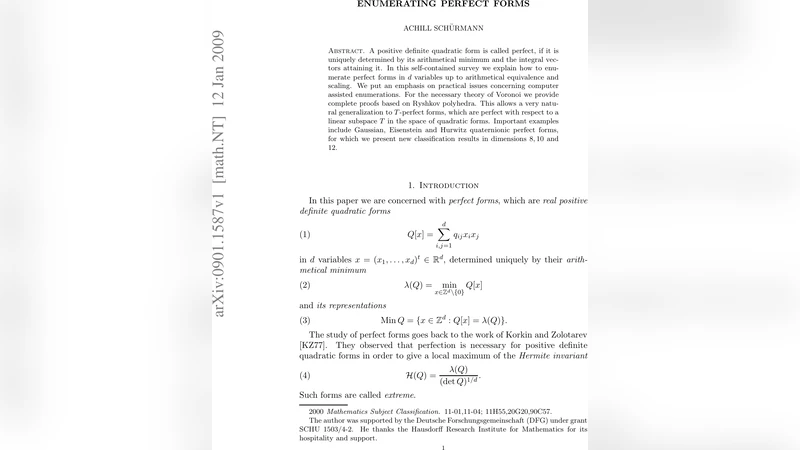
A positive definite quadratic form is called perfect, if it is uniquely determined by its arithmetical minimum and the integral vectors attaining it. In this self-contained survey we explain how to enumerate perfect forms in $d$ variables up to arithmetical equivalence and scaling. We put an emphasis on practical issues concerning computer assisted enumerations. For the necessary theory of Voronoi we provide complete proofs based on Ryshkov polyhedra. This allows a very natural generalization to $T$-perfect forms, which are perfect with respect to a linear subspace $T$ in the space of quadratic forms. Important examples include Gaussian, Eisenstein and Hurwitz quaternionic perfect forms, for which we present new classification results in dimensions $8,10$ and 12.
💡 Research Summary
The paper provides a self‑contained survey and a practical algorithmic framework for enumerating perfect positive‑definite quadratic forms in any dimension d, up to arithmetic equivalence and scaling. A perfect form is defined as a quadratic form uniquely determined by its arithmetical minimum m(Q) and the set Min(Q) of integral vectors attaining that minimum. The authors revisit this classical notion through the lens of Voronoi’s reduction theory, but instead of relying on the traditional Voronoi polyhedron they base their exposition on Ryshkov polyhedra – the convex region defined by the inequalities Q
Comments & Academic Discussion
Loading comments...
Leave a Comment