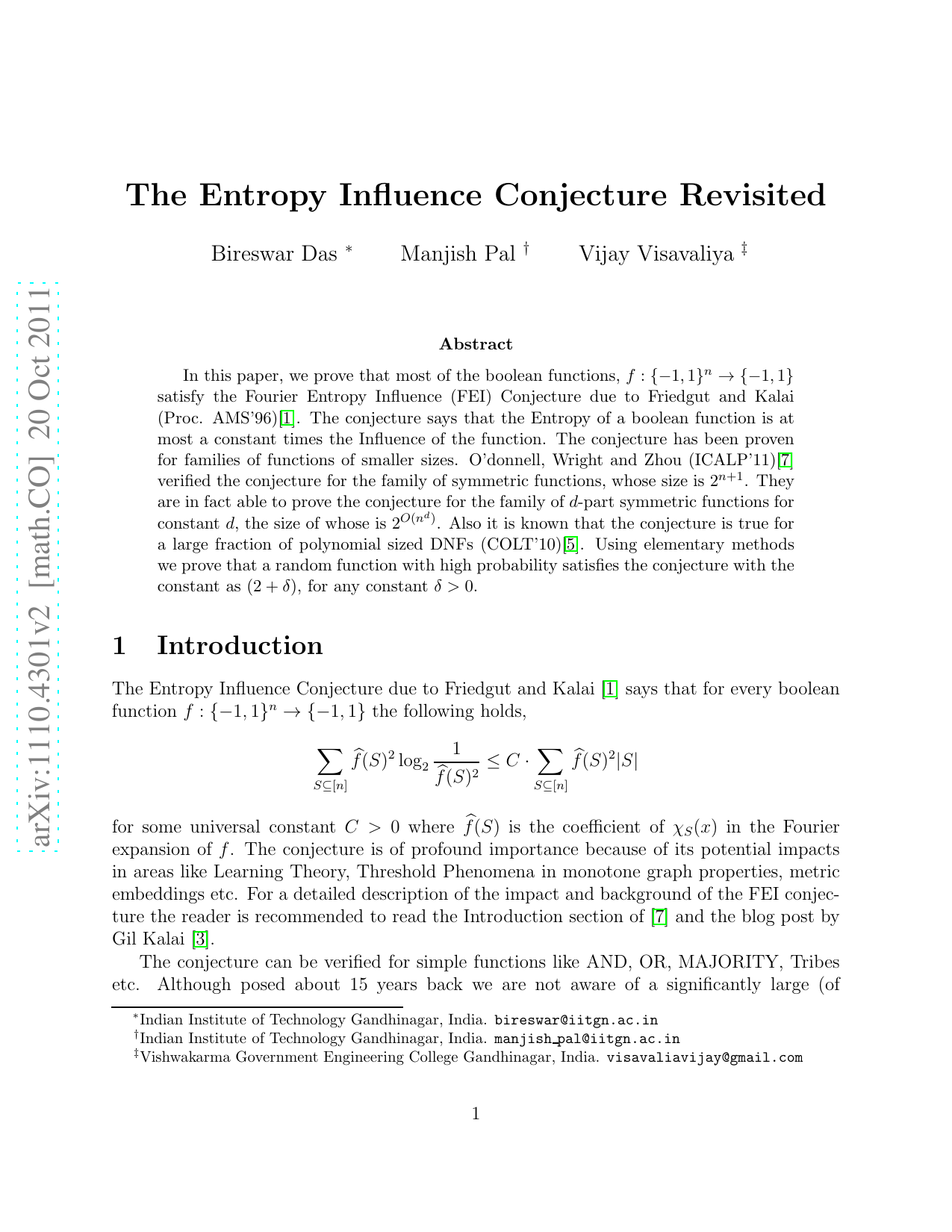
In this paper, we prove that most of the boolean functions, $f : \{-1,1\}^n \rightarrow \{-1,1\}$ satisfy the Fourier Entropy Influence (FEI) Conjecture due to Friedgut and Kalai (Proc. AMS'96). The conjecture says that the Entropy of a boolean function is at most a constant times the Influence of the function. The conjecture has been proven for families of functions of smaller sizes. O'donnell, Wright and Zhou (ICALP'11) verified the conjecture for the family of symmetric functions, whose size is $2^{n+1}$. They are in fact able to prove the conjecture for the family of $d$-part symmetric functions for constant $d$, the size of whose is $2^{O(n^d)}$. Also it is known that the conjecture is true for a large fraction of polynomial sized DNFs (COLT'10). Using elementary methods we prove that a random function with high probability satisfies the conjecture with the constant as $(2 + \delta)$, for any constant $\delta > 0$.
Deep Dive into The Entropy Influence Conjecture Revisited.
In this paper, we prove that most of the boolean functions, $f : \{-1,1\}^n \rightarrow \{-1,1\}$ satisfy the Fourier Entropy Influence (FEI) Conjecture due to Friedgut and Kalai (Proc. AMS'96). The conjecture says that the Entropy of a boolean function is at most a constant times the Influence of the function. The conjecture has been proven for families of functions of smaller sizes. O’donnell, Wright and Zhou (ICALP'11) verified the conjecture for the family of symmetric functions, whose size is $2^{n+1}$. They are in fact able to prove the conjecture for the family of $d$-part symmetric functions for constant $d$, the size of whose is $2^{O(n^d)}$. Also it is known that the conjecture is true for a large fraction of polynomial sized DNFs (COLT'10). Using elementary methods we prove that a random function with high probability satisfies the conjecture with the constant as $(2 + \delta)$, for any constant $\delta > 0$.
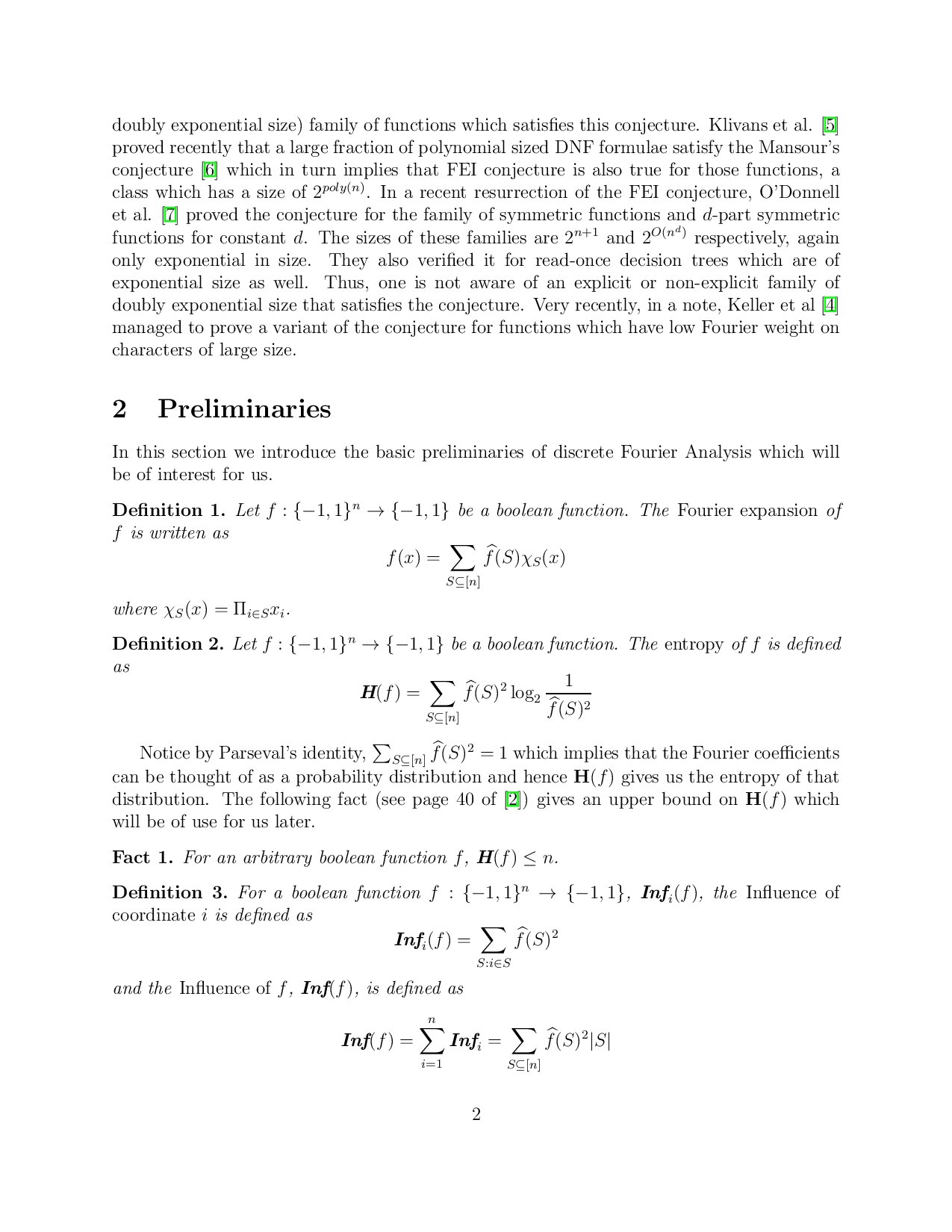
The Entropy Influence Conjecture due to Friedgut and Kalai [1] says that for every boolean function f : {-1, 1} n → {-1, 1} the following holds,
for some universal constant C > 0 where f (S) is the coefficient of χ S (x) in the Fourier expansion of f . The conjecture is of profound importance because of its potential impacts in areas like Learning Theory, Threshold Phenomena in monotone graph properties, metric embeddings etc. For a detailed description of the impact and background of the FEI conjecture the reader is recommended to read the Introduction section of [7] and the blog post by Gil Kalai [3]. The conjecture can be verified for simple functions like AND, OR, MAJORITY, Tribes etc. Although posed about 15 years back we are not aware of a significantly large (of doubly exponential size) family of functions which satisfies this conjecture. Klivans et al. [5] proved recently that a large fraction of polynomial sized DNF formulae satisfy the Mansour’s conjecture [6] which in turn implies that FEI conjecture is also true for those functions, a class which has a size of 2 poly(n) . In a recent resurrection of the FEI conjecture, O’Donnell et al. [7] proved the conjecture for the family of symmetric functions and d-part symmetric functions for constant d. The sizes of these families are 2 n+1 and 2 O(n d ) respectively, again only exponential in size. They also verified it for read-once decision trees which are of exponential size as well. Thus, one is not aware of an explicit or non-explicit family of doubly exponential size that satisfies the conjecture. Very recently, in a note, Keller et al [4] managed to prove a variant of the conjecture for functions which have low Fourier weight on characters of large size.
In this section we introduce the basic preliminaries of discrete Fourier Analysis which will be of interest for us.
where χ S (x) = Π i∈S x i .
Definition 2. Let f : {-1, 1} n → {-1, 1} be a boolean function. The entropy of f is defined as
Notice by Parseval’s identity, S⊆[n] f (S) 2 = 1 which implies that the Fourier coefficients can be thought of as a probability distribution and hence H(f ) gives us the entropy of that distribution. The following fact (see page 40 of [2]) gives an upper bound on H(f ) which will be of use for us later.
and the Influence of f , Inf(f ), is defined as
An equivalent combinatorial interpretation of the influence of the ith coordinate is given by Inf
] where x (i) is x with the ith coordinate flipped.
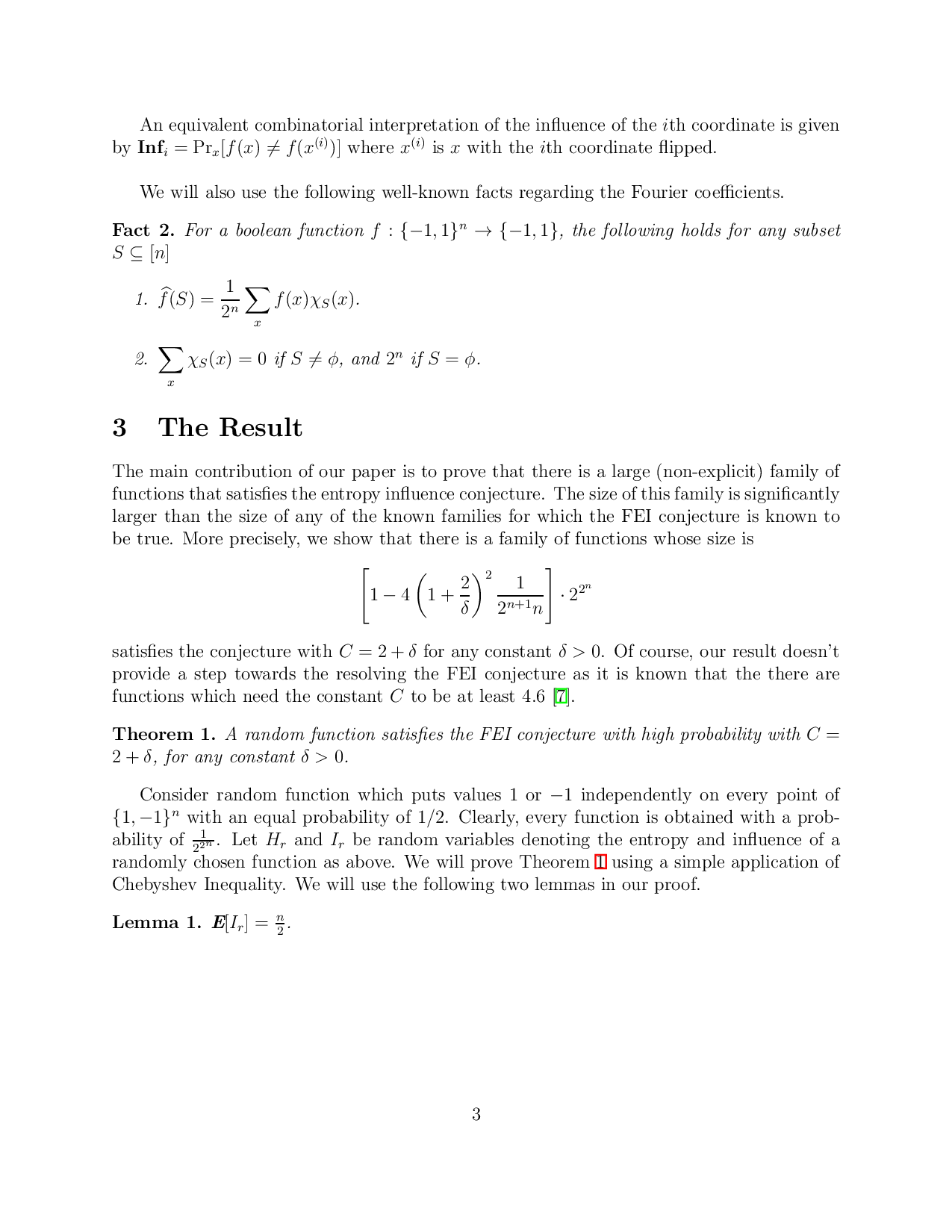
We will also use the following well-known facts regarding the Fourier coefficients.
Fact 2. For a boolean function f : {-1, 1} n → {-1, 1}, the following holds for any subset
x χ S (x) = 0 if S = φ, and
The main contribution of our paper is to prove that there is a large (non-explicit) family of functions that satisfies the entropy influence conjecture. The size of this family is significantly larger than the size of any of the known families for which the FEI conjecture is known to be true. More precisely, we show that there is a family of functions whose size is
satisfies the conjecture with C = 2 + δ for any constant δ > 0. Of course, our result doesn’t provide a step towards the resolving the FEI conjecture as it is known that the there are functions which need the constant C to be at least 4.6 [7].
Theorem 1. A random function satisfies the FEI conjecture with high probability with C = 2 + δ, for any constant δ > 0.
Consider random function which puts values 1 or -1 independently on every point of {1, -1} n with an equal probability of 1/2. Clearly, every function is obtained with a probability of 1 2 2 n . Let H r and I r be random variables denoting the entropy and influence of a randomly chosen function as above. We will prove Theorem 1 using a simple application of Chebyshev Inequality. We will use the following two lemmas in our proof.
Proof.
2 n |S| + 0 (this follows because for
. Proof. We have already calculated E[I r ]. To calculate,
To calculate the above sum, consider the following sets,
x,y
x,y
Thus, using the fact that x χ S 1 ∆S 2 (x) = 0 if S 1 = S 2 and 2 n otherwise, we have
Therefore,
Hence,
We are now ready to prove Theorem 1.
Proof. (Theorem 1) We will prove this using simple applications of Chebyshev inequality. As mentioned earlier we pick a random function which puts values -1 or 1 independently on every point of {-1, 1} n with an equal probability of 1/2. Recall that, H r and I r are random variables denoting the entropy and influence of a randomly chosen function. Let us define the event E F EI indicating that the randomly chosen boolean function satisfies the FEI conjecture with the constant C = 2 + 2ǫ for ǫ > 0. More precisely, E F EI is the event that H r ≤ (2 + 2ǫ)I r . Our aim is to prove that E F EI occurs with high probability. From Fact 1, we have H r ≤ n. Therefore, Pr[H r > n] = 0.
Consider the following events:
From Lemma 2, this in turn implies
2 n n with constant C = 2 + 2ǫ for arbitrary const
…(Full text truncated)…
This content is AI-processed based on ArXiv data.