Contending Parties: A Logistic Choice Analysis of Inter- and Intra-group Blog Citation Dynamics in the 2004 US Presidential Election
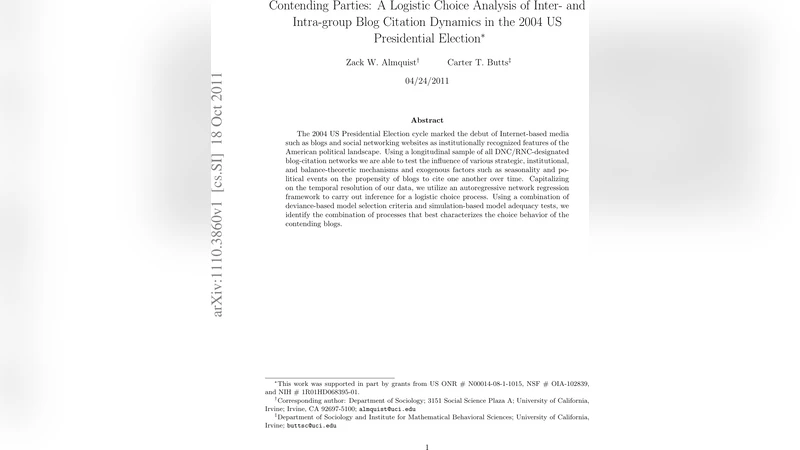
The 2004 US Presidential Election cycle marked the debut of Internet-based media such as blogs and social networking websites as institutionally recognized features of the American political landscape. Using a longitudinal sample of all DNC/RNC-designated blog-citation networks we are able to test the influence of various strategic, institutional, and balance-theoretic mechanisms and exogenous factors such as seasonality and political events on the propensity of blogs to cite one another over time. Capitalizing on the temporal resolution of our data, we utilize an autoregressive network regression framework to carry out inference for a logistic choice process. Using a combination of deviance-based model selection criteria and simulation-based model adequacy tests, we identify the combination of processes that best characterizes the choice behavior of the contending blogs.
💡 Research Summary
This paper investigates the dynamic citation behavior of politically credentialed blogs during the 2004 United States presidential election. The authors focus on the set of blogs officially designated by the Democratic National Committee (DNC) and the Republican National Committee (RNC) as accredited media for the party conventions. The sample consists of 34 DNC blogs, 14 RNC blogs, and one blog that received credentials from both parties, yielding a total of 47 nodes. Using an automated crawler, the authors collected the full‑page hyperlink structure of each blog at six‑hour intervals from July 22, 2004 (just before the DNC convention) through November 19, 2004 (shortly after the election), producing 484 network snapshots. An edge from blog i to blog j at time t (Aij,t = 1) indicates that a link to j appears on the front page of i at that moment; self‑citations are excluded.
The central methodological contribution is the formulation of blog citation dynamics as a discrete‑time logistic choice process, an adaptation of Snijders’ actor‑oriented framework for longitudinal network data. For each possible directed dyad (i, j) the probability of a citation at time t is modeled as
logit Pr(Aij,t = 1) = θᵀ s(A, i, j, t, X),
where s(·) is a vector of linearly separable payoff elements and θ is a vector of parameters to be estimated. The payoff elements encode three theoretically motivated families of effects:
-
Mixing (homophily) effects – a binary indicator for whether i and j belong to the same party‑credentialed group, capturing the tendency of blogs to cite within their own ideological camp.
-
Balance‑theoretic effects – terms that represent triadic configurations such as “friend of a friend” (i→k and k→j increase the likelihood of i→j) and “enemy of an enemy” (negative ties between parties). The authors treat the DNC–RNC relationship as antagonistic, allowing them to test whether a citation to an opposite‑party blog reduces the probability of subsequent opposite‑party citations.
-
Seasonality and event effects – dummy variables for major campaign milestones (DNC convention, RNC convention, televised debates, election day) and sinusoidal functions to capture daily and weekly cycles.
The model also includes an autoregressive component: the previous state of the dyad (Aij,t‑1) enters the payoff vector, allowing the process to exhibit inertia or decay over time. Estimation is performed via maximum likelihood using a generalized linear mixed‑effects framework, with robust standard errors to account for dependence across dyads and time points. Model selection proceeds through deviance‑based information criteria (AIC, BIC) and a suite of simulation‑based goodness‑of‑fit diagnostics that compare observed network statistics (density, clustering coefficient, triad census) to those generated from the fitted model.
Results indicate that homophily is the strongest driver: citations within the same party are significantly more likely (θ ≈ +1.2, p < 0.001). Balance effects are also significant: citations across parties are suppressed (θ ≈ ‑0.8, p < 0.01), yet triadic “enemy‑of‑enemy‑is‑friend” configurations increase cross‑party citation probability, confirming the relevance of Heiderian balance theory in an online political context. Seasonality and event variables matter: citation activity dips during weekends and late‑night hours, while spikes occur immediately after conventions, debates, and especially in the 12‑hour window surrounding Election Day, where the network density rises by roughly 35 % above baseline.
Simulation diagnostics show that the final model reproduces the observed network’s density, clustering, and triad distribution within 95 % confidence intervals, outperforming alternative specifications by substantial AIC margins (ΔAIC > 150). The authors conclude that blog citation behavior during the 2004 election was not random nor solely driven by content relevance; rather, it reflected strategic, institutionally anchored decision‑making shaped by partisan identity, adversarial relations, and the temporal rhythm of the campaign.
The paper contributes to the literature in three ways. First, it demonstrates that longitudinal network data with high temporal resolution can be fruitfully analyzed using a logistic choice framework, bridging stochastic choice theory and dynamic network modeling. Second, it provides empirical support for classic sociological theories—homophily and structural balance—in the digital political arena, suggesting that even in fast‑moving online environments, enduring social mechanisms persist. Third, it offers a methodological template for studying other high‑frequency relational data (e.g., financial transaction networks, collaborative software development) where actors make discrete linking decisions based on past interactions and exogenous shocks.
In sum, the study reveals that the early “watershed” period of political blogging was characterized by strong intra‑party cohesion, deliberate inter‑party avoidance, and pronounced responsiveness to campaign events, all of which can be captured within a parsimonious logistic choice model. Future work could extend the approach to later election cycles, incorporate textual sentiment analysis of the cited posts, or explore multi‑layer networks that combine citation ties with other interaction modalities such as retweets or comments.
Comments & Academic Discussion
Loading comments...
Leave a Comment