The asymptotic directions of pleating rays in the Maskit embedding
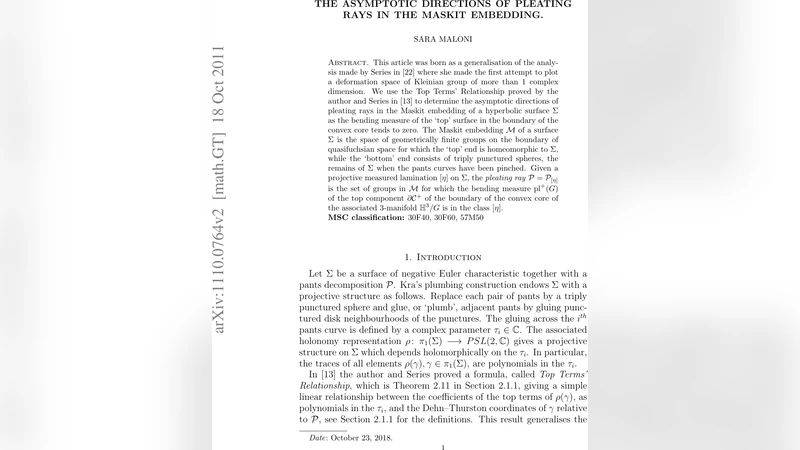
This article was born as a generalisation of the analysis made by Series, where she made the first attempt to plot a deformation space of Kleinian group of more than 1 complex dimension. We use the Top Terms’ Relationship proved by the author and Series to determine the asymptotic directions of pleating rays in the Maskit embedding of a hyperbolic surface S as the bending measure of the top' surface in the boundary of the convex core tends to zero. The Maskit embedding M of a surface S is the space of geometrically finite groups on the boundary of quasifuchsian space for which the top’ end is homeomorphic to S, while the `bottom’ end consists of triply punctured spheres, the remains of S when the pants curves have been pinched. Given a projective measured lamination l on S, the pleating ray P is the set of groups in M for which the bending measure of the top component of the boundary of the convex core of the associated 3-manifold is in the projective class of l.
💡 Research Summary
The paper “The Asymptotic Directions of Pleating Rays in the Maskit Embedding” by Sara Maloni extends the analysis of pleating rays from the low‑dimensional settings studied by Series to the full‑dimensional Maskit embedding of an arbitrary hyperbolic surface Σ of finite type. The central object is the Maskit embedding M(Σ), a complex‑analytic parametrisation of geometrically finite Kleinian groups whose “top” end is homeomorphic to Σ and whose “bottom” end consists of triply‑punctured spheres obtained by pinching a maximal pants decomposition {σ₁,…,σ_ξ} (where ξ = 3g − 3 + b).
The technical backbone is the “Top Terms Relationship” (Theorem 2.11 in the paper), proved jointly by the author and Series in an earlier work. This relationship links the leading coefficients of the trace polynomials of the holonomy representation ρ_τ(γ) (obtained from Kra’s plumbing construction) to the Dehn–Thurston coordinates (q_i, p_i) of a curve γ relative to the chosen pants curves. In other words, the highest‑order term of Tr ρ_τ(γ) is a linear combination of the q_i’s and p_i’s, providing an explicit bridge between the complex plumbing parameters τ = (τ₁,…,τ_ξ) and the combinatorial data of curves on Σ.
A pleating ray P_η is defined for a projective measured lamination
Comments & Academic Discussion
Loading comments...
Leave a Comment