A bialgebra axiom and the Dold-Kan correspondence
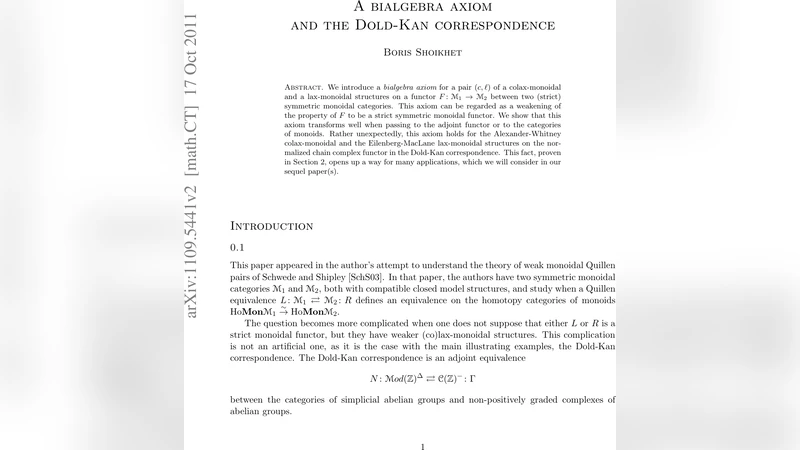
We introduce a bialgebra axiom for a pair $(c,\ell)$ of a colax-monoidal and a lax-monoidal structures on a functor $F\colon \mathscr{M}_1\to \mathscr{M}_2$ between two (strict) symmetric monoidal categories. This axiom can be regarded as a weakening of the property of $F$ to be a strict symmetric monoidal functor. We show that this axiom transforms well when passing to the adjoint functor or to the categories of monoids. Rather unexpectedly, this axiom holds for the Alexander-Whitney colax-monoidal and the Eilenberg-MacLane lax-monoidal structures on the normalized chain complex functor in the Dold-Kan correspondence. This fact, proven in Section 2, opens up a way for many applications, which we will consider in our sequel paper(s).
💡 Research Summary
The paper introduces a new compatibility condition, called the “bialgebra axiom”, for a pair ((c,\ell)) consisting of a colax‑monoidal structure (c) and a lax‑monoidal structure (\ell) on a functor (F\colon\mathscr M_1\to\mathscr M_2) between two strict symmetric monoidal categories. The axiom is a categorical analogue of the compatibility between product and coproduct in an ordinary bialgebra: it requires that a certain eight‑vertex diagram (displayed in Section 3.3) commutes. In concrete terms the axiom demands (i) symmetry of both (c) and (\ell), (ii) that the two possible composites (F(X\otimes Y)\xrightarrow{c}F(X)\otimes F(Y)\xrightarrow{\ell}F(X\otimes Y)) and its reverse are the identity (or at least homotopic to it), and (iii) that the square obtained by swapping the tensor factors also commutes. When (F) is a strict symmetric monoidal functor the axiom is automatic; the novelty lies in showing that it can hold for functors that are not strictly monoidal.
The first part of the paper studies the functorial behaviour of this axiom. Lemma 1.1 shows that if (F\dashv G) is an adjoint pair, a colax‑monoidal structure on the left adjoint induces a lax‑monoidal structure on the right adjoint and vice‑versa, and these assignments are inverse. Lemma 1.2 proves that if the adjunction is an equivalence of underlying categories, the bialgebra axiom is preserved under passage to the adjoint. Lemma 1.3 gives a simple sufficient condition: if both composites are literally the identity and both structures are symmetric, the axiom holds trivially. Corollary 1.4 then states that any functor which is already symmetric monoidal automatically yields an adjoint satisfying the axiom.
The second part lifts these considerations to the categories of monoids. Lemma 1.5 explains how a symmetric lax‑monoidal structure on (F) induces a lax‑monoidal functor (F_{\mathrm{mon}}\colon\mathrm{Mon},\mathscr M_1\to\mathrm{Mon},\mathscr M_2). Lemma 1.6 shows that if (F) also carries a compatible colax‑monoidal structure (i.e. the pair satisfies the bialgebra axiom), then (F_{\mathrm{mon}}) inherits a colax‑monoidal structure and the pair ((c_{\mathrm{mon}},\ell_{\mathrm{mon}})) again satisfies the axiom. Thus the compatibility survives the passage from objects to monoids.
The central example is the Dold–Kan correspondence. The normalized chain complex functor \
Comments & Academic Discussion
Loading comments...
Leave a Comment