Tight Measurement Bounds for Exact Recovery of Structured Sparse Signals
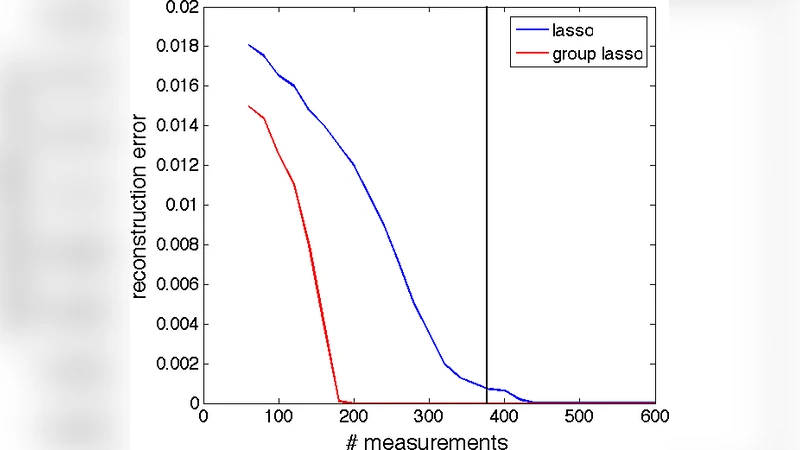
Standard compressive sensing results state that to exactly recover an s sparse signal in R^p, one requires O(s. log(p)) measurements. While this bound is extremely useful in practice, often real world signals are not only sparse, but also exhibit structure in the sparsity pattern. We focus on group-structured patterns in this paper. Under this model, groups of signal coefficients are active (or inactive) together. The groups are predefined, but the particular set of groups that are active (i.e., in the signal support) must be learned from measurements. We show that exploiting knowledge of groups can further reduce the number of measurements required for exact signal recovery, and derive universal bounds for the number of measurements needed. The bound is universal in the sense that it only depends on the number of groups under consideration, and not the particulars of the groups (e.g., compositions, sizes, extents, overlaps, etc.). Experiments show that our result holds for a variety of overlapping group configurations.
💡 Research Summary
The paper addresses the problem of exact recovery of high‑dimensional signals that are not only sparse but also exhibit a known group structure. In many practical settings—such as genetics (genes organized in pathways), image processing (wavelet coefficients forming trees), and wideband spectrum sensing (clusters of active frequencies)—non‑zero coefficients tend to appear together in predefined groups. The authors assume a collection of M groups ( {G_1,\dots,G_M} ) covering the index set ({1,\dots,p}). A signal (x^\star) is said to be k‑group‑sparse if its support lies entirely within the union of k of these groups; the groups may overlap arbitrarily, and the size of the largest group is denoted by (B).
The main contribution is a non‑asymptotic bound on the number of i.i.d. Gaussian measurements required for exact recovery when the reconstruction is performed via the overlapping group‑lasso (or, equivalently, atomic‑norm minimization). The authors first show that the atomic set built from unit‑norm vectors supported on each group yields an atomic norm that coincides exactly with the overlapping group‑lasso norm. Consequently, the recovery problem can be cast as \
Comments & Academic Discussion
Loading comments...
Leave a Comment