A conjecture on independent sets and graph covers
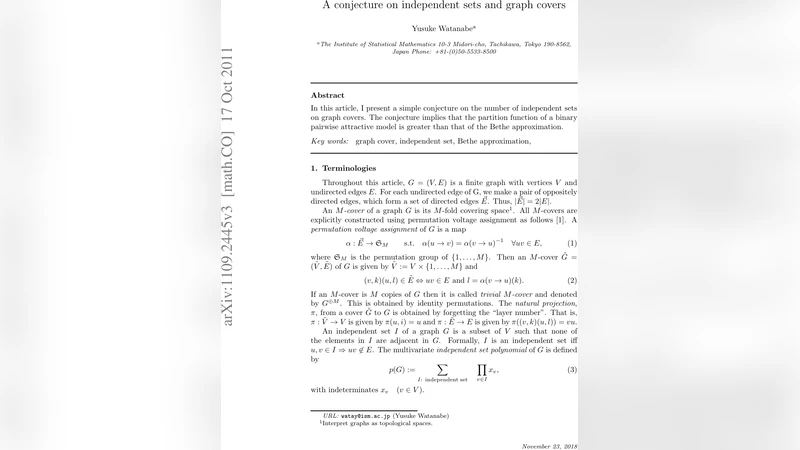
In this article, I present a conjecture on the number of independent sets on graph covers. I also show that the conjecture implies that the partition function of a binary pairwise attractive model is greater than that of the Bethe approximation.
💡 Research Summary
The paper introduces a conjecture linking the multivariate independent‑set polynomial of a bipartite graph G to that of any of its M‑covers \tilde G. An M‑cover is constructed via a “permutation voltage assignment” α: \tilde E → S_M, where S_M is the symmetric group on {1,…,M}. For each undirected edge uv of G, two opposite directed edges are created; α satisfies α(u→v)=α(v→u)⁻¹. The cover’s vertex set is \tilde V = V × {1,…,M} and an edge ((v,k),(u,l)) exists exactly when uv∈E and l = α(v→u)(k). The natural projection π simply forgets the layer index.
The independent‑set polynomial of a graph is defined as
p(G) = Σ_{I∈Ind(G)} ∏{v∈I} x_v,
where each independent set contributes a monomial in variables x_v. The projection π is lifted to a ring homomorphism Π by setting Π(x{(v,k)}) = x_v and extending multiplicatively.
Conjecture 1 states that for any bipartite graph G and any M‑cover \tilde G, the coefficient‑wise inequality
Π(p(\tilde G)) ≤ p(G)^M
holds. In other words, after collapsing the layer variables, every monomial’s coefficient in the cover’s polynomial does not exceed the corresponding coefficient in the M‑th power of the base polynomial. Equivalently, for every vertex subset U⊆V, the number of independent sets I⊂\tilde V with π(I)=U is at most the number of independent sets in the trivial cover G⊕M (M disjoint copies of G) that project to U.
The author verifies the conjecture for a simple example: G is a 4‑cycle, \tilde G is its 3‑cover (a 12‑cycle). Direct expansion shows the inequality holds.
The paper then connects this combinatorial statement to statistical physics. Consider a binary pairwise model on G with attractive interactions (J_{uv}≥0) and external fields h_v. Its partition function is
Z(G;J,h) = Σ_{s∈{0,1}^V} exp( Σ_{uv∈E} J_{uv}s_u s_v + Σ_{v∈V} h_v s_v ).
By rewriting exp(J_{uv}s_u s_v) = 1 + A_{uv}s_u s_v with A_{uv}=e^{J_{uv}}−1 and exp(h_v s_v)=B_v^{s_v} with B_v=e^{−h_v}, the sum can be reorganized as a sum over edge subsets S⊆E. The resulting expression is exactly the independent‑set polynomial of a bipartite “edge‑vertex incidence” graph G′ (obtained by inserting a new vertex on each edge of G) with edge weights A_{uv} and vertex weights B_v:
Z(G) = (∏_{v} B_v)·p(G′;A,B).
The Bethe approximation Z_B is defined as the exponential of the negative Bethe free energy minimum, equivalently as the limit of the M‑th root of the average partition function over all M‑covers: Z_B = lim_{M→∞} ⟨ Z(\tilde G) ⟩^{1/M}.
If Conjecture 1 holds, then for every M‑cover \tilde G we have Z(G)^M ≥ Z(\tilde G). Taking expectations over all covers and letting M→∞ yields Z(G) ≥ Z_B. Thus the conjecture implies that the Bethe approximation is always a lower bound for attractive binary models.
The author notes that a similar inequality for the permanent of non‑negative matrices (the “Bethe permanent”) has been proved by Gurvits using Schrijver’s inequality, and that the present conjecture can be viewed as a combinatorial analogue for independent sets. The paper concludes with remarks on possible extensions to matchings, perfect matchings, and Eulerian subgraphs, and with a bibliography containing the relevant prior work.
In summary, the paper proposes a new coefficient‑wise domination conjecture for independent‑set polynomials under graph covers, demonstrates its plausibility on small examples, and shows that its truth would provide a clean combinatorial proof that the Bethe approximation never overestimates the true partition function of attractive binary pairwise models.
Comments & Academic Discussion
Loading comments...
Leave a Comment