Distributed Verification and Hardness of Distributed Approximation
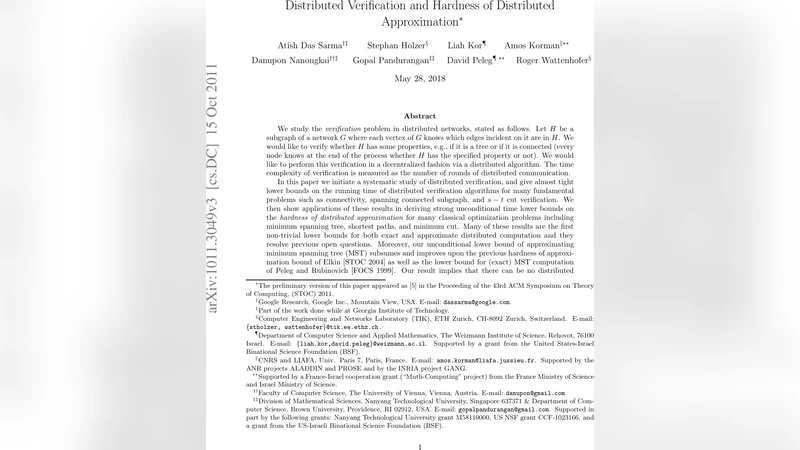
We study the {\em verification} problem in distributed networks, stated as follows. Let $H$ be a subgraph of a network $G$ where each vertex of $G$ knows which edges incident on it are in $H$. We would like to verify whether $H$ has some properties, e.g., if it is a tree or if it is connected. We would like to perform this verification in a decentralized fashion via a distributed algorithm. The time complexity of verification is measured as the number of rounds of distributed communication. In this paper we initiate a systematic study of distributed verification, and give almost tight lower bounds on the running time of distributed verification algorithms for many fundamental problems such as connectivity, spanning connected subgraph, and $s-t$ cut verification. We then show applications of these results in deriving strong unconditional time lower bounds on the {\em hardness of distributed approximation} for many classical optimization problems including minimum spanning tree, shortest paths, and minimum cut. Many of these results are the first non-trivial lower bounds for both exact and approximate distributed computation and they resolve previous open questions. Moreover, our unconditional lower bound of approximating minimum spanning tree (MST) subsumes and improves upon the previous hardness of approximation bound of Elkin [STOC 2004] as well as the lower bound for (exact) MST computation of Peleg and Rubinovich [FOCS 1999]. Our result implies that there can be no distributed approximation algorithm for MST that is significantly faster than the current exact algorithm, for {\em any} approximation factor. Our lower bound proofs show an interesting connection between communication complexity and distributed computing which turns out to be useful in establishing the time complexity of exact and approximate distributed computation of many problems.
💡 Research Summary
The paper initiates a systematic study of distributed verification, a problem that asks whether a subgraph H of a network G satisfies a given property when each node only knows which incident edges belong to H. Working in the standard CONGEST model (each node can send O(log n) bits per round), the authors first establish near‑optimal lower bounds on the number of communication rounds required for a wide range of fundamental verification tasks such as connectivity, spanning‑tree verification, and s‑t cut verification.
The technical core relies on reductions from classic two‑party communication‑complexity problems—most notably set‑disjointness and pointer‑chasing—to distributed verification. By embedding a hard communication‑complexity instance into a carefully constructed network topology, they prove that any distributed algorithm that verifies connectivity (or any of the other listed properties) must use at least Ω(√n + D) rounds, where n is the number of nodes and D is the network diameter. This bound matches known upper bounds up to polylogarithmic factors and is essentially tight for many problems.
Having secured these verification lower bounds, the authors turn to hardness of distributed approximation. They observe that if an α‑approximation algorithm for a global optimization problem (e.g., MST, shortest‑path, minimum‑cut) could run in T rounds, then one could use it to verify the optimal solution in roughly the same time: the approximation algorithm would either produce a solution that violates the property (hence revealing a counter‑example) or confirm that the given subgraph is close enough to optimal. Consequently, any lower bound for verification immediately translates into a lower bound for approximation.
Applying this principle, the paper derives the following striking results:
-
Minimum Spanning Tree (MST) – For every constant approximation factor α ≥ 1, any distributed α‑approximation algorithm requires Ω(√n + D) rounds. This subsumes and strengthens earlier work by Elkin (STOC 2004), which only handled specific approximation ratios, and it also generalizes the exact‑MST lower bound of Peleg and Rubinovich (FOCS 1999). In other words, there is no asymptotic speed‑up possible for MST approximation compared with exact computation.
-
Shortest‑Path Approximation – Any (1 + ε)‑approximation algorithm for single‑source shortest paths also needs Ω(√n + D) rounds, implying that the best known O(√n log n) algorithms are essentially optimal.
-
Minimum Cut Approximation – A similar Ω(√n + D) lower bound holds for (1 + ε)‑approximation of global minimum cuts.
These results constitute the first non‑trivial unconditional lower bounds for a broad class of distributed optimization problems, both in the exact and approximate regimes. The paper also discusses how the communication‑complexity based technique can be adapted to other problems and highlights several open directions, such as tightening bounds for specific graph families (e.g., planar or bounded‑treewidth graphs) and extending the framework to randomized or fault‑tolerant settings.
Overall, the work establishes a deep and previously under‑explored connection between two‑party communication complexity and distributed algorithmic lower bounds, providing a powerful tool for proving that many classic network optimization problems cannot be substantially accelerated by allowing approximation.
Comments & Academic Discussion
Loading comments...
Leave a Comment