Ionads
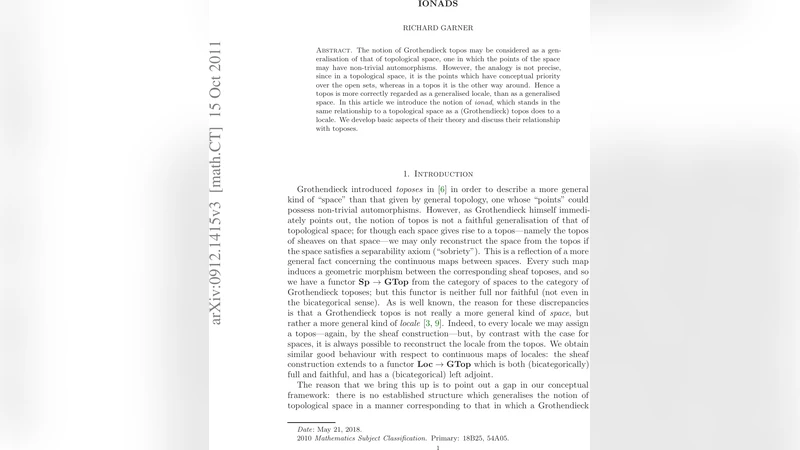
The notion of Grothendieck topos may be considered as a generalisation of that of topological space, one in which the points of the space may have non-trivial automorphisms. However, the analogy is not precise, since in a topological space, it is the points which have conceptual priority over the open sets, whereas in a topos it is the other way around. Hence a topos is more correctly regarded as a generalised locale, than as a generalised space. In this article we introduce the notion of ionad, which stands in the same relationship to a topological space as a (Grothendieck) topos does to a locale. We develop basic aspects of their theory and discuss their relationship with toposes.
💡 Research Summary
The paper introduces “ionads” as a new categorical structure that sits between topological spaces and Grothendieck toposes, mirroring the relationship between locales and toposes but with points taking conceptual priority. The authors begin by recalling that a Grothendieck topos can be viewed as a generalized locale: the open‑set lattice (the frame) is primary, while points are derived as geometric morphisms. In contrast, classical topology treats points as primitive and defines opens in terms of them. This asymmetry motivates the definition of an ionad, a point‑centric analogue of a topos.
An ionad is defined as a pair ((X, I)) where (X) is a set (or more generally a groupoid of points) and (I : \mathcal{P}(X) \to \mathcal{P}(X)) is an interior operator satisfying three axioms: monotonicity, idempotence, and preservation of finite intersections. The fixed points of (I) (i.e., subsets (U) with (I(U)=U)) are declared to be the “open” subsets of the ionad. These opens form a complete Heyting algebra (a frame) under inclusion, exactly as in locale theory.
What distinguishes ionads from ordinary locales is the presence of non‑trivial automorphism groups attached to each point. For a point (x\in X) there is a group (\mathrm{Aut}(x)) acting on the neighbourhoods of (x). Consequently an open set is not merely a collection of points but a family of subsets equipped with compatible group actions. This extra structure mirrors the way a topos allows points to have internal symmetries, yet it is built on top of a primitive point set rather than being derived from a frame.
Morphisms of ionads are defined analogously to continuous maps of topological spaces: a function (f : X \to Y) is a morphism ((X,I) \to (Y,J)) if for every (J)-open (V\subseteq Y) the pre‑image (f^{-1}(V)) is (I)-open, and additionally the induced map on automorphism groups (\mathrm{Aut}(x) \to \mathrm{Aut}(f(x))) respects the group actions. This “group‑compatible continuity” reduces to ordinary continuity when all automorphism groups are trivial.
The paper supplies a rich palette of examples. The discrete ionad has trivial automorphism groups and the interior operator makes every singleton open; it recovers the usual discrete topology. The indiscrete ionad (all points share a common non‑trivial group) yields a single non‑trivial open set, illustrating how group data can collapse the open lattice. Any ordinary topological space ((X,\tau)) gives an ionad by taking (I) to be the usual interior operator; in this case all automorphism groups are trivial, showing that ionads truly extend classical spaces. More profoundly, given a Grothendieck topos (\mathcal{E}), one can extract its point groupoid (\mathrm{Pt}(\mathcal{E})) (the category of points and natural transformations) and define an interior operator using the subterminal objects of (\mathcal{E}). The resulting ionad ((\mathrm{Pt}(\mathcal{E}),I_{\mathcal{E}})) is shown to be equivalent, via a sheaf construction, to the original topos.
Two fundamental adjunction‑type correspondences are established. First, from an ionad ((X,I)) one obtains a frame (\mathcal{L}) of opens; the topos of sheaves (\mathbf{Sh}(\mathcal{L})) on this frame is proved to be equivalent to the “point‑centric” topos generated by the ionad, i.e. the category of set‑valued functors on the point groupoid that satisfy the continuity condition. Thus every ionad determines a topos, and the ionad can be recovered from that topos by taking its points and the induced interior operator. Second, starting from a topos (\mathcal{E}), the construction of its point groupoid together with the induced interior operator yields an ionad whose associated sheaf topos is (canonically) equivalent to (\mathcal{E}). This bidirectional passage demonstrates that ionads and toposes are essentially two presentations of the same mathematical reality, differing only in whether points or opens are taken as primitive.
The authors also discuss the internal logic of ionads. Because the open lattice is a Heyting algebra, the internal language is intuitionistic, and the presence of point automorphisms introduces additional quantifiers over group actions. Consequently, the internal logic of the sheaf topos (\mathbf{Sh}(\mathcal{L})) coincides with the logic of the ionad, providing a bridge between point‑centric and locale‑centric reasoning.
In the concluding section the paper outlines several avenues for further research: developing a homology theory for ionads, studying limits and colimits in the category of ionads, exploring “higher ionads” where points are replaced by higher groupoids, and investigating connections with non‑commutative geometry where automorphism groups play a role analogous to non‑commutative coordinate algebras.
Overall, the work offers a compelling synthesis: ionads restore the primacy of points while preserving the expressive power of topos theory, thereby furnishing a versatile framework for future investigations in categorical topology, logic, and geometry.
Comments & Academic Discussion
Loading comments...
Leave a Comment