Product fixed points in ordered metric spaces
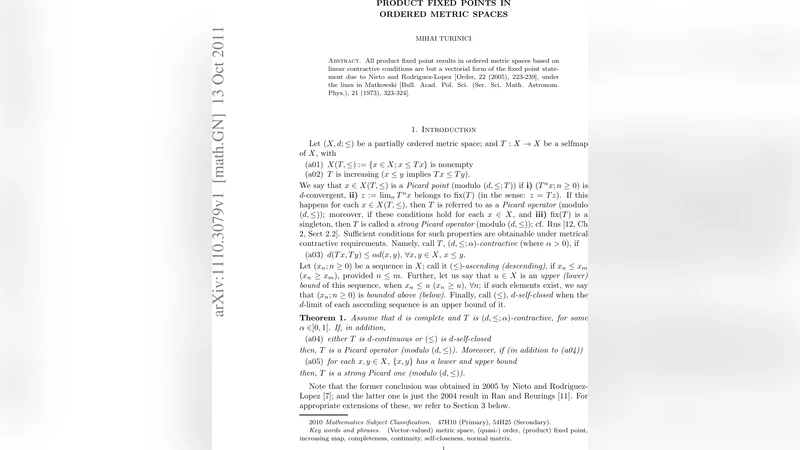
All product fixed point results in ordered metric spaces based on linear contractive conditions are but a vectorial form of the fixed point statement due to Nieto and Rodriguez-Lopez [Order, 22 (2005), 223-239], under the lines in Matkowski [Bull. Acad. Pol. Sci. (Ser. Sci. Math. Astronom. Phys.), 21 (1973), 323-324].
💡 Research Summary
The paper revisits the extensive literature on product fixed‑point theorems in ordered metric spaces that are based on linear contractive conditions. The author’s central claim is that all such results are essentially vector‑valued versions of the classical fixed‑point theorem of Nieto and Rodríguez‑López (Order, 2005). The paper proceeds in several stages.
First, the author restates the well‑known theorem (Theorem 1) for a partially ordered metric space ((X,d;\le)) and an increasing self‑map (T). If (T) is a ((d,\le;\alpha))-contraction with (0<\alpha<1), and either (T) is (d)-continuous or the order is (d)-self‑closed, then every point (x) with (x\le Tx) generates a Picard iteration ({T^{n}x}) that converges in (d) to a fixed point of (T). If, in addition, every pair ({x,y}) possesses a lower and an upper bound, the fixed point is unique and (T) becomes a strong Picard operator. This result reproduces the 2005 theorem of Nieto‑Rodríguez‑López and the 2004 result of Ran and Reurings.
The second part introduces the notion of a normal matrix, originally due to Matkowski. For a non‑negative matrix (A\in L_{+}(\mathbb R^{n})) the quantity (\nu(A)=\inf{\lambda\ge0:Az\le\lambda z\text{ for some }z>0}) is defined; (A) is normal iff (\nu(A)<1). Matkowski’s equivalent condition (2.1) is transformed into a set of simple positivity inequalities (b03) (a^{(i)}{ii}>0). The author shows that normal matrices are precisely the admissible (or a‑) matrices, and proves the chain of equivalences: normal (\Leftrightarrow) asymptotic (i.e. (A^{p}\to0) in any compatible matrix norm) (\Leftrightarrow) spectral radius (\rho(A)<1). Lemmas 1–4 and Propositions 1–4 give detailed proofs, including the construction of a monotone norm (|\cdot|{A}) on (\mathbb R^{n}) that satisfies (|Ax|{A}\le\alpha|x|{A}) for some (\alpha\in(0,1)).
Armed with this matrix machinery, the author tackles product fixed‑point problems. The space (X) is equipped with a quasi‑order (\le) and a vector‑valued metric (\Delta:X^{2}\to\mathbb R^{n}{+}) defined by (\Delta(x,y)=(d(T{1}x,T_{1}y),\dots,d(T_{n}x,T_{n}y))) where (T_{i}) are the component maps of a product operator (T). If a normal matrix (A) satisfies (\Delta(Tx,Ty)\le A\Delta(x,y)) for all (x,y), then the asymptotic property of (A) forces (\Delta(T^{k}x,T^{k}y)\to0). Consequently each component map shares a common fixed point, and the product operator becomes a Picard (or strong Picard) operator. This reduction shows that any “product” fixed‑point theorem based on a linear contraction can be derived from the single‑map theorem (Theorem 1).
Theorem 2 presents a weaker version of Theorem 1 that replaces the completeness of the order by a self‑closedness condition and introduces the equivalence relation (\sim) generated by (\langle\rangle)-chains (chains of comparable points). Under these milder hypotheses the same Picard conclusions hold, and the strong Picard property follows when every pair of points is connected by a chain, i.e. (\sim = X\times X).
Finally, the paper extends the framework to (R_{q})-valued metric spaces, where the distance takes values in (\mathbb R^{q}_{+}) and satisfies reflexivity, symmetry and a vector‑valued triangle inequality. By choosing the standard (\ell^{1}) norm on (\mathbb R^{q}), the author shows that the previous results carry over verbatim, thereby providing a unified approach to product fixed points for systems of equations, matrix equations, and differential/integral equations.
In summary, the article demonstrates that the plethora of product fixed‑point results in ordered metric spaces are not genuinely new; they are direct corollaries of the classical Nieto‑Rodríguez‑Lopez theorem once one recognizes the role of normal (or admissible) matrices. The paper supplies a clear matrix‑theoretic toolkit that streamlines proofs, clarifies the underlying assumptions, and opens the way for further extensions to vector‑valued metrics and more complex ordered structures.
Comments & Academic Discussion
Loading comments...
Leave a Comment