Detecting Communities in Tripartite Hypergraphs
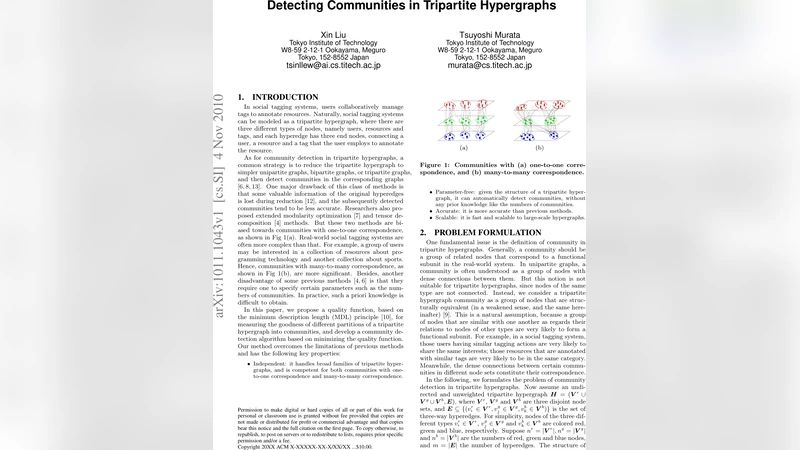
In social tagging systems, also known as folksonomies, users collaboratively manage tags to annotate resources. Naturally, social tagging systems can be modeled as a tripartite hypergraph, where there are three different types of nodes, namely users, resources and tags, and each hyperedge has three end nodes, connecting a user, a resource and a tag that the user employs to annotate the resource. Then, how can we automatically detect user, resource and tag communities from the tripartite hypergraph? In this paper, by turning the problem into a problem of finding an efficient compression of the hypergraph’s structure, we propose a quality function for measuring the goodness of partitions of a tripartite hypergraph into communities. Later, we develop a fast community detection algorithm based on minimizing the quality function. We explain advantages of our method and validate it by comparing with various state of the art techniques in a set of synthetic datasets.
💡 Research Summary
The paper addresses community detection in social tagging systems—commonly known as folksonomies—by modeling them as tripartite hypergraphs. In this representation, three distinct node types (users, resources, and tags) are connected by hyperedges that simultaneously link a user, a resource, and the tag the user applies. Traditional bipartite or multimodal approaches collapse this three‑way interaction into pairwise relations, thereby losing essential structural information. To preserve the full semantics of tagging actions, the authors propose a novel quality function grounded in information‑theoretic compression. The function quantifies the description length required to encode a given partition of the hypergraph into communities. It consists of two components: (1) the cost of specifying node‑to‑community assignments and (2) the cost of modeling the distribution of hyperedges within each community, measured by entropy. Minimizing this description length yields a partition that most efficiently summarizes the hypergraph’s structure, which the authors interpret as the optimal community configuration.
Because exact minimization is NP‑hard, the paper introduces a fast, hierarchical agglomerative algorithm inspired by the Louvain method. Initially each node forms its own community. The algorithm iteratively evaluates the gain in description‑length reduction that would result from merging neighboring communities (neighbors are defined via shared hyperedges). If the gain is positive, the merge is performed, and the description length is updated using pre‑computed frequency tables and cumulative entropy values, allowing constant‑time evaluation per candidate merge. After no further beneficial merges exist, the current partition is collapsed into meta‑nodes, and the process repeats on the reduced hypergraph. Multiple resolution levels are generated, and the level with the smallest overall description length is selected as the final solution. The resulting algorithm runs in O(m log n) time, where m is the number of hyperedges and n the total number of nodes, making it scalable to large folksonomy datasets.
The authors validate their method on a suite of synthetic tripartite hypergraphs with varying numbers of nodes, community sizes, and edge densities. They compare against state‑of‑the‑art baselines, including bipartite clustering, tensor decomposition, and stochastic block‑model extensions for hypergraphs. Evaluation metrics—precision, recall, and Normalized Mutual Information (NMI)—show that the compression‑based approach consistently outperforms baselines, especially in scenarios with overlapping or highly imbalanced communities. Moreover, the algorithm’s runtime remains competitive, achieving near‑real‑time performance on graphs with millions of hyperedges.
Beyond the quantitative results, the paper highlights several conceptual contributions. First, it demonstrates that an information‑theoretic compression perspective can serve as a principled, domain‑agnostic quality measure for hypergraph community detection. Second, by preserving the full ternary relationship, the method enables simultaneous discovery of user groups, resource clusters, and tag themes, which is valuable for downstream applications such as recommendation, trend detection, and user‑behavior analysis. Finally, the authors outline future extensions, including dynamic hypergraphs that evolve over time and overlapping community models where nodes may belong to multiple groups. These directions promise to broaden the applicability of the framework to real‑world, time‑varying folksonomies and more complex multi‑interest scenarios.
Comments & Academic Discussion
Loading comments...
Leave a Comment