Topological and simplicial models of identity types
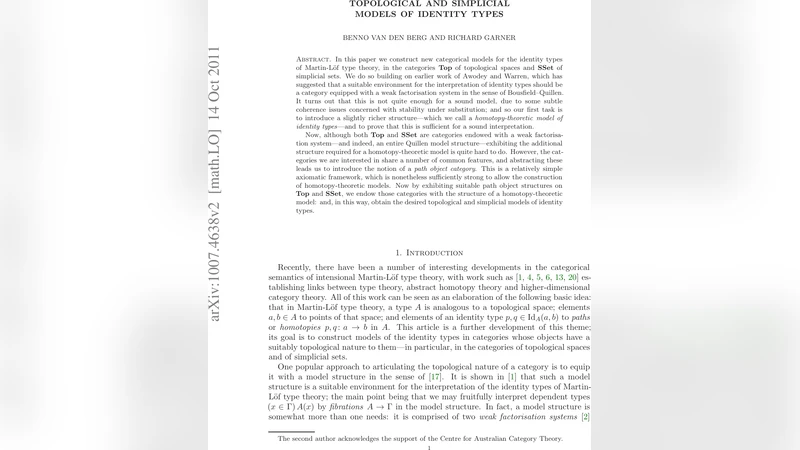
In this paper we construct new categorical models for the identity types of Martin-L"of type theory, in the categories Top of topological spaces and SSet of simplicial sets. We do so building on earlier work of Awodey and Warren, which has suggested that a suitable environment for the interpretation of identity types should be a category equipped with a weak factorisation system in the sense of Bousfield–Quillen. It turns out that this is not quite enough for a sound model, due to some subtle coherence issues concerned with stability under substitution; and so our first task is to introduce a slightly richer structure—which we call a homotopy-theoretic model of identity types—and to prove that this is sufficient for a sound interpretation. Now, although both Top and SSet are categories endowed with a weak factorisation system—and indeed, an entire Quillen model structure—exhibiting the additional structure required for a homotopy-theoretic model is quite hard to do. However, the categories we are interested in share a number of common features, and abstracting away from these leads us to introduce the notion of a path object category. This is a relatively simple axiomatic framework, which is nonetheless sufficiently strong to allow the construction of homotopy-theoretic models. Now by exhibiting suitable path object structures on Top and SSet, we endow those categories with the structure of a homotopy-theoretic model: and in this way, obtain the desired topological and simplicial models of identity types.
💡 Research Summary
The paper addresses the long‑standing problem of providing categorical models for the identity (or equality) types of Martin‑Löf type theory (MLTT). Awodey and Warren previously observed that a category equipped with a weak factorisation system (WFS) is a natural setting for interpreting identity types, but they also noted that a WFS alone does not guarantee the coherence required for substitution stability. In other words, the usual rules for identity—reflexivity, symmetry, transitivity, and the J‑eliminator—cannot be soundly interpreted unless the underlying structure behaves well under pullbacks of contexts.
To overcome this obstacle the authors introduce a richer structure called a homotopy‑theoretic model of identity types. Such a model consists of, for every object X in the ambient category, a path object P X together with two projection maps π₀, π₁ : P X → X. The path object must admit a section (reflexivity) and a composition operation that witnesses transitivity, and these operations must be natural with respect to substitution. Moreover, the path objects must be fibrant (i.e., they belong to the right class of the WFS) and must be stable under pullback, ensuring that the interpretation of identity types respects context extension.
Recognising that the homotopy‑theoretic requirements are still rather heavy, the authors abstract the common features of the categories they wish to treat and propose the notion of a path‑object category. This is an axiomatic framework consisting of four main axioms:
- Existence of Path Objects – every object X has a designated path object P X and projections π₀, π₁.
- Fibrancy – each P X is fibrant with respect to the chosen WFS.
- Composition and 2‑Cell Structure – there is a homotopy‑composition operation on paths together with coherent 2‑cells, allowing the expression of symmetry and transitivity internally.
- Stability under Substitution – the construction of path objects commutes with pullbacks, guaranteeing that the interpretation of identity types is compatible with context substitution.
These axioms are deliberately weaker than requiring a full Quillen model structure, yet they are strong enough to derive a sound interpretation of MLTT identity types.
The paper then demonstrates that the two classical homotopical categories of interest, Top (the category of topological spaces) and SSet (the category of simplicial sets), satisfy the path‑object axioms.
- In Top, the path object of a space X is taken to be the space of continuous maps X^{I} from the unit interval I =
Comments & Academic Discussion
Loading comments...
Leave a Comment