Types are weak omega-groupoids
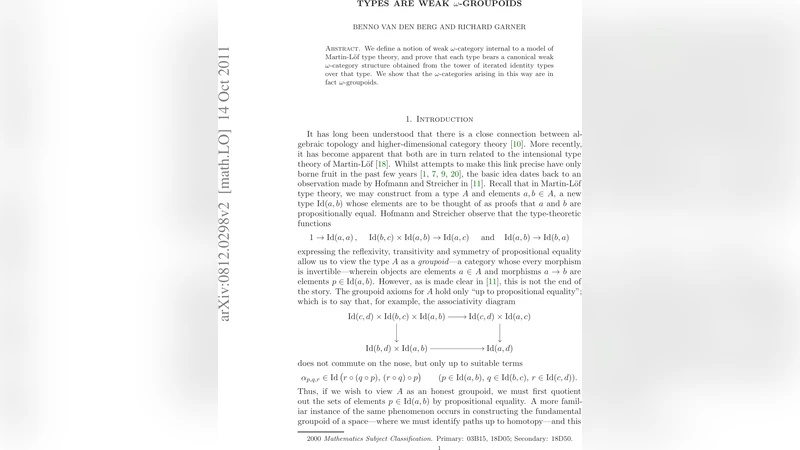
We define a notion of weak omega-category internal to a model of Martin-L"of type theory, and prove that each type bears a canonical weak omega-category structure obtained from the tower of iterated identity types over that type. We show that the omega-categories arising in this way are in fact omega-groupoids.
💡 Research Summary
The paper establishes a precise bridge between Martin‑Löf type theory (MLTT) and higher‑dimensional category theory by defining a notion of weak ω‑category internal to any model of MLTT and then showing that every type canonically carries such a structure. The authors begin by reviewing the necessary background: the syntax of MLTT, especially identity types and the J‑rule, and the distinction between strong and weak ω‑categories in the categorical literature. They emphasize that a weak ω‑category relaxes strict equalities of composition, associativity, and unit laws to higher‑dimensional equivalences (homotopies), a perspective that aligns naturally with the homotopical interpretation of identity types.
In the second section they give a formal definition of an internal weak ω‑category. Objects, 1‑cells, 2‑cells, and so on are defined inductively, together with composition operations comp_n and identity cells id_n at each level. Crucially, these operations are required to satisfy the usual categorical axioms only up to higher‑dimensional homotopies. To manage this, the authors introduce the concept of a “homotopy chain”, a systematic way of recording how each n‑cell is related to lower‑dimensional cells via explicit homotopies. This machinery makes it possible to formulate the coherence conditions (associativity, unit, interchange) as families of higher homotopies rather than strict equalities.
The heart of the work lies in the third section, where the main theorem is proved: for any type A in MLTT, the tower of iterated identity types
A
Id_A
Id_{Id_A}
…
forms a weak ω‑category, and moreover this ω‑category is an ω‑groupoid. The proof proceeds by induction on the dimension of cells. At dimension 1, the usual composition of paths (given by the J‑rule) satisfies associativity up to a 2‑cell, which is precisely the higher identity type Id_{Id_A}. At each subsequent level the authors construct the required homotopies using the eliminator for identity types, showing that the coherence laws hold at the next dimension. A key technical device is the “normalized homotopy chain”, which provides a canonical representative for each homotopy class and simplifies the verification of interchange laws. By exploiting the fact that identity types are themselves contractible up to higher identity, the authors demonstrate that every n‑cell possesses an inverse up to an (n+1)‑cell, establishing the groupoid condition.
The final section discusses implications and future directions. The result confirms the long‑standing intuition in Homotopy Type Theory (HoTT) that “types are ∞‑groupoids”, but does so in a fully internal, syntactic manner without appealing to external model‑categorical semantics. This internal viewpoint opens the door to a range of applications: (1) formalising higher‑dimensional algebraic structures directly inside type theory, (2) developing proof assistants that can manipulate higher homotopies automatically, (3) exploring connections with ∞‑toposes and other models of higher category theory, and (4) extending the construction to more general models (e.g., non‑cartesian closed categories or models lacking strict normalization). The authors acknowledge that their current development relies on certain regularity properties of the underlying model (such as the existence of a well‑behaved normalization procedure) and suggest that relaxing these constraints is a promising line of research.
In summary, the paper provides a rigorous, constructive account of how every type in MLTT carries a canonical weak ω‑groupoid structure derived from its iterated identity types. By giving an explicit internal definition of weak ω‑categories and proving the groupoid property, the authors not only substantiate a central claim of HoTT but also supply concrete tools for further integration of type‑theoretic and higher‑categorical methods. This work is likely to influence both the theoretical foundations of type theory and practical developments in proof‑assistant technology.
Comments & Academic Discussion
Loading comments...
Leave a Comment