Homomorphisms of higher categories
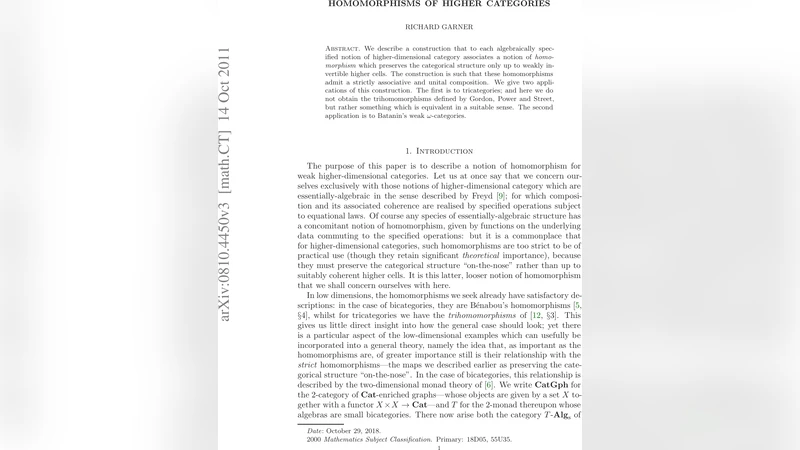
We describe a construction that to each algebraically specified notion of higher-dimensional category associates a notion of homomorphism which preserves the categorical structure only up to weakly invertible higher cells. The construction is such that these homomorphisms admit a strictly associative and unital composition. We give two applications of this construction. The first is to tricategories; and here we do not obtain the trihomomorphisms defined by Gordon, Power and Street, but only something equivalent in a suitable sense. The second is to Batanin’s weak omega-categories.
💡 Research Summary
The paper addresses a long‑standing problem in higher‑category theory: how to define a notion of homomorphism that is weak enough to be useful, yet still admits strictly associative and unital composition. Starting from any essentially‑algebraic presentation of a higher‑dimensional category, one has a category of strict homomorphisms (objects are the higher categories, morphisms preserve all operations on the nose). Such strict maps are too rigid because they forbid any higher‑cell flexibility.
The author’s solution is to equip the category of strict homomorphisms with a weak factorisation system (WFS) and then take a cofibrant‑replacement comonad Q on it. A homomorphism from A to B is defined to be a strict map QA → B; composition of f : QA → B and g : QB → C is given by the usual co‑Kleisli formula QA → QQA → QB → C using the comultiplication Δ and counit ε of Q. Because Q satisfies the comonad axioms, this composition is strictly associative and the identities are given by ε. Thus the homomorphisms form the co‑Kleisli category of Q, a genuine ordinary category.
The crucial technical point is how to obtain a canonical Q. For a locally finitely presentable (l.f.p.) category C and a set J of generating cofibrations, the WFS (L,R) cofibrantly generated by J admits a universal algebraic realisation (Garner 2009). This realisation supplies functorial factorizations and, consequently, a canonical cofibrant‑replacement comonad. The construction eliminates arbitrary choices: the comonad is uniquely determined by the generating set J, not by any particular small‑object argument.
Two applications illustrate the power of the method. First, for tricategories (the Batanin‑Gordon‑Power‑Street definition), the existing notion of trihomomorphism yields only a bicategory of maps. By applying the cofibrant‑replacement comonad to the strict tricategory homomorphisms, the author obtains a category of “homomorphisms” whose objects are the same tricategories but whose morphisms are strict maps from a cofibrant replacement. He then proves that this category is biequivalent to the bicategory of trihomomorphisms, showing that the new maps are sufficiently weak while enjoying strict compositional structure.
Second, the method is applied to Batanin’s weak ω‑categories. In that setting, the lack of a well‑behaved co‑ring structure prevents a direct definition of composable weak maps. By using the general WFS/comonad construction, the author bypasses the need for a co‑ring and produces a well‑defined category of homomorphisms between weak ω‑categories. This provides the first systematic, compositional notion of weak maps in the ω‑categorical context.
Overall, the paper establishes a uniform, homotopy‑theoretic framework for defining weak homomorphisms of any essentially‑algebraic higher category. It shows that a suitable cofibrantly generated weak factorisation system yields a canonical cofibrant‑replacement comonad, whose co‑Kleisli category supplies the desired homomorphisms with strict associativity and units. The two detailed case studies confirm that the approach both recovers known notions up to biequivalence and extends them to settings where previous techniques failed. This work therefore bridges higher‑category algebra, model‑category ideas, and the practical need for flexible morphisms in higher‑dimensional category theory.
Comments & Academic Discussion
Loading comments...
Leave a Comment