The low-dimensional structures formed by tricategories
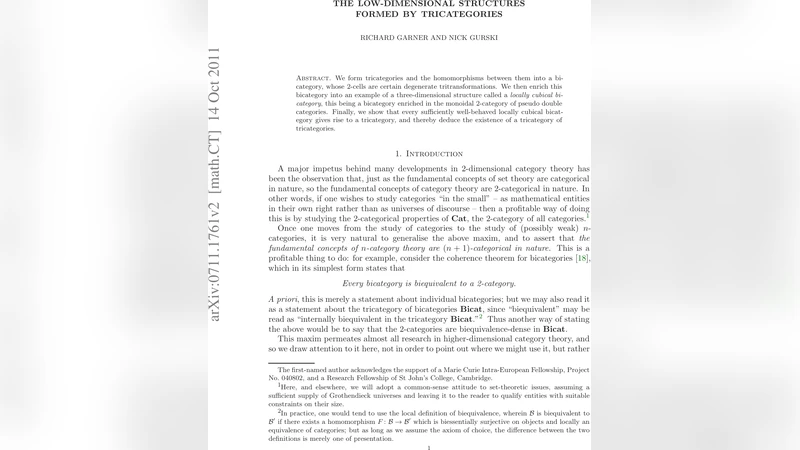
We form tricategories and the homomorphisms between them into a bicategory, whose 2-cells are certain degenerate tritransformations. We then enrich this bicategory into an example of a three-dimensional structure called a locally cubical bicategory, this being a bicategory enriched in the monoidal 2-category of pseudo double categories. Finally, we show that every sufficiently well-behaved locally cubical bicategory gives rise to a tricategory, and thereby deduce the existence of a tricategory of tricategories.
💡 Research Summary
The paper develops a systematic bridge between tricategories and a newly introduced three‑dimensional categorical structure called a locally cubical bicategory. It begins by recalling the definition of a tricategory—objects, 1‑cells, 2‑cells, and 3‑cells together with the intricate coherence data for tritransformations and modifications. Directly forming a bicategory out of tricategories and their strong homomorphisms is obstructed by the complexity of general tritransformations. To overcome this, the authors restrict attention to a class of “degenerate tritransformations” that forget part of the 3‑cell data and can serve as 2‑cells in a bicategory B. In B, objects are tricategories, 1‑cells are strong homomorphisms, and 2‑cells are these degenerate tritransformations; composition is inherited from the underlying tricategories.
The next step is to enrich B in the monoidal 2‑category of pseudo double categories. This enrichment replaces each hom‑category of B by a pseudo double category, thereby endowing B with an extra vertical direction. The resulting structure is called a locally cubical bicategory. The term “cubical” reflects the presence, around each object, of a three‑dimensional cube of cells: horizontal 1‑cells, vertical 1‑cells, square 2‑cells (the faces), and cube 3‑cells (the interior). All compositions obey the double‑category axioms in each direction and interact coherently across the three dimensions, so that the whole picture can be visualized as a collection of commuting cubes.
A central theorem of the paper states that any sufficiently well‑behaved locally cubical bicategory gives rise to a tricategory. The authors exhibit an explicit construction: the objects, horizontal and vertical 1‑cells become the objects and 1‑cells of a tricategory; the square 2‑cells correspond bijectively to the tricategory’s 2‑cells; and the cube 3‑cells correspond bijectively to the tricategory’s 3‑cells. They verify that the associativity, unit, and interchange laws for the cubes translate exactly into the coherence axioms for a tricategory. Consequently, there is a full equivalence between the data of a locally cubical bicategory and that of a tricategory.
Using this equivalence, the paper finally builds a tricategory whose objects are tricategories themselves. In this “tricategory of tricategories,” 1‑cells are strong homomorphisms, 2‑cells are the degenerate tritransformations introduced earlier, and 3‑cells are the usual modifications. The existence of such a self‑referential tricategory resolves a long‑standing meta‑categorical gap: the collection of all tricategories forms a tricategory. This result mirrors the well‑known fact that categories form a 2‑category and bicategories form a tricategory, extending the pattern one level higher.
The significance of the work is threefold. First, it provides a concrete, cubical visualization of the otherwise opaque coherence data in tricategories, making calculations more tractable. Second, the locally cubical bicategory serves as a unifying framework that simultaneously captures the features of bicategories (horizontal composition) and double categories (vertical composition), thereby filling the conceptual gap between 2‑ and 3‑dimensional category theory. Third, by establishing that tricategories themselves assemble into a tricategory, the authors open the door to higher‑dimensional algebraic constructions, such as iterated enrichment, higher operads, and applications in mathematical physics where 3‑dimensional categorical symmetries appear (e.g., in topological quantum field theory and higher gauge theory).
Future directions suggested by the authors include extending the cubical enrichment to obtain locally hyper‑cubical structures that model 4‑categories and beyond, investigating strictification results within this framework, and applying the machinery to concrete problems in homotopy theory and quantum algebra. The paper thus not only resolves a foundational structural question but also equips researchers with a versatile new tool for exploring the landscape of higher category theory.
Comments & Academic Discussion
Loading comments...
Leave a Comment